



الصفحة 33
الصفحة 33

Combinatorial Optimization : Theory and Algorithms
Puts special emphasis on theoretical results and algorithms with provably good performance, in contrast to heuristics. It has arisen as the basis of several courses on combinatorial optimization and more special topics at graduate level. Since the complete book contains enough material for at least four semesters (4 hours a week), one usually selects material in a suitable way. The book contains complete but concise proofs, also for many deep results, some of which did not appear in a book before. Many very recent topics are covered as well, and many references are provided. Thus this book represents the state of the art of combinatorial optimization. This third edition contains a new chapter on facility location problems, an area which has been extremely active in the past few years. Furthermore there are several new sections and further material on various topics. New exercises and updates in the bibliography were added.

Combinatorial Optimization : Theory and Algorithms
Places special emphasis on theoretical results and algorithms with provably good performance, in contrast to heuristics. It has arisen as the basis of several courses on combinatorial optimization and more special topics at graduate level. It contains complete but concise proofs, also for many deep results, some of which did not appear in a textbook before. Many very recent topics are covered as well, and many references are provided. Thus this book represents the state of the art of combinatorial optimization.

Combinatorial and algorithmic aspects of networking ; Vol.3405 ; 1st Workshop on combinatorial and algorithmic aspects of networking, CAAN 2004, Banff, Alberta, Canada, August 5-7, 2004, Revised Selected Papers
The Internet is a massive global network of over 700 million users and it is addingusers at the rate of 300,000 per day. This large, distributed, and everchangingnetwork poses a challenge to researchers: How does one study, model, or under-stand such a decentralized, constantly evolving entity? The workshop Combi-natorial and Algorithmic Aspects of Networking and the Internet (CAAN 2004)provided a forum for the exchange of ideas on these topics. and among thepapers were some new and surprising results as well as some introductions tothe foundations of the field.The workshop program featured 12 peer-reviewed papers bracketed by Topics covered by the talks ranged from the Web graph to game theoryto string matching, all in the context of large-scale networks. This volume collectstogether the talks delivered at the workshop along with a number of survey articlesto round out the presentation and give a comprehensive introduction to the topic.

Colloidal Transport in Porous Media
Colloids are known to be the often neglected phase for the transport of pollutants in aquatic ecosystems. The book covers the basics of abiotic colloid characterization, of biocolloids and biofilms, the resulting transport phenomena and their engineering aspects. The subject is presented from an international group of leading specialists devoted to colloidal sciences. The contributions include theoretical considerations, results from model experiments as well as field studies. The information given will serve students and scientists interested in the analytical, chemical, microbiological, geological and hydrological aspects of material transport in aquatic systems and soils.

Collective Bargaining and Wage Formation; Performance and Challenges
This volume considers the development of the wage formation and wage bargaining institutions as a response to changes in the bargaining environment. These changes include a lower level of inflation and the growth in intraindustrial trade as firms have become more specialised. The response to these changes will depend on the current institutions and on the characteristics of the bargaining system. Generally there has been some move towards decentralisation; the question is what should be bargained centrally and which issues should be transferred to lower levels. Some of the contributions pay special attention to Nordic regimes using survey results gathered from the Finnish labour market partners.

Collaborative research and development projects : A practical guide
This book is a manual for all individuals and organisations from academia and industry working together on research and development projects. This book covers winning grant support, the legal arrangements, working with academics and practitioners, managing project progress and exploiting the project results.

Collaborative and Distributed Chemical Engineering : From Understanding to Substantial Design Process Support; Results of the IMPROVE Project
The focus of IMRPOVE is on understanding, formalizing, evaluating, and, consequently, improving design processes in chemical engineering. In particular, IMPROVE focuses on conceptual design and basic engineering, where the fundamental decisions concerning the design or redesign of a chemical plant are undertaken.

Cognitive Economics
As a manifestation of a 'cognitive turn' observable in all social sciences, Cognitive Economics is concerned with the beliefs and mental operations held by actors placed within a dynamical and strategic environment. It appears as a synthesis of an educative research program, dealing with crossed expectations of actors, and an evolutionist research program on collective learning processes. The book mainly aims at extending the framework of game theory in order to better fit the results of rapidly increasing laboratory experiments concerned with individual choices and collective interactions. It also seeks to better explain some original economic phenomena involving boundedly rational agents in an institutional setting such as financial bubbles, job search or technological innovation.

Cognitive Aspects of Bilingualism
A unique feature of this book is that chapters favor that line of cognitive linguistics which makes a clear distinction between real world and projected world. Information conveyed by language must be about the projected world. Both the experimental results and the systematic claims in this volume call for a weak form of whorfianism. Also, chapters add some relatively unexplored issues of bilingualism to the well-known ones, such as gender systems in the bilingual mind, context and task, synergic concepts, blending, the relationship between lexical categorization and ontological categorization among others.

Code-switching in Bilingual Children
The goal of this volume is to prove that mixed utterances in young bilinguals can be analyzed in the same way as adult code-switching. Analyzing a rich corpus of spontaneous child data, the author provides detailed empirical evidence for latest minimalist assumptions on the architecture of mind and confirms that code-switching is only constrained by the two grammars of the languages involved. The data show that the quantity of mixing in children depends on an individual choice rather than on language development, language dominance, or other factors. Besides critically reviewing the literature on language mixing in children and adults, this work offers a thorough grammatical analysis of the code-switching data of five Italian/German children. The book provides new insights not only in the field of code-switching and of language mixing in young bilinguals, but also in issues concerning general questions on linguistic theory which are difficult to be answered with monolingual data.

Codes et turbocodes = Codes and turbo codes
Devoted to one of the essential functions of modern telecommunications systems: channel coding, or error-correcting coding. At the crossroads of information theory, mathematics, and electronics, channel coding has undergone numerous developments since the foundational work of Claude Shannon. Algebraic codes, convolutional codes, and concatenated codes decoded iteratively form the core of the book, which also includes a presentation of digital modulations, to which channel coding is closely linked, forming the heart of the physical layer of telecommunications systems. The most important theoretical aspects are presented, and the construction of the codes is detailed and justified. Decoding algorithms are developed and, where possible, accompanied by simulation results that demonstrate their error-correcting capabilities and applications.

Coastal dunes : Ecology and conservation
Brings together coastal dune specialists from tropical and temperate latitudes, which together cover a wide set of topics, including: geomorphology, community dynamics, ecophysiology, biotic interactions and environmental problems and conservation. A major product of this book is a set of recommendations for future research, identifying relevant topics where detailed knowledge is still lacking. It also identifies management tools that will promote and maintain the rich diversity of the dune environments in the context of continuing coastal development.

Clinical trial registries : A practical guide for sponsors and researchers of medicinal products
A necessary addition to the library of all researchers who plan to publish their results in top-tier, peer-reviewed journals. ICMJE editors and other journal editors require registration of clinical trial information on publicly available Web sites before enrollment of study subjects and some countries and regions also require this information, as well as timely publication of study results. Not only does this book discuss the genesis of these requirements, it also provides practical information for researchers and sponsors on how to establish a workflow for a clinical registry project, how to file to a registry, and how to post results. More than 25 current Web addresses for registries are provided as well as a comprehensive annotated bibliography of papers on the topic of clinical trial registries. This book is a valuable source of information for all sponsors of medicinal products.

Clinical text mining : Secondary use of electronic patient records
Describes the results of natural language processing and machine learning methods applied to clinical text from electronic patient records. It is divided into twelve chapters. Chapters 1-4 discuss the history and background of the original paper-based patient records, their purpose, and how they are written and structured. These initial chapters do not require any technical or medical background knowledge. The remaining eight chapters are more technical in nature and describe various medical classifications and terminologies such as ICD diagnosis codes, SNOMED CT, MeSH, UMLS, and ATC. Chapters 5-10 cover basic tools for natural language processing and information retrieval, and how to apply them to clinical text. The book’s closing chapters present a number of applications in clinical text mining and summarise the lessons learned from the previous chapters.
Mathematical Linguistics
Mathematical Linguistics introduces the mathematical foundations of linguistics to computer scientists, engineers, and mathematicians interested in natural language processing. The book presents linguistics as a cumulative body of knowledge from the ground up, with no prior knowledge of linguistics being assumed, covering more than the average two-semester introductory course in linguistics.This comprehensive, reader-friendly volume offers readers a high-level orientation, discussing the foundations of the field and presenting both the classical work and the most recent results. It covers an extremely rich array of topics including not only syntax and semantics but also phonology and morphology, probabilistic approaches, complexity, learnability, and the analysis of speech and handwriting.
Mathematical Formulas for Economists
The present collection of formulas has been composed for students of economics or management science at universities, colleges and trade schools. It contains basic knowledge in mathematics, financial mathematics and statistics in a compact and clearly arranged form. This volume is meant to be a reference work to be used by students of undergraduate courses together with a textbook and by researchers in need of exact statements of mathematical results. People dealing with practical or applied problems will also find this collection to be an efficient and easy-to-use work of reference.
Mathematical Control Theory and Finance
This book highlights recent developments in mathematical control theory and its applications to finance. It presents a collection of original contributions by distinguished scholars, addressing a large spectrum of problems and techniques. Control theory provides a large set of theoretical and computational tools with applications in a wide range of fields, ranging from "pure" areas of mathematics up to applied sciences like finance. Stochastic optimal control is a well established and important tool of mathematical finance. Other branches of control theory have found comparatively less applications to financial problems, but the exchange of ideas and methods has intensified in recent years. This volume should contribute to establish bridges between these separate fields. The diversity of topics covered as well as the large array of techniques and ideas brought in to obtain the results make this volume a valuable resource for advanced students and researchers.
Mathematical Aspects of Classical and Celestial Mechanics
In this book we describe the basic principles, problems, and methods of clssical mechanics. Our main attention is devoted to the mathematical side of the subject. Although the physical background of the models considered here and the applied aspects of the phenomena studied in this book are explored to a considerably lesser extent, we have tried to set forth first and foremost the “working” apparatus of classical mechanics. This apparatus is contained mainly in Chapters 1, 3, 5, 6, and 8. Chapter 1 is devoted to the basic mathematical models of classical - chanics that are usually used for describing the motion of real mechanical systems. Special attention is given to the study of motion with constraints and to the problems of realization of constraints in dynamics. In Chapter 3 we discuss symmetry groups of mechanical systems and the corresponding conservation laws. We also expound various aspects of ord- reduction theory for systems with symmetries, which is often used in appli- tions. Chapter 4 is devoted to variational principles and methods of classical mechanics. They allow one, in particular, to obtain non-trivial results on the existence of periodic trajectories. Special attention is given to the case where the region of possible motion has a non-empty boundary. Applications of the variational methods to the theory of stability of motion are indicated.
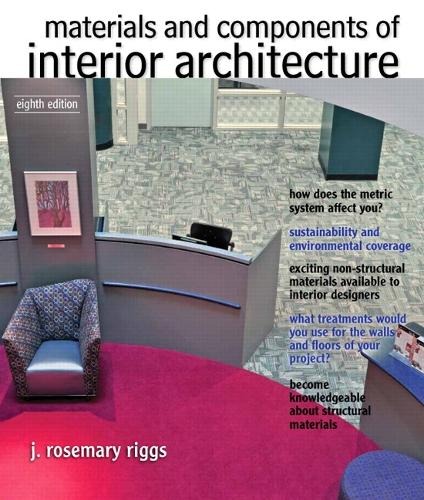
Materials and Components of Interior Architecture
Offers a unique look at interior design,fully covering the exciting breadth of nonstructural materials available to interior designers. With an eye on the environment, it instills a firm understanding of the products, properties, and uses of all materials—from floors, walls, and ceilings to installation and recycling. Going beyond paint and carpet, it explores over 27 different floorings and devotes separate chapters to kitchens and baths. Filled with the latest information from manufacturers, suppliers, and associations, it provides students with the knowledge to creatively engage the “nuts and bolts” of interior design—both in terms of structure and style.

Matematica generale con il calcolatore
By introducing mathematical objects, it teaches students how to use a computer to perform numerical and symbolic calculations, define a function and calculate its values, plot and explore graphs, and execute simple algorithms. The course is rich in examples, applications, and models, drawn from economics, physics, biology, statistics, and mathematics itself. The analysis of these models constitutes, in a certain sense, the true purpose of the mathematical theory covered. Automatic calculation tools (mathematics software, spreadsheets) are used extensively to explore and illustrate concepts and properties. Mathcad® software, in particular, was used, both as a calculation tool and as a simple yet powerful programming language. Considerable space is devoted to approximation, emphasizing the distinction between numerical and symbolic calculation; to algorithms as a synthesis of the syntactic and semantic aspects of mathematical objects; and to computer simulation, interpreted as a "physical" experiment and a source of conjecture. The ability to use a calculator marks a sort of "democratization" of mathematics: even complex results, which have always required a broad background of knowledge and laborious calculations, are now quickly accessible to anyone who understands the meaning of mathematical objects and knows how to use the syntax.
