



الصفحة 33
الصفحة 33

Essential Fish Habitat Mapping in the Mediterranean
This book presents latest advances in EFH mapping and modelling and introduces the environmental approach to EFH identification through the combined use of latest technologies and advanced techniques, such as Remote Sensing, Geographic Information Systems and Spatial Statistics.The contents of this book include overviews and comparisons of different approaches on species habitat modelling, methods to identify teleconnection patterns between large-scale meteo-oceanic phenomena and local environmental variation, and EFH maps for cephalopod, shrimp, hake, anchovy, sardine, and swordfish resources in the Mediterranean.

E-Service Intelligence : Methodologies, Technologies and Applications
Business organizations and governments are nowadays developing and providing internet based electronic services (e-services) featuring various intelligent functions. E-Service Intelligence integrates intelligent techniques into e-service systems for realizing intelligent internet information searching, presentation, provision, recommendation, online system design, implementation, and assessment to internet users. This book offers a thorough introduction and systematic overview of the new field and covers the state-of-the-art of the research and development in E-Service Intelligence ranging from e-services and/or intelligent techniques to web information presentation, search, and mining, to personalization, privacy, and trust in e-services, to e-service evaluation, optimization and knowledge discovery, and to intelligent e-service system developments.

E-science : Open, social and virtual technology for research collaboration
This book shows the breadth and various facets of e-Science, while also illustrating their shared core. Changes in scientific work are driven by the shift to grid-based worlds, the use of information and communication systems, and the existential infrastructure, which includes global collaboration. In this context, the book addresses emerging issues such as open access, collaboration and virtual communities and highlights the diverse range of developments associated with e-Science. As such, it will be of interest to researchers and scholars in the fields of information technology and knowledge management.

ERP Systems and Organisational Change : A Socio-technical Insight
ERP (Enterprise Resource Planning) systems are now the backbone of the information systems in public and private sector organisations. This book provides a unique and comprehensive insight into ERP systems, from both a social and a technical viewpoint.
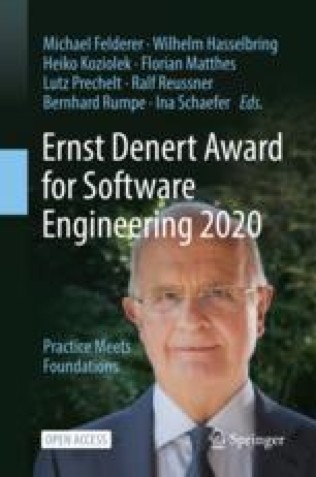
Ernst Denert Award for Software Engineering 2020 : Practice Meets Foundations
This book provides an overview of the dissertations of the eleven nominees for the Ernst Denert Award for Software Engineering in 2020. The prize, kindly sponsored by the Gerlind & Ernst Denert Stiftung, is awarded for excellent work within the discipline of Software Engineering, which includes methods, tools and procedures for better and efficient development of high quality software. An essential requirement for the nominated work is its applicability and usability in industrial practice.

Ernst Denert Award for Software Engineering 2019 : Practice Meets Foundations
This book provides an overview of the dissertations of the five nominees for the Ernst Denert Award for Software Engineering in 2019. The prize, kindly sponsored by the Gerlind & Ernst Denert Stiftung, is awarded for excellent work within the discipline of Software Engineering, which includes methods, tools and procedures for better and efficient development of high quality software. An essential requirement for the nominated work is its applicability and usability in industrial practice.

Environmental impact assessment of recycled wastes on surface and ground waters ; Vol.3 : Engineering modeling and sustainability
The state of the art of the impact assessment of recycled hazardous waste materials on surface and ground waters is presented. The topics include chemodynamics, toxicology, modeling and information systems. The book serves as a practical conceptual guide for those who have professional responsibility for the monitoring, design, management, or conduct of environmental impact assessment. It is believed that the book will prove useful to the reader who, regardless of disciplinary background, wants to examine in greater detail the kinds of interdisciplinary contributions to contemporary decision-making processes that characterize modern impact assessment project development.

Environmental Impact Assessment of Recycled Wastes on Surface and Ground Waters ; Vol.2 : Risk analysis
The state of the art of the impact assessment of recycled hazardous waste materials on surface and ground waters is presented. The topics include chemodynamics, toxicology, modeling and information systems. The book serves as a practical conceptual guide for those who have professional responsibility for the monitoring, design, management, or conduct of environmental impact assessment. It is believed that the book will prove useful to the reader who, regardless of disciplinary background, wants to examine in greater detail the kinds of interdisciplinary contributions to contemporary decision-making processes that characterize modern impact assessment project development.

Environmental Impact Assessment of Recycled Wastes on Surface and Ground Waters ; Vol.1 : Concepts, methodology and cemical analysis
The state of the art of the impact assessment of recycled hazardous waste materials on surface and ground waters is presented. The topics include chemodynamics, toxicology, modeling and information systems. Due to the wealth of information on this topic, the texts of T. Kassim (ed.): Environmental Impact Assessment are published in three separate volumes: vol. 1: Concepts, Methodology and Chemical Analysis; vol. 2: Risk Analysis and vol. 3: Engineering Modeling and Sustainability. The book serves as a practical conceptual guide for those who have professional responsibility for the monitoring, design, management, or conduct of environmental impact assessment. It is believed that the book will prove useful to the reader who, regardless of disciplinary background, wants to examine in greater detail the kinds of interdisciplinary contributions to contemporary decision-making processes that characterize modern impact assessment project development.

Enterprise Risk Management Models
Offers a comprehensive guide to several aspects of risk, including information systems, disaster management, supply chain and disaster management perspectives. A major portion of the book is devoted to presenting a number of operations research models that have been (or could be) applied to enterprise supply risk management, especially from the supply chain perspective.

Enterprise ontology : Theory and methodology
Such a theory and a matching methodology, which has passed the test of practical experience, constitute the contents of this book. The enterprise ontology, as developed by Dietz, is the starting point for profoundly understanding the organization of an enterprise and subsequently for analyzing, (re)designing, and (re)engineering it. The approach covers numerous issues in an integrated way: business processes, in- and outsourcing, information systems, management control, staffing etc.

Enterprise Management with SAP SEM™
In order to make strategy happen there is a need for powerful management information systems. SAP focuses on the application of modern business administration concepts, e.g. Value Based Management, the Balanced Scorecard, the Management Cockpit or flexible planning methods. The book describes the methodology and implementation of a powerful tool for enterprise management. Practical examples show how SAP Strategic Enterprise Management/Business Analytics (SAP SEM/BA) can help to improve cross functional planning, reporting and analyzing. SAP SEM/BA is a leading edge IT-solution for top management and related departments in large enterprises and groups. It demonstrates the state of the art of modern management information and decision support systems.

Enterprise Knowledge Infrastructures
Success of an organization is increasingly dependent on its capability to create an environment to improve the productivity of knowledge work. This book focuses on the concepts, models and technologies that are used to design and implement such an environment. It develops the vision of a modular, yet highly integrated enterprise knowledge infrastructure and presents an ideal architecture replete with current technologies and systems. The most important streams of technological development that are covered in the book are computer-supported cooperative work, document and content management, e-learning, enterprise portals, information life cycle management, knowledge management, mobile computing, and the Semantic Web. It includes learning goals, exercises and case examples that help the reader to easily understand and practice the concepts.

Enterprise interoperability III : New challenges and industrial approaches
This book provides knowledge for cost savings and business improvement as well as new technical solutions. Composed of over 50 papers, Enterprise Interoperability III ranges from academic research through case studies to industrial and administrative experience of interoperability.

Enterprise interoperability : New challenges and approaches
Interoperability: the ability of a system or a product to work with other systems or products without special effort from the user is a key issue in manufacturing and industrial enterprise generally. It is fundamental to the production of goods and services quickly and at low cost at the same time as maintaining levels of quality and customisation. Interoperability is achieved if internal and external collaborators can interact on at least three levels: data, applications and business enterprise (through the architecture of an enterprise model and making allowance for the semantics of both partners). Not only a problem of software and IT technologies, it implies support for communication and transactions between different organisations that must be based on shared business references. Today, a new and important consideration must be taken into account – economic business evaluation and the definition of dissemination policy.

Enterprise Information Systems VII
The purpose of the 7th International Conference on Enterprise Information Systems (ICEIS) was to bring together researchers, engineers and practitioners interested in the advances and business applications of information systems. Five simultaneous tracks have been held, covering different aspects of Enterprise Information Systems Applications, including Enterprise Database Technology, Systems Integration, Artificial Intelligence, Decision Support Systems, Information Systems Analysis and Specification, Internet Computing, Electronic Commerce and Human Factors.
Enterprise Information Systems VI
This book contains the best papers of the Sixth International Conference on Enterprise Information Systems (ICEIS 2004), held in Porto (Portugal) and organized by INSTICC (Institute for Systems and Technologies of Information, Communication and Control) in collaboration with PORTUCALENSE UNIVERSITY, who hosted the event. Following the route started in 1999, ICEIS has become a major point of contact between research scientists, engineers and practitioners on the area of business applications of information systems. This conference has received an increased interest every year, from especially from the international academic community, and it is now one of the world largest conferences in its area. This year, five simultaneous tracks were held, covering different aspects related to enterprise computing, including: “Databases and Information Systems Integration”,

Enterprise Information Systems V
ICEIS focuses on real world applications and aims at bringing together researchers, engineers and practitioners interested in the advances and business applications of information systems. As in previous years, ICEIS’2003 held four simultaneous tracks covering different aspects of enterprise computing: Databases and Information Systems Integration, Artificial Intelligence and Decision Support Systems, Information Systems Analysis and Specification and Software Agents and Internet Computing. Although ICEIS’2003 received 546 paper submissions from over 50 countries, only 80 were accepted as full papers and presented in 30-minutes oral presentations. With an acceptance rate of 15%, these numbers demonstrate the intention of preserving a high quality forum for future editions of this conference. From the articles accepted as long papers for the conference, only 32 were selected for inclusion in this book Additional keynote lectures, tutorials and industrial sessions were also held during ICEIS’2003, and, for the first time this year, the 1st Doctoral Consortium on Enterprise Information Systems gave PhD students an opportunity to present their work to an international audience of experts in the field of information systems.
Enterprise Information Systems ; 8th International Conference, ICEIS 2006, Paphos, Cyprus, May 23-27, 2006, Revised Selected Papers
This book contains the carefully selected best papers of the 8th International Conference on Enterprise Information Sysetms, ICEIS 2006, held in Paphos, Cyprus, in May 2006.The 4 invited papers and 27 revised and selected papers presented in this volume cover different aspects related to enterprise computing. They were selected from 63 accepted papers (out of more than 400 submissions). The contributions are grouped in sections on databases and information systems integration.

Enterprise Applications and Services in the Finance Industry ; 3rd International Workshop, FinanceCom 2007, Montreal, Canada, December 8, 2007. Revised Papers
This book constitutes the proceedings of the 4th International Workshop on Enterprise Applications and Services in the Finance Industry, FinanceCom2008, held in Paris, France, on December 13, 2008. The workshop spans multiple disciplines, including technical, economic, sociological and behavioral sciences. The guiding theme of this workshop was concerned with innovations in the financial services industry, driven by either new business models or changed regulations.
