



الصفحة 33
الصفحة 33

Computer and Information Seciences - ISCIS 2006 ; 21th International Symposium Istanbul, Turkey, Novenber 1-3, 2006, Proceedings
Thesearetheproceedingsofthe21stInternationalSymposiumonComputerand ? Information Sciences (ISCIS 2006) held in Istanbul, Turkey, November 1 – 3, 2006. ISCIS 2006 was organized by the Faculty of Engineering and Natural S- ences of Sabanc?University.

Computational Textile
This edited book collects a number of representative applications of computational techniques in textile and garment industry. These applications cover the following issues: Textile quality assessment by image analysis, Modeling and simulation of textile structures, Computer aided garment design, Computerized textile management and textile Supply Chain, Textile quality subjective and objective evaluation; Computational thermal bioengineering of textiles and clothing; Computational biomechanical engineering of textiles and clothing.

Computational science and its applications - ICCSA 2006 ; Vol. 3983 ; International Conference, Glasgow, UK, May 8-11, 2006, Proceedings, Part IV
This ?ve-volume set was compiled following the 2006 International Conference on Computational Science and its Applications, ICCSA 2006. It represents the outstanding collection of almost 664 refereed papers selected from over 2,450 submissions to ICCSA 2006. Computational science has ?rmly established itself as a vital part of many scienti?c investigations, a?ecting researchers and practitioners in areas ranging from applications such as aerospace and automotive, to emerging technologies such as bioinformatics and nanotechnologies, to core disciplines such as ma- ematics, physics, and chemistry.

Computational science and its applications - ICCSA 2006 ; Vol. 3982 ; International Conference, Glasgow, UK, May 8-11, 2006, Proceedings, Part III
This ?ve-volume set was compiled following the 2006 International Conference on Computational Science and its Applications, ICCSA 2006. It represents the outstanding collection of almost 664 refereed papers selected from over 2,450 submissions to ICCSA 2006. Computational science has ?rmly established itself as a vital part of many scienti?c investigations, a?ecting researchers and practitioners in areas ranging from applications such as aerospace and automotive, to emerging technologies such as bioinformatics and nanotechnologies, to core disciplines such as ma- ematics, physics, and chemistry.

Computational science and its applications - ICCSA 2006 ; Vol. 3981 ; International Conference, Glasgow, UK, May 8-11, 2006, Proceedings, Part II
This ?ve-volume set was compiled following the 2006 International Conference on Computational Science and its Applications, ICCSA 2006. It represents the outstanding collection of almost 664 refereed papers selected from over 2,450 submissions to ICCSA 2006. Computational science has ?rmly established itself as a vital part of many scienti?c investigations, a?ecting researchers and practitioners in areas ranging from applications such as aerospace and automotive, to emerging technologies such as bioinformatics and nanotechnologies, to core disciplines such as ma- ematics, physics, and chemistry.

Computational science and its applications - ICCSA 2006 ; Vol. 3980 ; International Conference, Glasgow, UK, May 8-11, 2006, Proceedings, Part I
This ?ve-volume set was compiled following the 2006 International Conference on Computational Science and its Applications, ICCSA 2006. It represents the outstanding collection of almost 664 refereed papers selected from over 2,450 submissions to ICCSA 2006. Computational science has ?rmly established itself as a vital part of many scienti?c investigations, a?ecting researchers and practitioners in areas ranging from applications such as aerospace and automotive, to emerging technologies such as bioinformatics and nanotechnologies, to core disciplines such as ma- ematics, physics, and chemistry.

Computational science and its applications - ICCSA 2006 ;Vol. 3984 ; International Conference, Glasgow, UK, May 8-11, 2006, Proceedings, Part V
This ?ve-volume set was compiled following the 2006 International Conference on Computational Science and its Applications, ICCSA 2006. It represents the outstanding collection of almost 664 refereed papers selected from over 2,450 submissions to ICCSA 2006. Computational science has ?rmly established itself as a vital part of many scienti?c investigations, a?ecting researchers and practitioners in areas ranging from applications such as aerospace and automotive, to emerging technologies such as bioinformatics and nanotechnologies, to core disciplines such as ma- ematics, physics, and chemistry.

Computational science and its applications - ICCSA 2005 ; Vol. 3483 ; International Conference, Singapore, May 9-12, 2005, Proceedings, Part IV
The four volume set assembled following The 2005 International Conference on Computational Science and its Applications, ICCSA 2005, held in Suntec International Convention and Exhibition Centre, Singapore, from 9 May 2005 till 12 May 2005, represents the ?ne collection of 540 refereed papers selected from nearly 2,700 submissions. Computational Science has ?rmly established itself as a vital part of many scienti?c investigations, a?ecting researchers and practitioners in areas ranging from applications such as aerospace and automotive, to emerging technologies such as bioinformatics and nanotechnologies, to core disciplines such as ma- ematics, physics, and chemistry. Due to the shear size of many challenges in computational science, the use of supercomputing, parallel processing, and - phisticated algorithms is inevitable and becomes a part of fundamental t- oretical research as well as endeavors in emerging ?elds.

Computational science and its applications - ICCSA 2005 ; Vol. 3482 ; International Conference, Singapore, May 9-12. 2005, Proceedings, Part III
The four volume set assembled following The 2005 International Conference on Computational Science and its Applications, ICCSA 2005, held in Suntec International Convention and Exhibition Centre, Singapore, from 9 May 2005 till 12 May 2005, represents the ?ne collection of 540 refereed papers selected from nearly 2,700 submissions. Computational Science has ?rmly established itself as a vital part of many scienti?c investigations, a?ecting researchers and practitioners in areas ranging from applications such as aerospace and automotive, to emerging technologies such as bioinformatics and nanotechnologies, to core disciplines such as ma- ematics, physics, and chemistry. Due to the shear size of many challenges in computational science, the use of supercomputing, parallel processing, and - phisticated algorithms is inevitable and becomes a part of fundamental t- oretical research as well as endeavors in emerging ?elds.

Computational science and its applications - ICCSA 2005 ; International Conference, Singapore, May 9-12, 2005, Proceedings, Part II
The four volume set assembled following The 2005 International Conference on Computational Science and its Applications, ICCSA 2005, held in Suntec International Convention and Exhibition Centre, Singapore, from 9 May 2005 till 12 May 2005, represents the ?ne collection of 540 refereed papers selected from nearly 2,700 submissions. Computational Science has ?rmly established itself as a vital part of many scienti?c investigations, a?ecting researchers and practitioners in areas ranging from applications such as aerospace and automotive, to emerging technologies such as bioinformatics and nanotechnologies, to core disciplines such as ma- ematics, physics, and chemistry. Due to the shear size of many challenges in computational science, the use of supercomputing, parallel processing, and - phisticated algorithms is inevitable and becomes a part of fundamental t- oretical research as well as endeavors in emerging ?elds.

Computational logic in multi-agent systems ; Vol. 3487 ; 5th International Workshop, CLIMA V, Lisbon, Portugal, September 29-30, 2004, Revised Selected and Invited Papers
The notion of agency has recently increased its in?uence in the research and - velopment of computational logic based systems, while at the same time sign- cantly gaining from decades of research in computational logic. Computational logic provides a well-de?ned, general, and rigorous framework for studying s- tax, semantics and procedures, for implementations, environments, tools, and standards, facilitating the ever important link between speci?cation and ver- cation of computational systems. The purpose of the Computational Logic in Multi-agent Systems (CLIMA) international workshop series is to discuss techniques, based on computational logic, for representing, programming, and reasoning about multi-agent systems in a formal way. Former CLIMA editions were conducted in conjunction with other major computational logic and AI events Thesubmittedpapersshowedthatthelogicalfoundationsofmulti-agent systems are felt by a large community to be a very important research topic, upon which classical AI and agent-related issues are to be addressed.

Computational Life Sciences ; Vol. 3695 ; 1st International Symposium, CompLife 2005, Konstanz, Germany, September 25-27, 2005, Proceedings
This book constitutes the refereed proceedings of the First International Symposium on Computational Life Sciences, CompLife 2005, held in Konstanz, Germany in September 2005. The integration of knowledge in the life sciences is continuing apace with ev- increasingimportancebeing placedoncomputer-basedmethodsofdata capture, analysis, and knowledge representation. Today, our many di?erent sciences are providing us with a sea of information: it is the handling of this in?ux that is becoming a key discovery and regulatory question. The solutions to these problems will result in advancements to all of the involved sciences and will be highly in?uential both in the selection of the areas scientists seek to investigate and also on their success. For this to happen, it is crucial to establish an open and lively exchange between computer scientists, biologists, and chemists. To encourage precisely this type of exchange, crossing the borders of the sciences, we organized the 1st Symposium on Computational Life Science in Konstanz, Germany(September 25 27,2005).

Computational intelligence in automotive applications
This volume is the first of its kind, suitable to automotive researchers, engineers and students. It provides a representative sample of contemporary CI activities in the area of automotive technology.

Computational intelligence : Methods and techniques
This book focuses on various techniques of computational intelligence, both single ones and those which form hybrid methods. Those techniques are today commonly applied issues of artificial intelligence, e.g. to process speech and natural language, build expert systems and robots.

Computational Forensic ; 2nd International Workshop, IWCF 2008, Washington, DC, USA, August 7-8, 2008. Proceedings
This book constitutes the refereed proceedings of the Second International Workshop, IWCF 2008, held in Washington, DC, USA, August 2008. The papers are organized in topical sections on trends and challenges; scanner, printer, and prints; human identification; shoeprints; linguistics;decision making and search; speech analysis; signatures and handwriting.

Computational Discovery of Scientific Knowledge : Introduction, Techniques, and Applications in Environmental and Life Sciences
Advances in technology have enabled the collection of data from scientific observations, simulations, and experiments at an ever-increasing pace. For the scientist and engineer to benefit from these enhanced data collecting capabilities, it is becoming clear that semi-automated data analysis techniques must be applied to find the useful information in the data. Computational scientific discovery methods can be used to this end: they focus on applying computational methods to automate scientific activities, such as finding laws from observational data. In contrast to mining scientific data, which focuses on building highly predictive models, computational scientific discovery puts a strong emphasis on discovering knowledge represented in formalisms used by scientists and engineers, such as numeric equations and reaction pathways. This state-of-the-art survey provides an introduction to computational approaches to the discovery of scientific knowledge and gives an overview of recent advances in this area, including techniques and applications in environmental and life sciences.
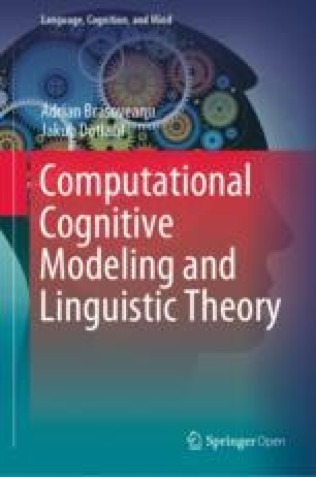
Computational Cognitive Modeling and Linguistic Theory
This book introduces a general framework that allows natural language researchers to enhance existing competence theories with fully specified performance and processing components. Gradually developing increasingly complex and cognitively realistic competence-performance models, it provides running code for these models and shows how to fit them to real-time experimental data. This computational cognitive modeling approach opens up exciting new directions for research in formal semantics, and linguistics more generally, and offers new ways of (re)connecting semantics and the broader field of cognitive science.

Combinatorics of Coxeter Groups
Coxeter groups are of central importance in several areas of algebra, geometry, and combinatorics. This clear and rigorous exposition focuses on the combinatorial aspects of Coxeter groups, such as reduced expressions, partial order of group elements, enumeration, associated graphs and combinatorial cell complexes, and connections with combinatorial representation theory. While Coxeter groups have already been exposited from algebraic and geometric perspectives, this text is the first one to focus mainly on the combinatorial aspects of Coxeter groups. The first part of the book provides a self-contained introduction to combinatorial Coxeter group theory. The emphasis here is on the combinatorics of reduced decompositions, Bruhat order, weak order, and some aspects of root systems. The second part deals with more advanced topics, such as Kazhdan-Lusztig polynomials and representations, enumeration, and combinatorial descriptions of the classical finite and affine Weyl groups. A wide variety of exercises, ranging from easy to quite difficult are also included.

Combinatorial Optimization : Theory and Algorithms
Puts special emphasis on theoretical results and algorithms with provably good performance, in contrast to heuristics. It has arisen as the basis of several courses on combinatorial optimization and more special topics at graduate level. Since the complete book contains enough material for at least four semesters (4 hours a week), one usually selects material in a suitable way. The book contains complete but concise proofs, also for many deep results, some of which did not appear in a book before. Many very recent topics are covered as well, and many references are provided. Thus this book represents the state of the art of combinatorial optimization. This third edition contains a new chapter on facility location problems, an area which has been extremely active in the past few years. Furthermore there are several new sections and further material on various topics. New exercises and updates in the bibliography were added.

Combinatorial Optimization : Theory and Algorithms
Places special emphasis on theoretical results and algorithms with provably good performance, in contrast to heuristics. It has arisen as the basis of several courses on combinatorial optimization and more special topics at graduate level. It contains complete but concise proofs, also for many deep results, some of which did not appear in a textbook before. Many very recent topics are covered as well, and many references are provided. Thus this book represents the state of the art of combinatorial optimization.
