



الصفحة 32
الصفحة 32
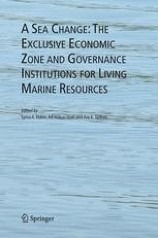
A Sea Change: The Exclusive Economic Zone and Governance Institutions for Living Marine Resources
A Sea Change in a Changing Sea The oceans, seas and coastal areas encompass over 70% of the earth’s surface. They are a critical driver of the earth’s hydrologic cycle and climate system, important for c- merce, transport, and tourism, a source of economically important living marine resources, minerals such as hydrocarbons, as well as new pharmaceutical compounds. The marine environment provides essential habitats for thousands of marine living 1 2 resources, which in turn contribute significantly to global food security, employment, 3 and trade. Overall, the sea’s contribution to human welfare, in terms of market and non-market resources and environmental services, has been estimated at US$21 trillion/year (Costanza, 2000). However, despite the importance of the ocean realm to humans, there is a growing sense that human impacts are destabilizing this system. Some experts believe that current fishing levels are approaching or exceeding the total 4 productivity of the ocean ecosystem (National Research Council, 1999).
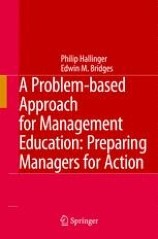
A Problem-based Approach for Management Education : Preparing Managers for Action
This book is designed to provide both novice and experienced users of PBL with resources for designing and implementing problem-based management education. The book provides the novice with useful theoretical and practical background on how to design a PBL curriculum, use PBL in a classroom, and develop PBL materials. At the same time, the book will challenge experienced users of PBL and case teaching to extend their applications through the use of learning technologies and more systematic approaches to assessment and curriculum design. Finally, the volume includes a set of sample PBL materials that provide readers with in-dept examples of what a PBL unit looks like and how it may be employed in the classroom.

A practical guide to corporate finance : Breaking the financial lce
Offers an approachable guide to all key concepts within corporate finance. Emphasizing the use of common sense rather than number-crunching models, A practical guide to corporate finance begins with the basics of how to read financial statements and how to estimate future cash flows. It also includes a guide to subjects such as capital budgeting decisions, the cost of financing for businesses, cash and working capital management, The process of business valuation, and how stock markets work. This textbook breaks the financial ice by offering real, practical advice, helping the reader to avoid common pitfalls, and translate the 'financialese', or business jargon that can cause confusion for those without a financial or banking background.
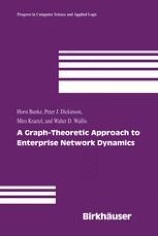
A Graph-Theoretic Approach to Enterprise Network Dynamics
This monograph treats the application of numerous graph-theoretic algorithms to a comprehensive analysis of dynamic enterprise networks. Network dynamics analysis yields valuable information about network performance, efficiency, fault prediction, cost optimization, indicators and warnings.
A Generalization of Bohr-Mollerup's Theorem for Higher Order Convex Functions
This book develops a far-reaching generalization of Bohr-Mollerup's theorem to higher order convex functions, along lines initiated by Wolfgang Krull, Roger Webster, and some others but going considerably further than past work. In particular, this generalization shows using elementary techniques that a very rich spectrum of functions satisfy analogues of several classical properties of the gamma function, including Bohr-Mollerup's theorem itself, Euler's reflection formula, Gauss' multiplication theorem, Stirling's formula, and Weierstrass' canonical factorization.

A First Course in Modular Forms
This book introduces the theory of modular forms with an eye toward the Modularity Theorem: All rational elliptic curves arise from modular forms. The topics covered include: • elliptic curves as complex tori and as algebraic curves, • modular curves as Riemann surfaces and as algebraic curves, • Hecke operators and Atkin–Lehner theory, • Hecke eigenforms and their arithmetic properties, • the Jacobians of modular curves and the Abelian varieties associated to Hecke eigenforms, • elliptic and modular curves modulo p and the Eichler–Shimura Relation, • the Galois representations associated to elliptic curves and to Hecke eigenforms. As it presents these ideas, the book states the Modularity Theorem in various forms, relating them to each other and touching on their applications to number theory.

A Beginner's Guide to Sketching Buildings & Landscapes : Perspective and Proportions for Drawing Architecture, Gardens and More! (With over 500 illustrations)
Provides dozens of examples showing you how to establish accurate perspective guidelines and proportions for your initial pencil sketches, setting your drawings up to succeed right from the start. If a sketch's perspective and proportions are correct, your finished work will look crisp and beautiful. If not, you'll have a frustrating time trying to correct the problems at a later stage--and the finished work will never look quite right. A Beginner's Guide to Sketching Buildings & Landscapes is here to help you avoid those frustrations and set up your composition for a finished piece that will make you proud. The detailed step-by-step lessons in this indispensable guide teach you how to: Establish a composition's point of view correctly / Locate the horizon line, dividing land and sky / Break down complicated scenes into simple component shapes / Create the right relationship between foreground and background / Express 3D imagery using 2-point and 3-point perspective
3-D Computer vision : Principles, algorithms and applications
Offers advanced content on computer vision (basic content can be found in its prerequisite textbook, “2D Computer Vision: Principles, Algorithms and Applications”), including the basic principles, typical methods and practical techniques. It is intended for graduate courses on related topics, e.g. Computer Vision, 3-D Computer Vision, Graphics, Artificial Intelligence, etc. The book is mainly based on my lecture notes for several undergraduate and graduate classes I have offered over the past several years, while a number of topics stem from my research publications co-authored with my students. This book takes into account the needs of learners with various professional backgrounds, as well as those of self-learners. Furthermore, it can be used as a reference guide for practitioners and professionals in related fields.
25 Years of Model Checking : History, Achievements, Perspectives
Model checking technology is among the foremost applications of logic to computer science and computer engineering. The model checking community has achieved many breakthroughs, bridging the gap between theoretical computer science and hardware and software engineering, and it is reaching out to new challenging areas such as system biology and hybrid systems. Model checking is extensively used in the hardware industry and has also been applied to the verification of many types of software. Model checking has been introduced into computer science and electrical engineering curricula at universities worldwide and has become a universal tool for the analysis of systems.

150 Best Minimalist House Ideas
Presents tips, tricks, and techniques revealing how to create your own gorgeous, sophisticated interiors. One of the most popular contemporary interior design trends, minimalism highlights the essence of a room, stressing clean lines, clutter-free spaces, and a limited color palette. In 150 Best Minimalist Interior Ideas, photographs and floor plans of minimalist homes around the world are featured. The images are of stunning bedrooms, living rooms, dining rooms, kitchens, and bathrooms; and insightful text complements them to reveal why the minimalist rooms are so eye-catching, cathartic, and desirable. The text includes a wealth of both big picture and more focused ideas. It covers subjects such as walls (if and when to use them), doors, and partitions, flooring, lighting, furniture, and staircases, and explores color, patterns, materials, and texture. The homes featured in this extraordinary volume were developed by distinguished international designers at the forefront of the minimalist movement.

101 Things I Learned in Architecture School
Concise lessons in design, drawing, the creative process, and presentation, from the basics of "How to Draw a Line" to the complexities of color theory
