



الصفحة 31
الصفحة 31

Geometry for Computer Graphics : Formulae, Examples and Proofs
Geometry is the cornerstone of computer graphics and computer animation, and provides the framework and tools for solving problems in two and three dimensions. This may be in the form of describing simple shapes such as a circle, ellipse, or parabola, or complex problems such as rotating 3D objects about an arbitrary axis. Geometry for Computer Graphics draws together a wide variety of geometric information that will provide a sourcebook of facts, examples, and proofs for students, academics, researchers, and professional practitioners.

Geometry and Topology in Hamiltonian Dynamics and Statistical Mechanics
This book explores the foundations of hamiltonian dynamical systems and statistical mechanics, in particular phase transition, from the point of view of geometry and topology. A broad participation of topology in these fields has been lacking and this book will provide a welcome overview of the current research in the area, in which the author himself is a pioneer. Using geometrical thinking to solve fundamental problems in these areas, compared to the purely analytical methods usually used in physics could be highly productive. The author skillfully guides the reader, whether mathematician or physicists through the background needed to understand and use these techniques.

Geometry and monadology : Leibniz’s Analysis Situs and philosophy of space
Reconstructs, from both historical and theoretical points of view, Leibniz’s geometrical studies, focusing in particular on the research Leibniz carried out in the last years of his life. It is indeed the first ever comprehensive historical reconstruction of Leibniz’s geometry that meets the interests of both mathematicians and philosophers. The main purpose of the work is to offer a better understanding of the Leibnizean philosophy of space and mature metaphysics, through a pressing confrontation with the problems of geometric foundations. Regarding the scope of these problems, the book also deals in depth with Leibniz’s theory of sensibility, thus favouring the comparison and contrast between Leibniz’s philosophy and Kant’s transcendentalist solution. The Appendix references to a number of previously unpublished manuscripts on geometry from the Leibniz Archiv in Hannover, which disclose new theories, points of view and technicalities of Leibniz’s thought.

Geometry and Dynamics of Groups and Spaces : In Memory of Alexander Reznikov
Alexander Reznikov (1960-2003) was a brilliant and highly original mathematician. This book presents 18 articles by prominent mathematicians and is dedicated to his memory. The book further provides an extensive survey on Kleinian groups in higher dimensions and some articles centering on Reznikov as a person.

Geometrical dynamics of complex systems : A unified modelling approach to physics, control, biomechanics, neurodynamics and psycho-socio-economical dynamics
This volume presents a comprehensive introduction into rigorous geometrical dynamics of complex systems of various natures. By "complex systems", in this book are meant high-dimensional nonlinear systems, which can be (but not necessarily are) adaptive. This monograph proposes a unified geometrical approach to dynamics of complex systems of various kinds: engineering, physical, biophysical, psychophysical, sociophysical, econophysical, etc. The main objective of this book is to show that high-dimensional nonlinear systems in "real life" can be modeled and analyzed using rigorous mathematics, which enables their complete predictability and controllability, as if they were linear systems.

Geometric Topology : Localization, Periodicity and Galois Symmetry : the 1970 MIT notes
The seminal `MIT notes' of Dennis Sullivan were issued in June 1970 and were widely circulated at the time, but only privately. The notes had a major influence on the development of both algebraic and geometric topology, pioneering the localization and completion of spaces in homotopy theory, including P-local, profinite and rational homotopy theory, the Galois action on smooth manifold structures in profinite homotopy theory, and the K-theory orientation of PL manifolds and bundles. This is the first time that this major work has actually been published, and made available to anyone interested in topology.

Geometric Qp Functions
This book documents the rich structure of the holomorphic Q functions which are geometric in the sense that they transform naturally under conformal mappings. Particular emphasis is placed on recent developments based on the interaction between geometric function/measure theory and other branches of mathematical analysis, including potential theory, complex variables, harmonic analysis, functional analysis, and operator theory." "Largely self-contained, this book will be an instructional and reference work for advanced courses and research in conformal analysis, geometry, or function spaces.
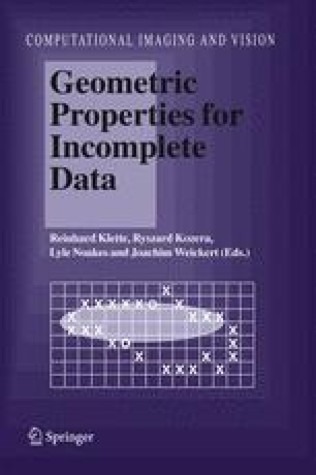
Geometric Properties for Incomplete Data
Computer vision and image analysis require interdisciplinary collaboration between mathematics and engineering. This book addresses the area of high-accuracy measurements of length, curvature, motion parameters and other geometrical quantities from acquired image data. It is a common problem that these measurements are incomplete or noisy, such that considerable efforts are necessary to regularise the data, to fill in missing information, and to judge the accuracy and reliability of these results. This monograph brings together contributions from researchers in computer vision, engineering and mathematics who are working in this area.
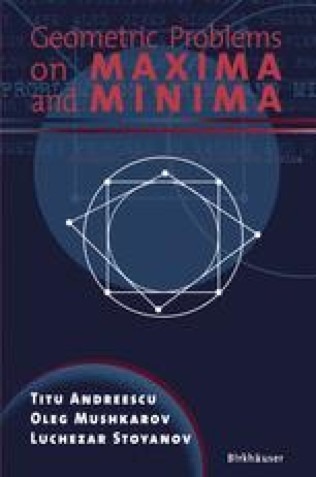
Geometric Problems on Maxima and Minima
Questions of maxima and minima have great practical significance, with applications to physics, engineering, and economics; they have also given rise to theoretical advances, notably in calculus and optimization. Indeed, while most texts view the study of extrema within the context of calculus, this carefully constructed problem book takes a uniquely intuitive approach to the subject: it presents hundreds of extreme-value problems, examples, and solutions primarily through Euclidean geometry.

Geometric numerical integration : Structure-preserving algorithms for ordinary differential equations
Numerical methods that preserve properties of Hamiltonian systems, reversible systems, differential equations on manifolds and problems with highly oscillatory solutions are the subject of this book. A complete self-contained theory of symplectic and symmetric methods, which include Runge-Kutta, composition, splitting, multistep and various specially designed integrators, is presented and their construction and practical merits are discussed. The long-time behaviour of the numerical solutions is studied using a backward error analysis (modified equations) combined with KAM theory. The book is illustrated by many figures, it treats applications from physics and astronomy and contains many numerical experiments and comparisons of different approaches.

Geometric Modelling, Numerical Simulation, and Optimization : Applied Mathematics at SINTEF
This book present scurrent activities of the Department of AppliedMathem- ics at SINTEF, the largest independent research organisation in Scandinavia. The book contains fteenpaperscontributedby employeesandfellowpartners from collaborating institutions. The research and development work within the department is focused on three main subject areas,andthestructureof the book refectsthisclustering: Part I Geometric Modelling Part II Numerical Simulation Part III Optimization Addressing Mathematics for Industry and Society, each contribution - scribesa problems ettingthatis of practical relevanceinone of thethreeareas and communicates the authors' own experiences in tackling these problems.

Geometric Modeling and Algebraic Geometry
The two ?elds of Geometric Modeling and Algebraic Geometry, though closely - lated, are traditionally represented by two almost disjoint scienti?c communities. Both ?elds deal with objects de?ned by algebraic equations, but the objects are studied in different ways. While algebraic geometry has developed impressive - sults for understanding the theoretical nature of these objects, geometric modeling focuses on practical applications of virtual shapes de?ned by algebraic equations. Recently, however, interaction between the two ?elds has stimulated new research. For instance, algorithms for solving intersection problems have bene?ted from c- tributions from the algebraic side.

Geometric Methods in Algebra and Number Theory
The transparency and power of geometric constructions has been a source of inspiration to generations of mathematicians. The beauty and persuasion of pictures, communicated in words or drawings, continues to provide the intuition and arguments for working with complicated concepts and structures of modern mathematics. This volume contains a selection of articles exploring geometric approaches to problems in algebra, algebraic geometry and number theory.

Geometric mechanics on riemannian manifolds : Applications to partial differential equations
This work presents a purely geometric treatment of problems in physics involving quantum harmonic oscillators, quartic oscillators, minimal surfaces, and Schrödinger's, Einstein's and Newton's equations. Historically, problems in these areas were approached using the Fourier transform or path integrals, although in some cases (e.g., the case of quartic oscillators) these methods do not work. New geometric methods are introduced in the work that have the advantage of providing quantitative or at least qualitative descriptions of operators, many of which cannot be treated by other methods. And, conservation laws of the Euler–Lagrange equations are employed to solve the equations of motion qualitatively when quantitative analysis is not possible. It includes : Lagrangian formalism on Riemannian manifolds; energy momentum tensor and conservation laws; Hamiltonian formalism; Hamilton–Jacobi theory; harmonic functions, maps, and geodesics; fundamental solutions for heat operators with potential; and a variational approach to mechanical curves.

Geometric Integration Theory
This textbook introduces geometric measure theory through the notion of currents. Currents—continuous linear functionals on spaces of differential forms—are a natural language in which to formulate various types of extremal problems arising in geometry, and can be used to study generalized versions of the Plateau problem and related questions in geometric analysis. Key features of Geometric Integration Theory: * Includes topics on the deformation theorem, the area and coarea formulas, the compactness theorem, the slicing theorem and applications to minimal surfaces * Applies techniques to complex geometry, partial differential equations, harmonic analysis, differential geometry, and many other parts of mathematics

Geometric Group Theory ; Geneva and Barcelona Conferences
This volume assembles research papers in geometric and combinatorial group theory. This wide area may be defined as the study of those groups that are defined by their action on a combinatorial or geometric object, in the spirit of Klein’s programme.The contributions range over a wide spectrum: limit groups, groups associated with equations, with cellular automata, their structure as metric objects, their decomposition, etc. Their common denominator is the language of group theory, used to express and solve problems ranging from geometry to logic.

Geometric Fundamentals of Robotics
Geometric Fundamentals of Robotics provides an elegant introduction to the geometric concepts that are important to applications in robotics. This second edition is still unique in providing a deep understanding of the subject: rather than focusing on computational results in kinematics and robotics, it includes significant state-of-the art material that reflects important advances in the field, connecting robotics back to mathematical fundamentals in group theory and geometry.

Geometric Function Theory : Explorations in Complex Analysis
Complex variables is a precise, elegant, and captivating subject. Presented from the point of view of modern work in the field, this new book addresses advanced topics in complex analysis that verge on current areas of research, including invariant geometry, the Bergman metric, the automorphism groups of domains, harmonic measure, boundary regularity of conformal maps, the Poisson kernel, the Hilbert transform, the boundary behavior of harmonic and holomorphic functions, the inhomogeneous Cauchy–Riemann equations, and the corona problem.
Geometric Data Analysis : From Correspondence Analysis to Structured Data Analysis
Geometric Data Analysis (GDA) is the name suggested by Stanford University to designate the approach to Multivariate Statistics initiated.as Correspondence Analysis, an approach that has become more and more used and appreciated over the years. This book presents the full formalization of GDA in terms of linear algebra - the most original and far-reaching consequential feature of the approach - and shows also how to integrate the standard statistical tools such as Analysis of Variance, including Bayesian methods. Chapter 9, Research Case Studies, is nearly a book in itself; it presents the methodology in action on three extensive applications, one for medicine, one from political science, and one from education (data borrowed from the Stanford computer-based Educational Program for Gifted Youth ). Thus the readership of the book concerns both mathematicians interested in the applications of mathematics, and researchers willing to master an exceptionally powerful approach of statistical data analysis.
Geometric Aspects of Functional Analysis : Israel Seminar 2004-2005
Most of the papers deal with different aspects of the Asymptotic Geometric Analysis, ranging from classical topics in the geometry of convex bodies, to inequalities involving volumes of such bodies or, more generally, log-concave measures, to the study of sections or projections of convex bodies. In many of the papers Probability Theory plays an important role; in some limit laws for measures associated with convex bodies, resembling Central Limit Theorems, are derive and in others probabilistic tools are used extensively. There are also papers on related subjects, including a survey on the behavior of the largest eigenvalue of random matrices and some topics in Number Theory.
