



الصفحة 3
الصفحة 3

Container Terminals and Automated Transport Systems : Logistics Control Issues and Quantitative Decision Support
Container transportation is the predominant mode of inter-continental cargo traffic. Since container ships and port terminals involve a huge capital investment and significant daily operating costs, it is of crucial importance to efficiently utilize the internal resources of container terminals and transportation systems. Today there is an ongoing trend to use automated container handling and transportation technology, in particular, in countries with high labour costs. This in turn requires highly sophisticated control strategies in order to meet the desired performance measures. The primary objective of this book is to reflect these recent developments and to present new insights and successful solutions to operational problems of automated container terminals and transportation systems. It comprises reports on the state of the art, applications of quantitative methods, as well as case studies and simulation results. Its contributions are written by leading experts from academia and business.

Constraint satisfaction techniques for agent-based reasoning
Constraint satisfaction problems are significant in the domain of automated reasoning for artificial intelligence. They can be applied to the modeling and solving of a wide range of combinatorial applications such as planning, scheduling and resource sharing in a variety of practical domains such as transportation, production, supply-chains, network management and human resource management. In this book we study new techniques for solving constraint satisfaction problems, with a special focus on solution adaptation applied to agent reasoning.

Concrete materials and technology : A practical guide
Demands an underlying knowledge of concrete fundamentals as well as its constituent materials, and in various formulations. Starting with the basics, Concrete Materials and Technology: A Practical Guide examines the production and chemistry of cement, as well as the different types and their applications. Quality control processes and numerous methods for testing are presented and explained in detail.

Concentrator Location in Telecommunications Networks
It presents polyhedral results and exact solution methods for location problems encountered in telecommunications but which also have applications in other areas like transportation and supply chain management.

Computer-Aided Highway Engineering
Aimed at developing professional knowledge in the field of highway engineering with adequate skills in planning, designing and implementation of the highway project with an exposure of hands on training of computer software in designing the worldwide road infrastructures. It discusses Digital Terrain Model (DTM) using satellite data including highway geometric, pavement and tunnel design, supported by relevant tutorials. Quantity estimation, cost estimation and production of various types of construction drawings are described in detail with theory and tutorials backed by real project data. Recognizes the role of information and computer technology in various aspects of highway design. Reviews different tasks for feasibility studies and DPR with software applications. Explores topographic survey, Digital Terrain Model (DTM) and highway geometrics and, pavement and drainage design. Discusses project estimations for various revisions of the engineering work. Includes HEADS Pro along with chapter wise tutorials containing design and field data, tutorial guides and various tutorial videos.

Column Generation
Column Generation is an insightful overview of the state of the art in integer programming column generation and its many applications. The volume begins with "A Primer in Column Generation" which outlines the theory and ideas necessary to solve large-scale practical problems, illustrated with a variety of examples. Other chapters follow this introduction on "Shortest Path Problems with Resource Constraints," "Vehicle Routing Problem with Time Window," "Branch-and-Price Heuristics," "Cutting Stock Problems," each dealing with methodological aspects of the field. Three chapters deal with transportation applications: "Large-scale Models in the Airline Industry," "Robust Inventory Ship Routing by Column Generation," and "Ship Scheduling with Recurring Visits and Visit Separation Requirements." Production is the focus of another three chapters: "Combining Column Generation and Lagrangian Relaxation," "Dantzig-Wolfe Decomposition for Job Shop Scheduling," and "Applying Column Generation to Machine Scheduling." The final chapter by François Vanderbeck, "Implementing Mixed Integer Column Generation," reviews how to set-up the Dantzig-Wolfe reformulation, adapt standard MIP techniques to the column generation context (branching, preprocessing, primal heuristics), and deal with specific column generation issues (initialization, stabilization, column management strategies).

Cognitive Computing in Human Cognition : Perspectives and Applications
This edited book designs the Cognitive Computing in Human Cognition to analyze to improve the efficiency of decision making by cognitive intelligence. The book is also intended to attract the audience who work in brain computing, deep learning, transportation, and solar cell energy. Due to this in the recent era, smart methods with human touch called as human cognition is adopted by many researchers in the field of information technology with the Cognitive Computing.
Mathematical and Computational Models for Congestion Charging
This book presents rigorous treatments of issues related to congestion pricing. The chapters describe recent advances in areas such as mathematical and computational models for predicting traffic congestion, determining when, where, and how much to levy tolls, and analyzing the impact of tolls on transporation systems. The analyses and methodologies developed in this book provide Mechanisms that aid in determining and comparing congestion pricing schemes; Methodologies for evaluating the efficiency of existing and proposed congestion pricing schemes; A means to predict the impact of pricing on urban transporation systems; and Information essential to the financial and political success of congestion pricing programs.
Management of Regulatory Influences on Corporate Strategy and Structure
In many industries, e.g. telecommunications, transportation, energy, chemicals, food and beverages, firm performance is heavily influenced by regulation. Despite this fact, strategic management research has traditionally focused on market strategies and related issues. Questions of how to manage regulatory involvement have been left to separate research streams on corporate political activity and a broader understanding of the complex inter-dependencies and mutual influences between corporate and external actors remains lacking.
Macro-Engineering : A Challenge for the Future
Macro-engineering involves the large-scale modification and manipulation of natural systems for the benefit of mankind. The primary goals of some Earth-based macroprojects described in this book are power production, land reclamation, food production, climate change, environment, water, transport and coastal protection. Other Earth or space projects considered here have a more futuristic ring, but our present-day technical skill makes their realization possible. Earth-based macroprojects usually combine different aspects and aims. They have a major impact on the ecology of a region and the inhabitants' means of living (like tourism, fishing, shipping). Its effects may be felt worldwide, like the rise in global sea level after the damming and evaporation of large ocean gulfs for power production, or the change in climate following the regional reduction of solar insolation.
LRFD Bridge Design : Fundamentals and Applications
Examines and explains material from the 9th edition of the AASHTO LRFD Bridge Design Specifications, including deck and parapet design, load calculations, limit states and load combinations, concrete and steel I-girder design, bearing design, and more. With increased focus on earthquake resiliency, two separate chapters– one on conventional seismic design and the other on seismic isolation applied to bridges– will fully address this vital topic. The primary focus is on steel and concrete I-girder bridges, with regard to both superstructure and substructure design. / Includes several worked examples for a project bridge as well as actual bridges designed by the author / Examines seismic design concepts and design details for bridges / Presents the latest material based on the 9th edition of the LRFD Bridge Design Specifications / Covers fatigue, strength, service, and extreme event limit states / Includes numerous solved problems and exercises at the end of each chapter to illustrate the concepts presented

Logistics Systems Analysis
It has two new sections, a new appendix, and more than half a dozen new figures. A few references have also been added, Much of the new material is based on work , The financial support of the National Science Foundation and the Volvo Foundations Center of Excellence for the Future of Urban Transportation at U. C. Berkeley is also acknowledged. The new appendix presents the logic behind the traveling salesman and vehicle routing results used in Sec. 4. 2 to describe the transportation ope- tion; Chapter 4 is more self-contained as a result. New section 5. 6 int- duces and evaluates a general method that automatically translates the c- tinuum approximation recipes of Chapters 4 and 5 into discrete system designs. This closes a gap in previous editions. Other additions include an explanation of how to develop system designs that can efficiently acc- modate real-time control strategies to manage uncertainty (new section 4. 6. 3), and extensions of the many-to-many design ideas of Chap. 6
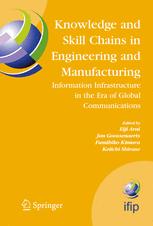
Knowledge and Skill Chains in Engineering and Manufacturing : Information Infrastructure in the Era of Global Communications
Explores knowledge and skill chains in engineering and manufacturing in the age of global communications. Information infrastructure involves a range of activities from product planning, engineering, and manufacturing trough transportation, marketing, and repair/upgrade to returns and recycling/disposal. Distinct from the traditional engineering database, life-cycle support information has its own characteristic requirements, -- flexible extensibility, distributed architecture, multiple viewpoints, long-time archiving, and product usage information. Several authors address the architecture of the information infrastructure, its services and its requirements. Other papers focus on the knowledge and skill chains that develop in a variety of situations: the supply chain, the factory floor, the man-system interaction, etc. For each of these, state-of-the-art and state-of-research scenarios for various industrial sectors address both engineering and operations requirements in the current socio-economic environment.
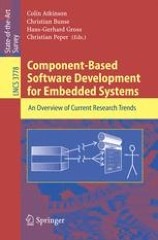
Component-Based Software Development for Embedded Systems : An Overview of Current Research Trends
Embedded systems are ubiquitous. They appear in cell phones, microwave ovens, refrigerators, consumer electronics, cars, and jets. Some of these embedded s- tems are safety- or security-critical such as in medical equipment, nuclear plants, and X-by-wire control systems in naval, ground and aerospace transportation - hicles. With the continuing shift from hardware to software, embedded systems are increasingly dominated by embedded software. Embedded software is complex. Its engineering inherently involves a mul- disciplinary interplay with the physics of the embedding system or environment. Embedded software also comes in ever larger quantity and diversity. The next generation of premium automobiles will carry around one gigabyte of binary code. The proposed US DDX submarine is e?ectively a ?oating embedded so- ware system, comprising 30 billion lines of code written in over 100 programming languages. Embedded software is expensive. Cost estimates are quoted at around US$15– 30 per line (from commencement to shipping). In the defense realm, costs can range up to $100, while for highly critical applications, such as the Space Shuttle, the cost per line approximates $1,000. In view of the exponential increase in complexity, the projected costs of future embedded software are staggering.
Civil Engineering Materials for Transportation Infrastructure
Includes the fundamental mechanical and physical properties of materials; properties, tests, and gradation designs of aggregates; production, composition, hydration, properties, and tests of lime and cement; composition, tests, and design of cement concrete; mechanisms, properties, and design of inorganic binder stabilized material; properties, tests, and grading of asphalt; composition, properties, tests, and designs of asphalt mixture; and properties, treatments, tests, and selections of steel.
Civil engineering for disaster risk reduction
Brings together all diverse disciplines of civil engineering and related areas (for example, geotechnical engineering, water resources engineering, structural engineering, transportation engineering, environmental engineering, construction management, GIS, and remote sensing) towards a common goal of disaster resilience through an interdisciplinary approach. It contains methods and case studies focusing on civil engineering solutions to reduce the disaster risk. The book contents are aligned in line with the priorities set by UN-Sendai Framework for Disaster Risk Reduction and UN-SDGs to promote a global culture of risk-awareness and disaster reduction. The book will be a useful comprehensive reference for disaster risk reduction beneficial for engineering students, teaching faculty, researchers, industry professionals and policymakers.

Changing Education : Leadership, Innovation and Development in a Globalizing Asia Pacific
This book responds to the growing unease of educators and non-educators alike about the inadequacy of most current educational systems and programs to meet sufficiently the demands of fast changing societies. These systems and programs evolved and were developed in and for societies that have long been transformed, and yet no parallel transformation has taken place in the education systems they spawned. In the last twenty years or so, other sectors of society, such as transportation and communications systems, have radically changed the way they operate, but education has remained essentially the same. There is no doubt: education needs to change.
Challenges and Solutions for Sustainable Smart City Development
Discusses advances in smart and sustainable development of smart environments. The authors discuss the challenges faced in developing sustainable smart applications and provide potential solutions. The solutions are aimed at improving reliability and security with the goal of affordability, safety, and durability. Topics include health care applications, sustainable smart transportation systems, intelligent sustainable wearable electronics, and sustainable smart building and alert systems. Authors are from both industry and academia and present research from around the world. Addresses problems and solutions for sustainable development of smart cities; Includes applications such as healthcare, transportation, wearables, security, and more ; Relevant for scientist and researchers working on real time smart city development.

Cerebral palsy
Cerebral palsy is a lifelong condition that affects the individual, family, and immediate community. Therefore, the goal of allowing the individual with cerebral palsy to live life with the least impact of the disability requires c- plex attention to the individual and the family. Furthermore, society needs to be sensitive and to accommodate individuals with disabilities by limiting architectural impediments and providing accessible public transportation and communication. The educational system provides the key means for helping the individual prepare to function in society to his or her maximum ability. In many ways, the medical care system probably has the least sign- icant role in preparing the child with cerebral palsy to function optimally in society. However, the medical care system is the place where parents first learn that their child has developmental issues outside the expected norm. It is almost universally the place where parents also expect the child to be made normal in our modern society. In earlier times, the parents would expect healing to possibly come from the doctor, but also they would place hope for healing in religion. As this belief in spiritual or miraculous healing has - creased, a significant font of hope has decreased for parents of young ch- dren with disabilities.

Carpooling optimization
The aim of this project is to collect and use the GPS data from mobile devices to get geolocations and translate this data to paths, starting points and destinations to detect patterns out of each individual trajectories that have stochastic nature on the close sight and find representations of those patterns. The second half of the artificial intelligence algorithms has the task of finding the optimal matching of the patterns that were detected in a computation efficient way that achieve the most efficient way of transportation.
