



الصفحة 3
الصفحة 3

Herbs for common ailments : How to make and use herbal remedies for home health care
Shows you how to use 56 common herbs to address a wide range of everyday ailments, from burns, wounds, and itchy skin to headaches, congestion, indigestion, strains, bruises, sore throats, coughs, fevers, colic, cramps, and insomnia. She also shows you how to stock a simple first-aid kit with safe, effective herbal remedies.

Herbal antivirals : Natural remedies for emerging & resistant viral infections ; 2nd ed.
Viruses are smart, mutating, and becoming resistant to antiviral pharmaceuticals. Global crises such as COVID-19, SARS, and dengue feaver spread more quickly than we can develop medicines to fight them. Herbalist and best-selling author Stephen Harrod Buhner has studied the antiviral properties of plants for many years. In this comprehensive guide, he profiles the plants that have proven most effective in fighting viral infections and provides in-depth instructions for preparing and using formulations to address the most common infections and strengthen immunity, safely and naturally. The updated 2nd edition includes an expanded guide to COVID-19, including a review of the most up-to-date medical research and the plant medicines that have been found to be most potent in preventing infection, lessening the impact of the virus on the body, and addressing longer-term effects and co-infections.

Herbal antibiotics : Natural alternatives for treating drug-resistant bacteria ; 2nd ed.
Health care providers have discovered many new resistant strains of bacteria, researchers have added to the growing body of knowledge about herbs, and the need for antivirals to treat emerging infections like SARS and West Nile Encephalitis has become urgent. Within ten years, according to sources cited in the book, pharmaceutical antibiotics will begin to fail at epidemic rates. There are, in fact, no new antibiotics currently in planning or development at any of the major pharmaceutical companies. Most notably, there is none for Gram-negative bacteria, which are emerging as the most dangerous pathogens.

Heavy-Tail Phenomena : Probabilistic and Statistical Modeling
This comprehensive text gives an interesting and useful blend of the mathematical, probabilistic and statistical tools used in heavy-tail analysis. Heavy tails are characteristic of phenomena where there is a significant probability of a single huge value impacting system behavior. Record-breaking insurance losses, financial returns, sizes of files stored on a server, transmission rates of files are all examples of heavy-tailed phenomena.
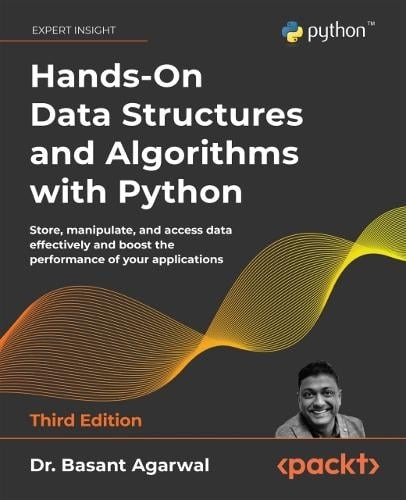
Hands-On Data Structures and Algorithms with Python : Store, manipulate, and access data effectively ; 3rd ed.
Expands your understanding of key structures, including stacks, queues, and lists, and also show you how to apply priority queues and heaps in applications. You'll learn how to analyze and compare Python algorithms, and understand which algorithms should be used for a problem based on running time and computational complexity. You will also become confident organizing your code in a manageable, consistent, and scalable way, which will boost your productivity as a Python developer. By the end of this Python book, you'll be able to manipulate the most important data structures and algorithms to more efficiently store, organize, and access data in your applications

Handbook of neurochemistry and molecular neurobiology : Neurotransmitter Systems
The brain is the organ that collects information from the environment, processes and stores the information, and generates behavior as and when needed. In essence, the brain makes us who we are. For this reason, understanding the biology of brain function is a great challenge and a major goal of modern science. The brain is one of the last great frontiers in science, and the unraveling of its mysteries is comparable in complexity to efforts in space exploration. A fundamental goal of neuroscience is to understand how neurons generate behavior and the pathophysiology of different mental and neurological diseases. This requires, among other things, information about where these neurons are located, how they are connected, and how they communicate with each other in various physiological and pathophysiological conditions. Our aim is to describe recent discoveries about the basic operations of the brain and to provide an introduction to the adaptations for specific types of information processing.

GPU-Based Interactive Visualization Techniques
This book focuses on efficient visualization techniques, which are the prerequisite for the interactive exploration of complex data sets. High performance is primarily achieved by devising algorithms for the fast graphics processing units (GPUs) of modern graphics hardware. Other aspects discussed in the book include parallelization on cluster computers with several GPUs, adaptive rendering methods, multi-resolution models, and non-photorealistic rendering techniques for visualization. Covering both the theoretical foundations and practical implementations of algorithms, this book provides the reader with a basis to understand and reproduce modern GPU-based visualization approaches.

Goliath strikes back : How traditional retailers are winning back customers from ecommerce startups
Goliath Strikes Back: How Traditional Retailers Are Winning Back Customers from Ecommerce Startups expands on this current industry shift in one of the most accessible, intriguing business books in recent times. Each chapter covers a different industry, as diverse and eclectic as consumer electronics, newspapers, groceries, logistics, and more. By looking at how traditional retailers are facing off against internet startups, you can gauge the landscape and form your own strategies.

Fuzzy database modeling with XML
Fuzzy Database Modeling with XML aims to provide a single record of current research and practical applications in the fuzzy databases. This volume is the outgrowth of research the author has conducted in recent years. Fuzzy Database Modeling with XML introduces state of the art information to the database research, while at the same time serving the information technology professional faced with a non-traditional application that defeats conventional approaches. The research on fuzzy conceptual models and fuzzy object-oriented databases is receiving increasing attention, in addition to fuzzy relational database models. With rapid advances in network and internet techniques as well, the databases have been applied under the environment of distributed information systems. It is essential in this case to integrate multiple fuzzy database systems. Since databases are commonly employed to store and manipulate XML data, additional requirements are necessary to model fuzzy information with XML. Second, this book maps fuzzy XML model to the fuzzy databases. Very few efforts at investigating these issues have thus far occurred.

Fundamentals of Relational Database Management Systems
Information is a valuable resource to an organization. Computer software provides an efficient means of processing information, and database systems are becoming an increasingly common means by which it is possible to store and retrieve information in an effective manner. This book provides comprehensive coverage of fundamentals of database management systems. This book is for those who wish a better understanding of relational data modeling, its purpose, its nature, and the standards used in creating relational data models.

Fundamental Trends in City Development
This book inquires into how the city can be re-established as the space of dialogue and communication, how the spatial conditions of the public sphere can be created and the city retrieved. And what the features might be of a city retrieved and restored to its citizens. The book adopts the concept of externity as an innovative element for the project for the city, a constituent feature of all those situations traditionally considered non-functional, therefore external, to our contemporary post-cities, which are consigned to us adrift through decomposition, genericity and segregation. We thus need to try to get the city to conserve and show its past even when not visible, and to continue nurturing the imagination of its inhabitants by urban action consisting perhaps of subtly improving their approach to the "void", the "small", to the past, the territory, in general, to all those spatial concepts which are in a sense external to our cultural worlds today, but which represent the most fertile material for the project for the city.
Functional and operatorial statistics
An increasing number of statistical problems and methods involve infinite-dimensional aspects. This is due to the progress of technologies which allow us to store more and more information while modern instruments are able to collect data much more effectively due to their increasingly sophisticated design. This evolution directly concerns statisticians, who have to propose new methodologies while taking into account such high-dimensional data (e.g. continuous processes, functional data, etc.). The numerous applications (micro-arrays, paleo-ecological data, radar waveforms, spectrometric curves, speech recognition, continuous time series, 3-D images, etc.) in various fields (biology, econometrics, environmetrics, the food industry, medical sciences, paper industry, etc.) make researching this statistical topic very worthwhile. This book gathers important contributions on the functional and operatorial statistics fields

Fuel Additives : Chemistry and technology
The book introduces and summarizes refinery operations to an extent that discussions of fuels in the following chapters become easier to understand. Then follow detailed descriptions of problems that occur for reasons of the ways in which liquid petroleum fuels are transported, stored, and used. In these discussions, their applications to jet fuel, heating oils, gasoline, diesel fuels, and bunker fuels are covered.

From Bulk to Nano : The Many Sides of Magnetism
The field of magnetism is rapidly advancing in this new millennium, revealing an ever-wider diversity of magnetic phenomena on more than one scale. With the emergence of countless applications particularly on a nanoscale, and their unpredictable implications mostly on a macroscale, it may seem that different aspects of magnetism are unrelated. Quite often, the overwhelming amount of topics discussed in the professional literature views only parts of a field, ignoring a broader context. Therefore, the present book aims at addressing the relationship between apparently unconnected topics in magnetism. Less obvious relationships are revealed among individual fields on various scales, making them better understandable.

Formal Concept Analysis ; 6th International Conference, ICFCA 2008, Montreal, Canada, February 25-28, 2008. Proceedings
Formal Concept Analysis (FCA) is a mathematical theory of concepts and c- ceptual hierarchyleadingto methods for conceptually analyzing data and kno- edge. The theory itselfstronglyreliesonorder and lattice theory,whichhasbeen studied by mathematicians over decades. FCA proved itself highly relevant in several applications from the beginning , and, over the last years, the range of application shaskept growing. The mainreasonfor this comesfromthe fact that our modern society has turned into an “information” society. After years and years of using computers, companies realized they had stored gigantic amounts of data.

Formal approaches to software testing ; Vol. 3395 ; 4th International workshop, FATES 2004, Linz, Austria, September 21, 2004, Revised Selected Papers
Testing often accounts for more than 50% of the required e?ort during system development.Thechallengeforresearchistoreducethesecostsbyprovidingnew methods for the speci?cation and generation of high-quality tests. Experience has shown that the use of formal methods in testing represents a very important means for improving the testing process. Formal methods allow for the analysis andinterpretationofmodelsinarigorousandprecisemathematicalmanner.The use of formal methods is not restricted to system models only. Test models may alsobeexamined.Analyzingsystemmodelsprovidesthepossibilityofgenerating complete test suites in a systematic and possibly automated manner whereas examining test models allows for the detection of design errors in test suites and their optimization with respect to readability or compilation and execution time. Due to the numerous possibilities for their application, formal methods have become more and more popular in recent years. The Formal Approaches in Software Testing (FATES) workshop series also bene?ts from the growing popularity of formal methods. After the workshops in Aalborg (Denmark, 2001), Brno (Czech Republic, 2002) and Montr´ eal (Canada, 2003), FATES 2004 in Linz (Austria) was the fourth workshop of this series. Similar to the workshop in 2003, FATES 2004 was organized in a?liation with the IEEE/ACM Conference on Automated Software Engineering (ASE 2004). FATES 2004 received 41 submissions. Each submission was reviewed by at least three independent reviewers from the Program Committee with the help of some additional reviewers. Based on their evaluations, 14 full papers and one wo- in-progress paper from 11 di?erent countries were selected for presentation.

Forging New Frontiers : Fuzzy Pioneers I
The 2005 BISC International Special Event-BISCSE’05 " FORGING THE FRONTIERS" was held in the University of California, Berkeley, “WHERE FUZZY LOGIC BEGAN, from November 3 – 6, 2005. The successful applications of fuzzy logic and it’s rapid growth suggest that the impact of fuzzy logic will be felt increasingly in coming years. Fuzzy logic is likely to play an especially important role in science and engineering, but eventually its influence may extend much farther. In many ways, fuzzy logic represents a significant paradigm shift in the aims of computing - a shift which reflects the fact that the human mind, unlike present day computers, possesses a remarkable ability to store and process information which is pervasively imprecise, uncertain and lacking in categoricity.

Forest Radioecology in Fukushima : Radiocesium Dynamics, Impact, and Future
This book provides holistic information on the radioactive contamination of forests. Topics are highly interdisciplinary, ranging from the dynamics of radioactive cesium in forest ecosystems to the radiation protection or the socio-economic aspects of radiation effects. It is designed to help people understand the radioactive contamination in forests and provide hints of how to cope with it and restore their livelihoods. The book is characterized by its well-balanced structure that allows the reader to understand the whole picture without going into too much scientific content. After explaining the basics of radioactive materials and radiation, the book illustrates the radioactive contamination of forests, it also describes the impacts on the forestry and life of local people and the measures taken by. Few books address the concerns about how to deal with radioactive contamination of forests and the future perspectives. In this book, people can learn all about the Fukushima nuclear accident of forests, forest products, and people with abundant reference materials.

Forest Diversity and Management
Natural forests with thousands of years of ecological continuity are unrivalled as the treasure store of terrestrial biodiversity on Earth. And while there is currently no fully comprehensive inventory of the biota associated with any given forest, it is reasonable to assume that in conserving natural forests we can conserve the myriads of unnamed bacteria, fungi, insects, mites and nematodes that forests support. Drawing on diverse research from biodiversity experts around the world, this collection of papers reflects the diversity of forest types and forest issues that concern forest scientists globally. Forest types considered vary from savannah and tropical rainforests to the ancient oak forests of Poland; issues explored include the effects of logging, management practices, forest dynamics and climate change on forest structure and biodiversity.

Food Price Volatility and Its Implications for Food Security and Policy
This book provides fresh insights into concepts, methods and new research findings on the causes of excessive food price volatility. It also discusses the implications for food security and policy responses to mitigate excessive volatility. The approaches applied by the contributors range from on-the-ground surveys, to panel econometrics and innovative high-frequency time series analysis as well as computational economics methods. It offers policy analysts and decision-makers guidance on dealing with extreme volatility.
