



الصفحة 3
الصفحة 3
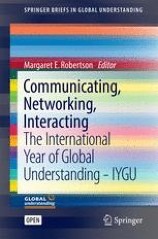
Communicating, Networking : Interacting : The International Year of Global Understanding - IYGU
illustrates the benefits to be gained from digitally networked communication for health, education and transitioning economies in developing nations (Sierra Leone and Papua New Guinea) and developed nations. Growing powers of e-citizenship can help build sustainable futures. This small volume provides a collection of examples and ideas from which the authors hope will help build a wider resource. Understanding how to link everyday lives with global networks in the digital world in ways that add benefit for the world’s people, and the health of the planet, is an ongoing project. IYGU recognises the integral roles of networking and communication systems, as well as interactions between people, near and far, as fundamental for building better futures. The global penetration of digital devices means everyday life, present and future, is inextricably linked with information technologies
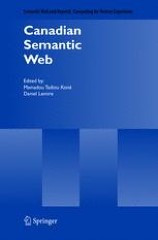
Canadian Semantic Web
This book covers a variety of well known topics of interest to practitioners in industry and research scientists. The range of topics includes languages, tools and methodologies for the semantic Web, semantic Web-based ontology management and engineering, semantic Web services, practical applications of the semantic Web techniques, artificial intelligence methods and tools for the semantic Web, software agents on the semantic Web, visualization and modeling of the semantic Web. The goal of this book is to provide a state-of-the-art review of the research as well as to introduce topics of interest to experts.
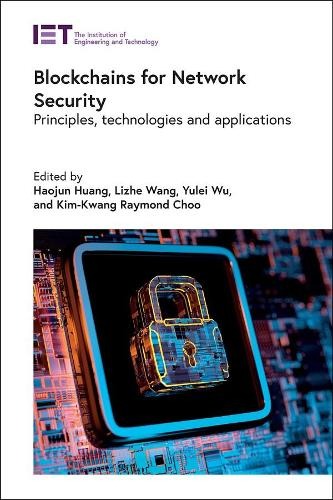
Blockchains For Network Security : Principles, technologies and applications
Blockchain technology is a powerful, cost-effective method for network security. Essentially, it is a decentralized ledger for storing all committed transactions in trustless environments by integrating several core technologies such as cryptographic hash, digital signature and distributed consensus mechanisms. Over the past few years, blockchain technology has been used in a variety of network interaction systems such as smart contracts, public services, Internet of Things (IoT), social networks, reputation systems and security and financial services. With its widespread adoption, there has been increased focus on utilizing blockchain technologies to address network security concerns and vulnerabilities as well as understanding real-world security implications.

Biosurveillance and biosecurity ; International Workshop, BioSecure 2008, Raleigh, NC, USA, December 2, 2008. Proceedings
This book constitutes the refereed proceedings of the International Workshop on Biosurveillance and Biosecurity, BioSecure 2008, held in Raleigh, NC, USA, in December 2008.

Autonomic and Trusted Computing ; 4th International Conference, ATC 2007, Hong Kong, China, July 11-13, 2007, Proceedings
To cope with the growing and ubiquitous complexity, autonomic computing (AC) focuses on se- manageable computing and communication systems that exhibit self-awareness, self-configuration, self-optimization, self-healing, self-protection and other self-x operations to the maximum extenteven without human interventionor guidance. Organiccomputing(OC)additionally emphasizes natural-analogueconceptslike self-organization and controlled emergence. Any autonomic ororganic system must be trus tworthy to avoid the risk of l- ing control and to retain confidence that the system will not fail. Trust and/or distrust relationships on the Internet and in pervasive infrastructures are key factors to enable dynamic interaction and cooperation of various users, systems and services. Trusted/trustworthy computing (TC) aims at making computing and communication systems as well as services available, predictable, traceable, controllable, assessable, sustainable, dependable, persist-able, security/privacy protect-able, etc.
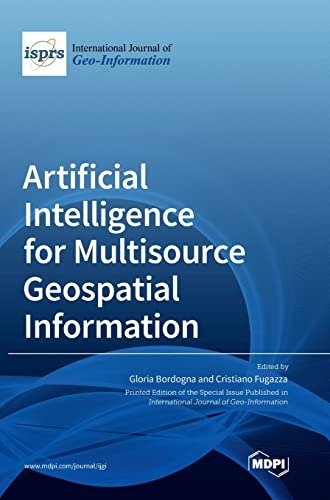
Artificial intelligence for multisource geospatial information
Collects 10 original research contributions published in the Special Issue entitled “Artificial Intelligence for Multisource Geospatial Information” of the ISPRS International Journal of Geo-Information. The focus is on different methods of Geospatial Artificial Intelligence (GeoAI) based on deep learning using different network architectures, clustering, soft computing, and semantic approaches. They are proposed to deal with a variety of Geospatial Big Data (GBD), such as georeferenced texts and photos in social networks, remote sensing images, cartographic maps, multidimensional geo databases, metadata in spatial data infrastructures, and for different tasks, such as for multisource georeferenced text integration and geodata flexible querying, for social sensing by applying sentiment analysis, clustering and geo analysis, for segmentation of roads, clouds and snow, and for detection of small targets and people on the streets.
Advancing Social Simulation: The First World Congress
Agent-based modeling and social simulation have emerged as both developments of and challenges to the social sciences. The developments include agent-based computational economics and investigations of theoretical sociological concepts using formal simulation techniques. Among the challenges are the development of qualitative modeling techniques, implementation of agent-based models to investigate phenomena for which conventional economic, social, and organizational models have no face validity, and the application of physical modeling techniques to social processes. Bringing together diverse approaches to social simulation and research agendas.

Advances in intelligent data analysis XVIII ; 18th International symposium on intelligent data analysis, IDA 2020, Konstanz, Germany, April 27–29, 2020, Proceedings
This book constitutes the proceedings of the 18th International Conference on Intelligent Data Analysis, IDA 2020, held in Konstanz, Germany, in April 2020. The 45 full papers presented in this volume were carefully reviewed and selected from 114 submissions. Advancing Intelligent Data Analysis requires novel, potentially game-changing ideas. IDA’s mission is to promote ideas over performance: a solid motivation can be as convincing as exhaustive empirical evaluation.
A Guide to Graph Algorithms
Offers high-quality content in the research area of graph algorithms and explores the latest developments in graph algorithmics. The reader will gain a comprehensive understanding of how to use algorithms to explore graphs. It is a collection of texts that have proved to be trend setters and good examples of that. The book aims at providing the reader with a deep understanding of the structural properties of graphs that are useful for the design of efficient algorithms. These algorithms have applications in finite state machine modelling, social network theory, biology, and mathematics. The book contains many exercises, some up at present-day research-level. The exercises encourage the reader to discover new techniques by putting things in a clear perspective.
