



الصفحة 3
الصفحة 3

Genome Editing : Gene Therapy or Gene Optimization?
Genome editing technology is considered one of the most revolutionary techniques lately. The ability of modifying the human genome has been one of the biggest dreams for therapist for the reason that the genetic modification with exogenous DNA can be considered a problem solver for many diseases and disorders (genetic disorders), especially those with high risks and low survival rates, on this case, gene therapy appears as the tool to be used, with its many protocols and approaches. Gene therapy is based on delivering a therapeutic gene throw suitable vectors, which is most of the time-modified viruses to carry the therapeutic genes to the target cells and so on providing the functional copy of the defective gene.

Genes, development, and cancer : The life and work of Edward B. Lewis
Edward B. Lewis' science is the bridge linking experimental genetics as conducted in the first half of the twentieth century, and the powerful molecular genetic approaches that revolutionized the field in its last quarter. For the first time Lewis' key publications in the fields of genetics, developmental biology, radiation and cancer are compiled within one volume.

Generator remote controlling using internet connection
The traditional technique of monitoring the electricity generated through regular checks on the alternator variables: oil, temperature, voltage and current on a daily basis. Therefore, maintaining a normal performance cycle requires hard work and is often imprecise. The idea is to create an application that monitors wireless generators using the popular smartphone Android operating system. Implemented sensors deliver analog signals that provide real-time data on the status of the generator. This data is converted and programmed through the Node MCU microcontroller, which reads the results from the sensors and then converts into a signal, which is transmitted to the android phone, through a router. Thus live feedback of the generator status is ensured. In addition, this project provides a control button that can actually turn this generator on and off. This project is the first step towards bringing systems and control together as it revolutionizes the ideology of monitoring and displaying real-time data that can be implemented in different fields according to different needs. These fields include electricity, mechanics, and communications.
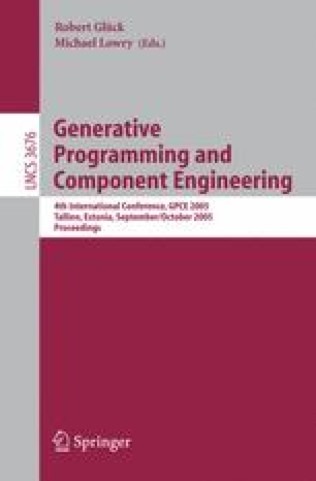
Generative programming and component engineering ; 4th International conference, GPCE 2005, Tallinn, Estonia, September 29 - October 1, 2005, Proceedings
Generative Programming and Component Engineering (GPCE) is a leading - searchconferenceonautomaticprogrammingandcomponentengineering.These approaches to software engineering have the potential to revolutionize software development as automation and components revolutionized manufacturing. The conference brings together researchers and practitioners interested in adva- ing automation for software development. It is also a premier forum for cro- fertilization between the programming language and software engineering - search communities. GPCEaroseasajointconference, mergingthepriorconferenceonGenerative and Component-Based Software Engineering (GCSE) and the Workshop on - mantics, Applications, andImplementationofProgramGeneration(SAIG). The proceedingsofthepreviousGPCEconferenceswerepublishedintheLNCSseries of Springer as volumes2487,2830, and 3286.In 2005 GPCE wasco-locatedwith the International Conference on Functional Programming (ICFP) and the s- posium on Trends in Functional Programming (TFP), re?ecting the vigorous interaction between the functional programming and generative programming research communities. GPCE and ICFP are both sponsored by the Association for Computing Machinery. The quality and breadth of the papers submitted to GPCE 2005 was impr- sive. All 86 papers, including 5 papers for tool demonstrations, were rigorously reviewed by 17 highly quali?ed Program Committee members. The members of the Program Committee ?rst provided in-depth individual reviews of the s- mitted papers, and then debated the merits of the papers through an extended electronicProgramCommitteemeeting.After much(friendly) argument,25r- ular papers and 2 tool demonstration papers were selected for publication. The ProgramCommittee provided extensive technical feedback to the authors of the submittedpapers.Theconferenceprogramwascomplementedwiththreeinvited talks, three extended tutorials, and three all-day workshops.

Gene delivery systems development and applications
Covers the development of gene therapy today, the technology involved, clinical applications of siRNA, non-viral vector-based mRNA delivery using nanotechnology, and RNA based vaccines for treating the infectious diseases. It also presents the current application of the CRISPR/Cas9 gene-editing technique which has revolutionized genome editing and which was awarded the 2020 Nobel Prize in Chemistry. Several new drug delivery systems are explored for the applications of gene therapy. These are found to be useful in treating chronic illnesses, including cancer and infectious diseases.

Galileo Galilei - When the World Stood Still
"I, Galileo, son of the late Vincenzio Galilei, Florentine, aged seventy years ...kneeling before you Most Eminent and Reverend Lord Cardinals ...I abjure, curse, detest the aforesaid errors and heresies."The mathematician and physicist Galileo Galilei is one of the most famous scientists of all times. The story of his life and times, of his epoch-making experiments and discoveries, of his stubbornness and pride, of his patrons in the house of Medici, of his enemies and friends in their struggle for truth - all is brought vividly to life in this book. Atle Næss has written a gripping account of one of the great figures in European history.

Funds, Flows and Time : An Alternative Approach to the Microeconomic Analysis of Productive Activities
The subject of this book is production, which is an important and extensive field in economic science. In fact, production, distribution and consump tion were long considered the three federated kingdoms which together formed the great empire of the economy. According to other slightly dif ferent traditions, production also held pride of place, specifically as a basic link in the long chain of social reproduction. Today, whatever the theoreti cal approach, production is a fundamental requirement for human survival. This was not, however, always the case. For much of the history of man kind hominids were hunter, scavenger and gatherers, with very little con trol over their environment, and extremely little in the way of artefacts with which to work. However, since the Neolithic revolution, productive processes have constituted an essential mechanism, providing human soci ety with goods and services to satisfy its needs and cravings.

From Summetria to Symmetry : The Making of a Revolutionary Scientific Concept
The concept of symmetry is inherent to modern science, and its evolution has a complex history that richly exemplifies the dynamics of scientific change. This study is based on primary sources, presented in context: the authors examine closely the trajectory of the concept in the mathematical and scientific disciplines as well as its trajectory in art and architecture. The principal goal is to demonstrate that, despite the variety of usages in many different domains there is a conceptual unity underlying the invocation of symmetry in the period from antiquity to the 1790s which is distinct from the scientific usages of this term that first emerged in France at the end of the 18th century.

From P2P to Web Services and Grids : Peers in a Client/Server World
Provides an overview of peer-to-peer (P2P) technologies that have revolutionized the way we think about distributed computing and the internet. This book compares these technologies to alternative solutions, most notably web services and Grid computing but also other technologies, such as client/server based systems and agent technologies.

From Object to Experience : The New Culture of Architectural Design
Combines a history of ideas about architectural experience with the latest insights from the fields of neuroscience, cognitive science and evolutionary biology to make a powerful argument about the nature and future of architectural design. Today, the sciences have granted us the tools to help us understand better than ever before the precise ways in which the built environment can affect the building user's individual experience. Through an understanding of these tools, architects should be able to become better designers, prioritizing the experience of space - the emotional and aesthetic responses, and the sense of homeostatic well-being, of those who will occupy any designed environment. In From Object to Experience, Mallgrave goes further, arguing that it should also be possible to build an effective new cultural ethos for architectural practice. Drawing upon a range of humanistic and biological sources, and emphasizing the far-reaching implications of new neuroscientific discoveries and models, this book brings up-to-date insights and theoretical clarity to a position that was once considered revolutionary but is fast becoming accepted in architecture

From grids to service and pervasive computing
Grids are a crucial enabling technology for scientific and industrial development. Peer-to-peer computing, grid, distributed storage technologies, emerging web service technologies, and other types of networked distributed computing have provided new paradigms exploiting distributed resources. Grids are revolutionizing computing as profoundly as e-mail and the Web.From Grids to Service and Pervasive Computing, the 10th edited volume of the CoreGRID series, is based on the 2008 CoreGRID Symposium, held August 25-26 in the Canary Islands, Spain.

Forecasting with Exponential Smoothing : The State Space Approach
Exponential smoothing methods have been around since the 1950s, and are the most popular forecasting methods used in business and industry. Recently, exponential smoothing has been revolutionized with the introduction of a complete modeling framework incorporating innovations state space models, likelihood calculation, prediction intervals and procedures for model selection. In this book, all of the important results for this framework are brought together in a coherent manner with consistent notation. In addition, many new results and extensions are introduced and several application areas are examined in detail.

Food lens = فود لينس
Food lens is an innovative application designed to revolutionize dietary management by leveraging advanced image recognition and nutritional analysis. The primary objective of this senior project is to develop a user-friendly tool that identifies various foods through a camera interface and provides detailed nutritional information. This application not only enhances the user's understanding of their dietary intake but also assists in achieving personalized health and fitness goals. The core functionality of Food Lens involves the integration of a robust image recognition system capable of accurately identifying a wide range of foods. Upon identification, the application retrieves comprehensive nutritional data, including calorie content, macronutrient distribution (proteins, fats, carbohydrates), and essential micronutrients (vitamins and minerals). This data is then seamlessly integrated into the user's dietary profile. Food Lens is designed to track the user's daily caloric intake and compare it against personalized recommendations based on age, gender, weight, height, and activity level. By maintaining a dynamic record of consumed foods, the application provides real-time feedback on the user’s nutritional progress. This feature is particularly beneficial for individuals aiming to manage weight, address dietary restrictions, or improve overall health.

Financial technologies and DeFi : A revisit to the digital finance revolution
Fleshes out the core developments and trending fintech 2.0 solutions that pause challenges and bring opportunities for businesses and economies. It comprises nine main chapters with collective insights and interdisciplinary perspectives covering the business, tech, and regulatory layers of financial technologies and decentralized finance. Besides, the book illustrates how to leverage these state-of-the-art technologies for the evolving digital and decentralized finance world.

Femtosecond laser spectroscopy
As concepts and methodologies have evolved over the past two decades, the realm of ultrafast science has become vast and exciting and has impacted many areas of chemistry, biology and physics, and other fields such as materials science, electrical engineering, and optical communication. The field has recently exploded with the announcement of a series of remarkable new developments and advances. This volume surveys this recent growth in eleven chapters written by leading international researchers in the field. It includes sections on femtosecond optical frequency combs, soft x-ray femtosecond laser sources, and attosecond laser sources. In addition, the contributors address real-time spectroscopy of molecular vibrations with sub-5-fs pulses and multidimensional femtosecond coherent spectroscopies for studying molecular and electron dynamics. Novel methods for measuring and characterizing ultrashort laser pulses and ultrashort pulses of light are also described. The topics covered are revolutionizing the fields of biomedical imaging, electron dynamics, ultrahigh precision spectroscopy, and optical frequency metrology. Surveying the latest advances in ultrafast lasers, Femtosecond Laser Spectroscopy will be of interest to both researchers and graduate students.

Fashion forge
"Fashion forge" revolutionizes clothing shopping with a cutting-edge mobile application. This AI-powered platform empowers users to describe their dream garment and visualize it instantly, bridging the gap between imagination and reality for fashion-forward users and designers. A recommendation system tailors clothing suggestions based on user preferences, while stores leverage a dedicated social platform for effective marketing. "Fashion Forge" fosters a connected fashion community, empowering users, designers, and stores alike.

Extensionalism : The Revolution in Logic
This vivid and thought-provoking book by the Israeli logician Nimrod Bar-Am impels one to rethink the place of logic in Western thought. It shows that the history of logic from Aristotle to Tarski is the history of the gradual undoing of the classic conflation of logic and empirical science. It sets tomorrow’s agenda for philosophers and historians of logic and scientific method by taking as its starting point the mere fact that, curiously, ancient logic is not as formal as current literature presents it. Rather, as Bar-Am explains, modern formal logic became possible only after a series of bold criticisms of the magnificent Aristotelian system. These criticisms begin with David Hume’s declaration that logic does not sanction induction, follow on with Kant’s view of logic as an extremely limited system, and culminating with Booles’ introduction of logic as an extensional system, and Russell’s solution to his own paradox.

Experiment and Natural Philosophy in Seventeenth-Century Tuscany : The History of the Accademia del Cimento
This work is to counter historiographies that search for the origins of modern science within the experimental practices of Europe’s first scientific institutions, such as the Cimento. It proposes that we should look beyond the experimental rhetoric found in published works, to find that the Cimento academicians were participants in a culture of natural philosophical theorising that existed throughout Europe.

Exchange traded funds : Structure, regulation and application of a new fund class
The organization of traditional mutual funds as Exchange Traded Funds (ETFs) produced revolutionary changes in the fund industry. These changes, and the subsequent events to which they led, have greatly - creased the practical way of trading funds. Traditional mutual fund m- kets were fragmented, and transactions were both costly and from time to time difficult to arrange. Investments in emerging markets for example were anything but efficient. As a consequence of establishing ETF funds market segments, the efficiency of transactions has been broadly increased as well as transaction costs dramatically reduced. All this changed in the early Nineties with the introduction of the first ETF for the purpose of trading funds. Exchange Traded Funds – Structure, Regulation and Application of a New Fund Class is a comprehensive summary of articles covering all aspects of the Exchange Traded Fund industry.The present book is divided into four parts: The opening part, containing ETFs – A Leading Financial Innovation and From Continent to Sectors: Challenges and Uses of ETFs in Europe, is - signed to give the reader broad insight into the industry, developments and trends. Further, the article Spiders: Where Are the Bugs? examine the characteristics and performance of these instruments from an academic point of view.

Essentials of endodontics
Updates the text incorporating all the advances in materials, instruments, and techniques, which have revolutionized endodontics in the past few years. This edition has been thoroughly updated. - New chapters have been added ('Drugs Used in Endodontics', 'Endodontic Case Selection', and 'Ethics in Endodontics' among others.
