



الصفحة 3
الصفحة 3

Dynamical Systems, Graphs, and Algorithms
Provides a taster for using symbolic analysis, graph theory, and set-oriented methods in a quest to understand the global structure of the dynamics in a continuous- or discrete-time system. In many ways, the techniques discussed here are complementary to more traditional ways of analysing a dynamical system and as such, this book can be viewed as a valuable entry into the theory and computational methods

Dynamic Vision for Perception and Control of Motion
The book uniquely details an approach to real-time machine vision for the understanding of dynamic scenes, viewed from a moving platform that begins with spatio-temporal representations of motion for hypothesized objects whose parameters are adjusted by well-known prediction error feedback and recursive estimation techniques. A coherent and up-to-date coverage of the subject matter is presented, with the machine vision and control aspects detailed, along with reports on the mission performance of the first vehicles using these innovative techniques built at Munich. Pointers to the future development and likely applications of this hugely important field of research are presented.

Distribution and phenotype of proliferating cells in the Forebrain of adult macaque monkeys after transient global cerebral ischemia
The authors' results show that ischemia differentially activates endogenous neural precursors residing in diverse locations of the adult primate central nervous system. A limited endogenous potential for postischemic neuronal repair exists in neocortex and striatum, but not in the hippocampus proper of the adult macaque monkey brain. The presence of putative parenchymal progenitors and of sustained progenitors in germinative centers opens novel possibilities for precursor cell recruitment.

Discrete Mathematics Using a Computer
Discrete Mathematics Using a Computer offers a new, "hands-on" approach to teaching Discrete Mathematics. Using software that is freely available on Mac, PC and Unix platforms, the functional language Haskell allows students to experiment with mathematical notations and concepts -- a practical approach that provides students with instant feedback and allows lecturers to monitor progress easily.

Diophantine Approximation : Festschrift for Wolfgang Schmidt
This volume contains 22 research and survey papers on recent developments in the field of diophantine approximation. The first article by Hans Peter Schlickewei is devoted to the scientific work of Wolfgang Schmidt. Further contributions deal with the subspace theorem and its applications to diophantine equations and to the study of linear recurring sequences. The articles are either in the spirit of more classical diophantine analysis or of geometric or combinatorial flavor. In particular, estimates for the number of solutions of diophantine equations as well as results concerning congruences and polynomials are established. Furthermore, the volume contains transcendence results for special functions and contributions to metric diophantine approximation and to discrepancy theory.

Dimension and Recurrence in Hyperbolic Dynamics
The main objective of this book is to give a broad unified introduction to the study of dimension and recurrence in hyperbolic dynamics. It includes the discussion of the foundations, main results, and main techniques in the rich interplay of four main areas of research: hyperbolic dynamics, dimension theory, multifractal analysis, and quantitative recurrence. It also gives a panorama of several selected topics of current research interest. More than half of the material appears here for the first time in book form, describing many recent developments in the area such as topics on irregular sets, variational principles, applications to number theory, measures of maximal dimension, multifractal nonrigidity, and quantitative recurrence. All the results are included with detailed proofs, many of them simplified or rewritten on purpose for the book.

Digital self-tuning controllers : Algorithms, implementation and applications
Digital Self-tuning Controllers presents you with a complete course in self-tuning control, beginning with a survey of adaptive control and the formulation of adaptive control problems. Modelling and identification are dealt with before passing on to algebraic design methods and particular PID and linear-quadratic forms of self-tuning control. Finally, laboratory verification and experimentation will show you how to ground your theoretical knowledge in real plant control.

Diagnostic Imaging in Head and Neck Cancer
This succinct compendium focuses on the key practical aspects of head and neck cancer imaging. It also provides essential information on handling and analyzing imaging data. Head and neck cancer is the sixth most common cancer worldwide. CT and MRI imaging are absolutely crucial to accurate diagnosis and staging, and radiologists have to be especially familiar with the anatomy of that region of the body. In addition, they must be highly proficient in interpreting radiographic images in order to judge the patterns of metastasis, response to treatment, and the signs and patterns of recurrence. This concise but detailed book describes the latest imaging modalities for all types of head and neck cancer diagnosis in light of recent technological advances. Featuring abundant high-quality images supplemented by advice from experts on the management of each cancer, it is a valuable resource for diagnostic and general radiologists, as well as all medical staff involved in the management of head and neck cancers.

Deep learning methods for converting speech to text = تقنيات التعلم العميق في تحويل الصوت إلى نص
Aims to design and develop a system capable of extracting audio content from films and audio recordings and converting it into text using deep learning techniques. This is done by analyzing audio patterns, extracting sounds and words from the video, and then converting them into written text. Deep learning, a branch of artificial intelligence, is used to accomplish this task. The study also includes comparing different deep learning techniques to determine their effectiveness in this context.

Data science for economics and finance : Methodologies and applications
The book starts with an introduction on the use of data science technologies in economics and finance and is followed by thirteen chapters showing success stories of the application of specific data science methodologies, touching on particular topics related to novel big data sources and technologies for economic analysis (e.g. social media and news); big data models leveraging on supervised/unsupervised (deep) machine learning; natural language processing to build economic and financial indicators; and forecasting and nowcasting of economic variables through time series analysis.

Critical Issues in Head and Neck Oncology : Key Concepts from the Seventh THNO Meeting
This book discusses the most current issues in head and neck cancer with a focus on current trends such as biomarkers, precision medicine and immunotherapy. New approaches in the diagnosis such as liquid biopsies and imaging biomarkers to predict radiotherapy toxicity as well as approaches in the surgical management of head and neck cancers are discussed. The book discusses medical and surgical approaches in both primary, recurrent and metastatic disease and also covers approaches for rare head neck cancers

Cornea and External Eye Disease : Corneal Allotransplantation, Allergic Disease and Trachoma
The 8 recurring volumes of the "Essentials in Ophthalmology" series cover the most recent developments in one of eight subspecialties in Ophthalmology.

Column Generation
Column Generation is an insightful overview of the state of the art in integer programming column generation and its many applications. The volume begins with "A Primer in Column Generation" which outlines the theory and ideas necessary to solve large-scale practical problems, illustrated with a variety of examples. Other chapters follow this introduction on "Shortest Path Problems with Resource Constraints," "Vehicle Routing Problem with Time Window," "Branch-and-Price Heuristics," "Cutting Stock Problems," each dealing with methodological aspects of the field. Three chapters deal with transportation applications: "Large-scale Models in the Airline Industry," "Robust Inventory Ship Routing by Column Generation," and "Ship Scheduling with Recurring Visits and Visit Separation Requirements." Production is the focus of another three chapters: "Combining Column Generation and Lagrangian Relaxation," "Dantzig-Wolfe Decomposition for Job Shop Scheduling," and "Applying Column Generation to Machine Scheduling." The final chapter by François Vanderbeck, "Implementing Mixed Integer Column Generation," reviews how to set-up the Dantzig-Wolfe reformulation, adapt standard MIP techniques to the column generation context (branching, preprocessing, primal heuristics), and deal with specific column generation issues (initialization, stabilization, column management strategies).

Managing Failed Anti-Reflux Therapy
This multiauthored text provides information on the pathophysiology of GERD, appropriate medical management, and proper indications for and performance of surgical and endoscopic procedures for GERD. Thousands of patients will experience inadequate relief from medical therapy or will develop complications from their procedures or recurrent or new symptoms afterwards; this text describes in detail the proper evaluation and management of such patients.

Logic and Theory of Algorithms ; 4th Conference on Computability in Europe, CiE 2008, Athens, Greece, June 15-20, 2008 Proceedings
Constitutes the refereed proceedings of the 4th International Conference on Computability in Europe, CiE 2008, held in Athens, Greece, in June 2008.The 36 revised full papers presented together with 25 invited tutorials and lectures were carefully reviewed and selected from 108 submissions. Among them are papers of 6 special sessions entitled algorithms in the history of mathematics, formalising mathematics and extracting algorithms from proofs, higher-type recursion and applications, algorithmic game theory, quantum algorithms and complexity, and biology and computation.

Leibnizs Metaphysics of Time and Space
Leibniz’s metaphysics of space and time stands at the centre of his philosophy and is one of the high-water marks in the history of the philosophy of science. In this work, Futch provides the first systematic and comprehensive examination of Leibniz’s thought on this subject. In addition to elucidating the nature of Leibniz’s relationalism, the book fills a lacuna in existing scholarship by examining his views on the topological structure of space and time, including the unity and unboundedness of space and time. It is shown that, like many of his more recent counterparts, Leibniz adopts a causal theory of time where temporal facts are grounded on causal facts, and that his approach to time represents a precursor to non-tensed theories of time.
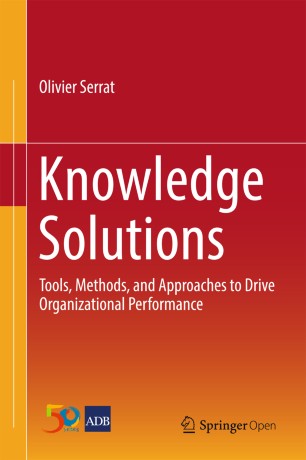
Knowledge Solutions : Tools, Methods, and Approaches to Drive Organizational Performance
Covers topics in knowledge management and competence in strategy development, management techniques, collaboration mechanisms, knowledge sharing and learning, as well as knowledge capture and storage. Presented in accessible “chunks,” it includes more than 120 topics that are essential to high-performance organizations. The extensive use of quotes by respected experts juxtaposed with relevant research to counterpoint or lend weight to key concepts; “cheat sheets” that simplify access and reference to individual articles; as well as the grouping of many of these topics under recurrent themes make this book unique. In addition, it provides scalable tried-and-tested tools, method and approaches for improved organizational effectiveness.
Java Challenges 100+ : Proven Tasks that Will Prepare You for Anything
Expand your knowledge of Java with this entertaining learning guide, which features 100+ exercises and programming challenges. Java Challenges will prepare you for your next exam or job interview, and covers many practical topics, such as strings, arrays, data structures, recursion, and date and time. The APIs and other material included in this book are Java 17 compatible. You will: Improve your Java knowledge by solving enjoyable but challenging programming puzzles / Solve mathematical problems, recursions, strings, arrays and more / Manage data processing and data structures like lists, sets, maps / Handle advanced recursion as well as binary trees, sorting and searching / Gamify key fundamentals for fun and easier reinforcement

Java : how to program. Late objects : Introducing Jshell
Introduction to Computers, the Internet and Java / Introduction to Java Applications; Input/Output and Operators / Control Statements: Part 1; Assignment, ++ and Operators / Control Statements: Part 2; Logical Operators / Methods / Arrays and ArrayLists / Introduction to Classes and Objects / Classes and Objects: A Deeper Look / Object-Oriented Programming: Inheritance / Object-Oriented Programming: Polymorphism and Interfaces / Exception Handling: A Deeper Look / JavaFX Graphical User Interfaces / JavaFX GUI / Strings, Characters and Regular Expressions / Files, Input/Output Streams, NIO and XML Serialization / Generic Collections / Lambdas and Streams / Recursion / Searching, Sorting and Big O / Generic Classes and Methods: A Deeper Look / Custom Generic Data Structures / JavaFX Graphics and Multimedia / Concurrency / Accessing Databases with JDBC / Introduction to JShell: Java 9's REPL for Interactive Java
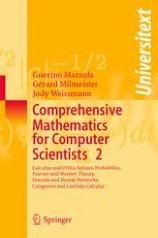
Comprehensive mathematics for computer scientists 2 : Calculus and ODEs, splines, probability, fourier and wavelet theory, fractals and neural networks, categories and lambda calculus
This second volume of a comprehensive tour through mathematical core subjects for computer scientists completes the first volume in two - gards: Part III first adds topology, di?erential, and integral calculus to the t- ics of sets, graphs, algebra, formal logic, machines, and linear geometry, of volume 1. With this spectrum of fundamentals in mathematical e- cation, young professionals should be able to successfully attack more involved subjects, which may be relevant to the computational sciences. In a second regard, the end of part III and part IV add a selection of more advanced topics. In view of the overwhelming variety of mathematical approaches in the computational sciences, any selection, even the most empirical, requires a methodological justi?cation. Our primary criterion has been the search for harmonization and optimization of thematic - versity and logical coherence. This is why we have, for instance, bundled such seemingly distant subjects as recursive constructions, ordinary d- ferential equations, and fractals under the unifying perspective of c- traction theory.
