



الصفحة 3
الصفحة 3

Intelligent interactive multimedia systems for e-Healthcare applications
includes high-quality research on various aspects of intelligent interactive multimedia technologies in healthcare services. The topics covered in the book focus on state-of-the-art approaches, methodologies, and systems in the design, development, deployment, and innovative use of multimedia systems, tools, and technologies in healthcare. The volume provides insights into smart healthcare service demands. It presents all information about multimedia uses in e-healthcare applications. The book also includes case studies and self-assessment problems for readers and future researchers. This book proves to be a valuable resource to know how AI can be an alternative tool for automated and intelligent analytics for e-healthcare applications.

Intelligent connectivity : AI, IoT, and 5G
Explores the economics and technology of AI, IOT, and 5G integration. Delivers a comprehensive technological and economic analysis of intelligent connectivity and the integration of artificial intelligence, Internet of Things (IoT), and 5G. It covers a broad range of topics, including Machine-to-Machine (M2M) architectures, edge computing, cybersecurity, privacy, risk management, IoT architectures, and more. Will also get access to: A thorough introduction to technology adoption and emerging trends in technology, including business trends and disruptive new applications / Comprehensive explorations of telecommunications transformation and intelligent connectivity, including learning algorithms, machine learning, and deep learning / Practical discussions of the Internet of Things, including its potential for disruption and future trends for technological development / In-depth examinations of 5G wireless technology, including discussions of the first five generations of wireless tech

Intelligent Algorithms in Ambient and Biomedical Computing
The rapid growth in electronic systems in the past decade has boosted research in the area of computational intelligence. As it has become increasingly easy to generate, collect, transport, process, and store huge amounts of data, the role of intelligent algorithms has become prominent in order to visualize, manipulate, retrieve, and interpret the data. For instance, intelligent search techniques have been developed to search for relevant items in huge collections of web pages, and data mining and interpretation techniques play a very important role in making sense out of huge amounts of biomolecular measurements. As a result, the added value of many modern systems is no longer determined by hardware only, but increasingly by the intelligent software that supports and facilitates the user in realizing his or her objectives.

Intelligence and Security Informatics ; Vol. 3975 ; IEEE International Conference on Intelligence and Security Informatics, ISI 2006, San Diego, CA, USA, May 23-24, 2006.
In the past few years, intelligence and security informatics (ISI) research, which is concerned with the study of the development and use of advanced information te- nologies and systems for national and international security-related applications, has experienced tremendous growth and attracted substantial interest from academic - searchers in related fields as well as practitioners from both government agencies and industry. The ISI community is maturing, and a core set of research methodologies and technical approaches has emerged and is becoming the underpinning of ISI research.

Intelligence and Security Informatics ; Vol. 3917 ; International Workshop, WISI 2006, Singapore, April 9, 2006, Proceedings
Intelligence and security informatics (ISI) can be broadly defined as the study of the development and use of advanced information technologies and systems for national and international security-related applications. The First and Second Symposiums on ISI were held in Tucson, Arizona, in 2003 and 2004, respectively. In 2005, the IEEE International Conference on ISI was held in Atlanta, Georgia. These ISI conferences brought together academic researchers, law enforcement and intelligence experts, information technology consultants and practitioners to discuss their research and practice related to various ISI topics including ISI data management, data and text mining for ISI applications, terrorism informatics, deception detection, terrorist and criminal social network analysis, crime analysis, monitoring and surveillance, policy studies and evaluation, and information assurance, among others. We continued these stream of ISI conferences by organizing the Workshop on Intelligence and Security Informatics (WISI 2006) in conjunction with the Pacific Asia Conference on Knowledge Discovery and Data Mining (PAKDD 2006).
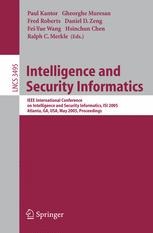
Intelligence and security informatics ; Vol. 3495 : IEEE International Conference on Intelligence and Security Informatics, ISI 2005, Atlanta, GA, USA, May 19-20, 2005, Proceedings
Intelligence and security informatics (ISI) can be broadly defined as the study of the development and use of advanced information technologies and systems for national and international security-related applications, through an integrated technological, organizational, and policy-based approach. In the past few years, ISI research has experienced tremendous growth and attracted substantial interest from academic researchers in related fields as well as practitioners from both government agencies and industry. The first two meetings (ISI 2003 and ISI 2004) in the ISI symposium and conference series were held in Tucson, Arizona, in 2003 and 2004, respectively. They provided a stimulating intellectual forum for discussion among previously disparate communities: academic researchers in information technologies, computer science, public policy, and social studies; local, state, and federal law enforcement and intelligence experts; and information technology industry consultants and practitioners.

Intelligence and security informatics ; Pacific Asia Workshop, PAISI 2007, Chengdu, China, April 11-12, 2007, Proceedings
Intelligence and security informatics (ISI) is concerned with the study of the development and use of advanced information technologies and systems for national, international, and societal security-related applications.

Intelligence and security informatics ; IEEE ISI 2008 International Workshops : PAISI, PACCF, and SOCO 2008, Taipei, Taiwan, June 17, 2008. Proceedings
This book constitutes the refereed proceedings of the three international workshops PAISI 2008, PACCF 2008, and SOCO 2008, held as satellite events of the IEEE International Conference on Intelligence and Security Informatics, ISI 2008, in Taipei, Taiwan, in June 2008.The 55 revised full papers presented were carefully reviewed and selected from the presentations at the workshops. The 21 papers of the Pacific Asia Workshop on Intelligence and Security Informatics (PAISI 2008) cover topics such as information retrieval and event detection, internet security and cybercrime, currency and data protection, cryptography, image and video analysis, privacy issues, social networks, modeling and visualization, and network intrusion detection.

Intelligence and security informatics ; 1st European Conference, EuroISI 2008, Esbjerg, Denmark, December 3-5, 2008. Proceedings
This book constitutes the refereed proceedings of the First European Conference on Intelligence and Security Informatics, EuroISI 2008, held in Esbjerg, Denmark, in December 2008.The 23 revised full papers and 2 revised poster papers presented were carefully reviewed and selected from 48 submissions. The papers are organized in topical sections on criminal and social network analysis, intelligence analysis and knowledge discovery, Web-based intelligence monitoring and analysis, privacy protection, access control, and digital rights management, malware and intrusion detection, as well as surveillance and crisis management.
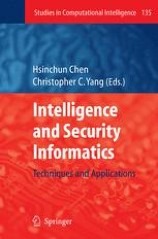
Intelligence and security informatics : Techniques and applications
This book, INTELLIGENCE and SECURITY INFORMATICS: TECHNIQUES & APPLICATIONS, presents a collection of works discussing terrorism informatics, information sharing, data mining, intelligence and crime analysis, infrastructure protection, privacy protection, information surveillance, and emergency response.

Intellectual Property in the Global Trading System : EU-China Perspective
Having explored multifaceted issues of IPR enforcement, this book argues that IPR enforcement problem is not an actual outcome of Confucian philosophy and "to steal a book" is not an "elegant offence." This book demonstrates that counterfeiting and piracy are common inevitable consequences of inadequate economic development and a by-product of a unique set of socioeconomic crises deriving from the development of a dysfunctional institutional regime. By examining areas of compatibilities between European and Chinese cultures and analysing painful lessons from the US-China negotiations over IPR protection.

Integration and innovation orient to e-society ; Vol.2 ; 7th IFIP International Conference on e-business, e-Services, and e-Society (I3E2007), October 10-12, Wuhan, China
The IFIP series publishes state-of-the-art results in the sciences and technologies of information and communication. The principal aim of the IFIP series is to encourage education and the dissemination and exchange of information about all aspects of computing.

Insurance distribution directive : A legal analysis
This book of the AIDA Europe Research Series on Insurance Law and Regulation offers the first comprehensive legal and regulatory analysis of the Insurance Distribution Directive (IDD).

Insider attack and cyber security : Beyond the hacker
This book sets an agenda for an ongoing research initiative to solve one of the most vexing problems encountered in computer security, and includes the following topics: critical IT infrastructure protection, insider threats, awareness and dealing with nefarious human activities in a manner that respects individual liberties and privacy policies of organizations while providing the best protection of critical resources and services. In some sense, the insider problem is the ultimate security problem. This volume concludes with technical and legal challenges facing researchers who study and propose solutions to mitigate insider attacks.

Innovative Tools and methods using BIM for an efficient renovation in buildings
This book describes a BIM-based toolkit that has been developed according to the latest research activities on building information modelling and semantic interoperability to optimize the building process. It highlights the impacts of using such new tools to fast renovation activities starting from the decision-making and design stages to the construction site management with the possibility to monitor occupants' and owners’ feedback during the realization process. In this process, a framework has been developed and implemented to allow stakeholders involved in a renovation project to efficiently compile, maintain, and add data about (i) building elements, (ii) building services systems, (iii) tenants, operators, and owners of the building, and (iv) current and predicted performance of the building from the various data sources available. The framework applies and specializes the existing practices in the Semantic Web, Linked Data, and ontology domain to the management of renovation projects. It has been designed to be open so that any system which implements the required functions and uses the specified conventions will be able to achieve semantic interoperability with other framework-compliant systems in the renovation domain. Finally, this book represents the validation process of the toolkit that has been held in three demo sites: a social housing building in Italy and two private residential buildings in Poland and Finland. The outcome shows that the toolkit facilitates the renovation process with relevant reductions of time, costs, and energy consumption and that the inhabitants can take advantage of the increase in building performances, quality, and comfort.

Innovations in rehabilitation sciences education : Preparing Leaders for the future
We are most fortunate to be housed in an institution that embraces risk taking and innovation in education. Part of the joy of working at McMaster University is the sense that you will be supported in your efforts to develop new ways of facilitating learning even if these are not always successful. We are privileged to work with a group of exceptional colleagues who embrace - novation and strive for ongoing excellence in education.

Innovation Capacity and the City : The Enabling Role of Design
This book represents one of the key milestones of DESIGNSCAPES: value creation through design-enabled innovation”. The book demonstrates that adopting design allows us to embed innovation within the city so as to arrive at feasible answers to complex global challenges. In this way, innovation can become disruptive, while also sparking a dynamic of gradual change in the “urbanscape” it acts within. To explore this potential, the book puts forward the concept of “design enabled innovation in urban environments” and examines the part that the city can play in promoting and facilitating the adoption of design among public and private sector innovators. This leads to a potential evaluation framework in which a given urbanscape is assessed both in terms of its capacity for generating innovation, and of the nature (more or less design-dependent or design-prone) of the innovative initiatives it hosts. This thread of reasoning holds many promising implications, including a possible “third way” between those who dream of an alternative economic model where revenues and growth are sacrificed on the altar of social and environmental respect, and the supporters of the traditional market-based view, who feel it is enough to add a touch of responsibility and concern to a system that should continue rewarding the profitability of innovations.

Information theory and machine learning
The recent successes of machine learning, especially regarding systems based on deep neural networks, have encouraged further research activities and raised a new set of challenges in understanding and designing complex machine learning algorithms. New applications require learning algorithms to be distributed, have transferable learning results, use computation resources efficiently, convergence quickly on online settings, have performance guarantees, satisfy fairness or privacy constraints, incorporate domain knowledge on model structures, etc. A new wave of developments in statistical learning theory and information theory has set out to address these challenges.

Information Systems Security and Privacy ; 5th International Conference, ICISSP 2019, Prague, Czech Republic, February 23-25, 2019, Revised Selected Papers
This book constitutes the revised selected papers of the 5th International Conference on Information Systems Security and Privacy, ICISSP 2019, held in Prague, Czech Republic, in February 2019. The 19 full papers presented were carefully reviewed and selected from a total of 100 submissions. The papers presented in this volume address various topical research, including new approaches for attack modelling andprevention, incident management and response, and user authentication andaccess control, as well as business and human-oriented aspects such as data pro-tection and privacy, and security awareness.

Information Systems Security ; Vol. 4332 ; 2nd International Conference, ICISS 2006, Kolkata, India, December 19-21, 2006, Proceedings
This book constitutes the refereed proceedings of the Second International Conference on Information Systems Security, ICISS 2006, held in Kolkata, India in December 2006. The 20 revised full papers and five short papers presented together with four invited papers and three ongoing project summaries were carefully reviewed and selected from 79 submissions. The papers discuss in depth the current state of the research and practice in information systems security.
