



الصفحة 3
الصفحة 3

Readings in Public Choice and Constitutional Political Economy
Public choice is the study of behavior at the intersection of economics and political science. Since the pioneering work of Duncan Black in the 1940s, public choice has developed a rich literature, drawing from such related perspectives as history, philosophy, law, and sociology, to analyze political decision making (by citizen-voters, elected officials, bureaucratic administrators, lobbyists, and other "rational" actors) in social and economic context, with an emphasis on identifying differences between individual goals and collective outcomes. Constitutional political economy provides important insights into the relationship between effective constitutions and the behavior of ordinary political markets.

Qualitative Theory of Planar Differential Systems
The book deals essentially with systems of polynomial autonomous ordinary differential equations in two real variables. The emphasis is mainly qualitative, although attention is also given to more algebraic aspects as a thorough study of the center/focus problem and recent results on integrability. In the last two chapters the performant software tool P4 is introduced: based on both algebraic manipulation and numerical calculation, this was conceived for the purpose of drawing "Polynomial Planar Phase Portraits" on part of the plane, or on a Poincaré compactification, or even on a Poincaré-Lyapunov compactification of the plane.From the start, differential systems are represented by vector fields enabling, in full strength, a dynamical systems approach. All essential notions, including invariant manifolds, normal forms, desingularization of singularities, index theory and limit cycles, are introduced and the main results are proved for smooth systems with the necessary specifications for analytic and polynomial systems.

Premiers pas en simulation = First steps in simulation
Why simulation techniques? Simulation methods, designed for use in statistics and operations research, have experienced and continue to develop rapidly due to the extraordinary evolution of computers. Applications are found in industry and in economics, or even social sciences, in particle physics, in astronomy and in many other fields. In many situations, whether in everyday life or in scientific research, the researcher is faced with problems which he seeks solutions on the basis of certain initial assumptions and constraints. To solve this type of problem, there exist analytical methods applicable to situations where the model makes it possible to treat the di? Erent variables by mathematically manageable equations, and numerical methods where the complexity of the model imposes a fragmentation of the problem, in particular by the identification of the various variables which come into play and the study of their interactions. This last approach is often accompanied by a large mass of calculations. Simulation techniques are numerical techniques: to simulate a phenomenon essentially means to carefully reconstruct its evolution.

Pharmacocinétique avec Mathematica® = Pharmacokinetics with Mathematica®
This work provides a computer method which allows you to calculate yourself the dispensing of a drug and to visualize the result by varying the ordinary parameters of the medical prescription. It is based on the practical use of Mathematica® as a single or repeated administration regardless of the route of administration in one or two distribution compartments. The traditional differential equations are all replaced by the Laplace transformation which also makes it possible to better differentiate the phenomenon of linearity and non-linearity. It also offers an introduction to population kinetics which, in essence, validates previous calculations and paves the way for modern use of pharmacokinetics for drugs that require greater precision of use. Students of medicine, science and pharmacy will benefit from reading this book, as will drug professionals.

Partial Differential Equations in Action : From Modelling to Theory
This book is designed as an advanced undergraduate or a first-year graduate course for students from various disciplines like applied mathematics, physics, engineering. The main purpose is on the one hand to train the students to appreciate the interplay between theory and modelling in problems arising in the applied sciences; on the other hand to give them a solid theoretical background for numerical methods, such as finite elements. Accordingly, this textbook is divided into two parts. The first one has a rather elementary character with the goal of developing and studying basic problems from the macro-areas of diffusion, propagation and transport, waves and vibrations. Ideas and connections with concrete aspects are emphasized whenever possible, in order to provide intuition and feeling for the subject. For this part, a knowledge of advanced calculus and ordinary differential equations is required.

Organic Nanostructures for Next Generation Devices
This book provides the first comprehensive overview of fabrication, fundamental properties and applications of a new class of nanoscaled organic materials which holds huge promise for future submicron-sized photonics and optoelectronics. By controlled self-assembled growth on single crystal surfaces, fiber-like structures are fabricated with macroscopic lengths up to millimeter size but mesoscopic widths of mere hundreds of nanometers and nanoscopic heights of several ten nanometers. The extraordinary beauty of these new structures is that they are quasi single crystalline, providing superior optical and electronic properties, and that their properties can be freely tailored via functionalization of their organic building blocks.

Ordinary Differential Equations with Applications to Mechanics
The present book has its source in the authors’ wish to create a bridge between the mathematical and the technical disciplines, which need a good knowledge of a strong mathematical tool. The necessity of such an interdisciplinary work drove the authors to publish a first book to this aim with Editura Tehnica, Bucharest, Romania.The present book is a new, English edition of the volume published in 1999. It contains many improvements concerning the theoretical (mathematical) information, as well as new topics, using enlarged and updated references. Only ordinary differential equations and their solutions in an analytical frame were considered, leaving aside their numerical approach.

Ordinary Differential Equations with Applications
Contains both theory and applications, with the applications interwoven with the theory throughout the text. The author also links ordinary differential equations with advanced mathematical topics such as differential geometry, Lie group theory, analysis in infinite-dimensional spaces and even abstract algebra.This edition incorporates corrections and improvements of the original text. New material includes a proof of the Grobman-Hartman theorem for flows based on the Lie derivative, more extensive treatment of the Euler-Lagrange equation and its applications, a proof of Noether's theorem on the existence of first integrals in the presence of symmetries and a new section on dynamic bifurcation with a proof of Pontryagin's formula. The impressive array of existing exercises has been more than doubled in size and further enhanced in scope, providing mathematics, physical science and engineering graduate students with a thorough introduction to the theory and application of ordinary differential equations.

On color
Investigates color from numerous perspectives: literary, historical, cultural, anthropological, philosophical, art historical, political, and scientific. In ten lively and wide-ranging chapters, each devoted to a different color, they examine the various ways colors have shaped and continue to shape our social and moral imaginations. Each individual color becomes the focal point for a consideration of one of the extraordinary ways in which color appears and matters in our lives. Beautifully produced in full color, this book is a remarkably smart, entertaining, and fascinating guide to this elusive topic.

Oculoplastics and Orbit
Considerable progress has been made in various fields of oculoplastic surgery, e.g. the development of endoscopic transcanalicular as well as endonasal minimal invasive techniques in lacrimal surgery, the use of muscle pedunculated scleral flaps to improve implant motility without pegging. This extraordinary volume enhances your understanding of Graves’ ophthalmopathy and helps you to define situations suitable for radiotherapy and more differentiated surgical strategies such as orbital fat resection, balance bony decompression and lid lengthening procedures. It exemplifies progress in aesthetic surgery such as endoscopic brow lift and soft techniques for mid-face rejuvenation and discusses general risks of infectious disease transmission using allografts as well as current concepts in the management of conjunctival neoplasms.

Numerical methods in computational finance : A partial differential equation (PDE/FDM) approach
This book is a detailed and step-by-step introduction to the mathematical foundations of ordinary and partial differential equations, their approximation by the finite difference method and applications to computational finance.
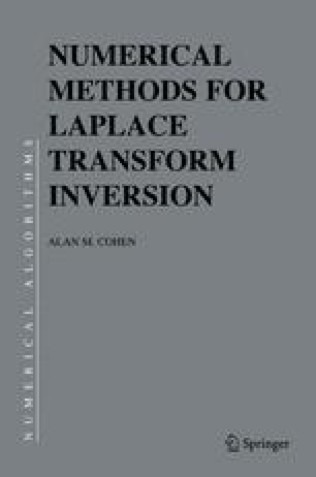
Numerical Methods for Laplace Transform Inversion
Operational methods have been used for over a century to solve many problems—for example, ordinary and partial differential equations. In many problems it is fairly easy to obtain the Laplace transform, but it can be very demanding to determine the inverse Laplace transform that is the solution of the given problem. Sometimes, after some difficult contour integration, we find that a series solution results, but even this may be quite difficult to evaluate in order to get an answer at a particular time value.

Neuroimmune Pharmacology
This exciting new textbook, Neuroimmune Pharmacology, reflects the history and vision of the Society on NeuroImmune Pharmacology and of the Society’s official publication, the Journal of Neuroimmune Pharmacology. All three represent deliberations arising from a relatively young, interdisciplinary, and dynamic field of research, which have major translational implications for neurodegenerative, neuroinflammatory, neuropsychiatric diseases, and infections of the nervous system. They all demonstrate the synergistic value of integrating the parts: Neuroscience, Immunology, and Pharmacology. The extraordinary accomplishment of Neuroimmune Pharmacology is its comprehensive nature.
Neural Information Processing ; 14th International Conference, ICONIP 2007, Kitakyushu, Japan, November 13-16, 2007, Revised Selected Papers, Part II
The 228 revised full papers presented were carefully reviewed and selected from numerous ordinary paper submissions and 15 special organized sessions. The 116 papers of the first volume are organized in topical sections on computational neuroscience, learning and memory, neural network models ,supervised /unsupervised/reinforcement learning, statistical learning algorithms, optimization algorithms, novel algorithms, as well as motor control and vision. The second volume contains 112 contributions related to statistical and pattern recognition algorithms, neuromorphic hardware and implementations, robotics, data mining and knowledge discovery, real world applications, cognitive and hybrid intelligent systems, bioinformatics, neuroinformatics, brain-conputer interfaces, and novel approaches.
Neural Information Processing ; 14th International Conference, ICONIP 2007, Kitakyushu, Japan, November 13-16, 2007, Revised Selected Papers, Part I
The 228 revised full papers presented were carefully reviewed and selected from numerous ordinary paper submissions and 15 special organized sessions. The 116 papers of the first volume are organized in topical sections on computational neuroscience, learning and memory, neural network models, supervised/unsupervised/reinforcement learning, statistical learning algorithms, optimization algorithms, novel algorithms, as well as motor control and vision. The second volume contains 112 contributions related to statistical and pattern recognition algorithms, neuromorphic hardware and implementations, robotics, data mining and knowledge discovery, real world applications, cognitive and hybrid intelligent systems, bioinformatics, neuroinformatics, brain-conputer interfaces, and novel approaches.

Nanotechnology for Smart Concrete
Nanomaterials can markedly improve the mechanical properties of concrete, as well as reduce the porosity and enhance the durability of concrete. The application of nanotechnology in concrete is still in its infancy. However, an ever-growing demand for ultra-high-performance concrete and recurring environmental pollution caused by ordinary Portland cement has encouraged engineers to exploit nanotechnology in the construction industry. Nanotechnology for Smart Concrete discusses the advantages and applications of nanomaterials in the concrete industry, including high-strength performance, microstructural improvement, self-healing, energy storage, and coatings. The book: Analyses the linkage of concrete materials with nanomaterials and nanostructures / Discusses the applications of nanomaterials in the concrete industry, including energy storage in green buildings, anti-corrosive coatings, and inhibiting pathogens and viruses / Covers self-healing concrete / Explores safety considerations, sustainability, and environmental impact of nanoconcrete / Includes an appendix of solved questions

Nanostructured Materials by High-Pressure Severe Plastic Deformation
Recently, it was reported that nanostructured materials processed under high pressure by HPT and ECAP have an extraordinary combination of both high strength and high ductility, which are two desirable, but rarely co-existing properties. These findings indicate that high-pressure is a critical factor that can be employed to process nanostructured materials with superior mechanical, and possibly also physical, properties. It is the objective of this workshop to review our current knowledge, identify issues for future research, and discuss future directions on the processing and properties of nanostructured materials via SPD techniques, with a special emphasis on high-pressure effects.

More Joel on software : Further toughts on diverse and occasionally related matters that will prove of interest to software developers, designers, and managers, and to those who, whether by good fortune or III Luck, work with them in some capacity
Joel Spolsky started his weblog in March 2000 in order to offer his insights, based on years of experience, on how to improve the world of programming. This weblog has become infamous among the programming world, and is linked to more than 600 other web sites and translated into 30+ languages! Spolsky's extraordinary writing skills, technical knowledge, and caustic wit have made him a programming guru. With the success of Joel on Software, there has been a strong demand for additional gems and advice, and this book is the answer to those requests. Containing a collection of all–new articles from the original, More Joel on Software has even more of an edge than the original, and the tips for running a business or managing people have far broader application than the software industry.

Modeling and Simulation in Scilab
Scilab is a free open-source software package for scientific computation. It includes hundreds of general purpose and specialized functions for numerical computation, organized in libraries called toolboxes, which cover such areas as simulation, optimization, systems and control, and signal processing. One important Scilab toolbox is Scicos. Scicos provides a block diagram graphical editor for the construction and simulation of dynamical systems. The objective of this book is to provide a tutorial for the use of Scilab/Scicos with a special emphasis on modeling and simulation tools. The book is divided into two parts. The first part concerns Scilab and includes a tutorial covering the language features, the data structures and specialized functions for doing graphics, importing, exporting data and interfacing external routines. It also covers in detail Scilab numerical solvers for ordinary differential equations and differential-algebraic equations. Even though the emphasis is placed on modeling and simulation applications, this part provides a global view of Scilab. The second part is dedicated to modeling and simulation of dynamical systems in Scicos. This type of modeling tool is widely used in industry because it provides a means for constructing modular and reusable models. This part contains a detailed description of the editor and its usage, which is illustrated through numerous examples.

Metric Spaces
This volume provides a complete introduction to metric space theory for undergraduates. It covers the topology of metric spaces, continuity, connectedness, compactness and product spaces, and includes results such as the Tietze-Urysohn extension theorem, Picard's theorem on ordinary differential equations, and the set of discontinuities of the pointwise limit of a sequence of continuous functions.
