



الصفحة 3
الصفحة 3
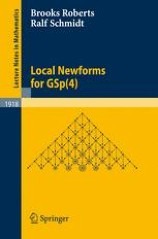
Local Newforms for GSp(4)
Local Newforms for GSp(4) describes a theory of new- and oldforms for representations of GSp(4) over a non-archimedean local field. This theory considers vectors fixed by the paramodular groups, and singles out certain vectors that encode canonical information, such as L-factors and epsilon-factors, through their Hecke and Atkin-Lehner eigenvalues. While there are analogies to the GL(2) case, this theory is novel and unanticipated by the existing framework of conjectures. An appendix includes extensive tables about the results and the representation theory of GSp(4).
Lectures on Advances in Combinatorics
The main focus of these lectures is basis extremal problems and inequalities – two sides of the same coin. Additionally they prepare well for approaches and methods useful and applicable in a broader mathematical context. Highlights of the book include a solution to the famous 4m-conjecture of Erdös/Ko/Rado 1938, one of the oldest problems in combinatorial extremal theory, an answer to a question of Erdös (1962) in combinatorial number theory "What is the maximal cardinality of a set of numbers smaller than n with no k+1 of its members pair wise relatively prime?", and the discovery that the AD-inequality implies more general and sharper number theoretical inequalities than for instance Behrend's inequality.

LATIN 2008 : Theoretical Informatics ; 8th Latin American Symposium, Búzios, Brazil, April 7-11, 2008. Proceedings
The Latin American Theoretical INformatics Symposium (LATIN) is becoming a traditional and high-quality conference on the Theory of Computing. Previous conferences havebeen organized twiceinBrazil: SaoPaulo (1992) and Campinas (1998); twice in Chile: Valpara so (1995) and Valdivia (2006); once in Uruguay: Punta del Este (2000); once in Mexico: Cancun (2002); and once in Argentina: Buenos Aires (2004). This volume contains the proceedings of the 8th Latin American Theore- cal INformatics Symposium (LATIN 2008), which was held in Buzio s, Rio de Janeiro, Brazil, April 7 11, 2008.
L’isomorphisme entre les tours de Lubin-Tate et de Drinfeld = The isomorphism between the Lubin-Tate and Drinfeld towers
This book contains a detailed and complete demonstration of the existence of an equivariate isomorphism between the Lubin-Tate and Drinfeld p-adic turns. The result is established in equal and unequal characteristics. There is also given as an application a proof that the equivariant cohomologies of these two turns are isomorphic, a result which has applications to the study of the local Langlands correspondence. During the proof, reminders and complements are given on the structure of the two preceding moduli spaces, the p-divisible formal groups and the p-adic rigid analytical geometry.
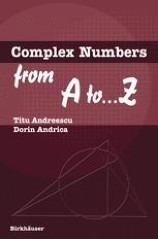
Complex Numbers from A to … Z
It is impossible to imagine modern mathematics without complex numbers. Complex Numbers from A to . . . Z introduces the reader to this fascinating subject that, from the time of L. Euler, has become one of the most utilized ideas in mathematics.The exposition concentrates on key concepts and then elementary results concerning these numbers. The reader learns how complex numbers can be used to solve algebraic equations and to understand the geometric interpretation of complex numbers and the operations involving them.The theoretical parts of the book are augmented with rich exercises and problems at various levels of difficulty. A special feature of the book is the last chapter, a selection of outstanding Olympiad and other important mathematical contest problems solved by employing the methods already presented.The book reflects the unique experience of the authors. It distills a vast mathematical literature, most of which is unknown to the western public, and captures the essence of an abundant problem culture.
Complex Analysis with Applications to Number Theory
The book discusses major topics in complex analysis with applications to number theory.It 's including the theory of several finitely and infinitely complex variables, hyperbolic geometry, two- and three-manifolds, and number theory. In addition to solved examples and problems, the book covers most topics of current interest, such as Cauchy theorems, Picard’s theorems, Riemann–Zeta function, Dirichlet theorem, Gamma function, and harmonic functions.
Complex Analysis : In the Spirit of Lipman Bers
In this book, the main focus is the theory of complex-valued functions of a single complex variable. This theory is a prerequisite for the study of many current and rapidly developing areas of mathematics including the theory of several and infinitely many complex variables, the theory of groups, hyperbolic geometry and three-manifolds, and number theory.
Compactifications of Symmetric and Locally Symmetric Spaces
Noncompact symmetric and locally symmetric spaces naturally appear in many mathematical theories, including analysis (representation theory, nonabelian harmonic analysis), number theory (automorphic forms), algebraic geometry (modulae) and algebraic topology (cohomology of discrete groups). In most applications it is necessary to form an appropriate compactification of the space. The literature dealing with such compactifications is vast. The main purpose of this book is to introduce uniform constructions of most of the known compactifications with emphasis on their geometric and topological structures. The book is divided into three parts. Part I studies compactifications of Riemannian symmetric spaces and their arithmetic quotients. Part II is a study of compact smooth manifolds. Part III studies the compactification of locally symmetric spaces.
Binary Quadratic Forms: An Algorithmic Approach
This book deals with algorithmic problems concerning binary quadratic forms 2 2 f(X,Y)= aX +bXY +cY with integer coe?cients a, b, c, the mathem- ical theories that permit the solution of these problems, and applications to cryptography.
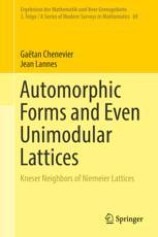
Automorphic forms and even unimodular lattices : Kneser neighbors of niemeier lattices
This book includes a self-contained approach of the general theory of quadratic forms and integral Euclidean lattices.It explains how the new advances in the Langlands program mentioned above pave the way for a solution. This study proves to be very rich, leading us to classical themes such as theta series, Siegel modular forms, the triality principle, L-functions and congruences between Galois representations.
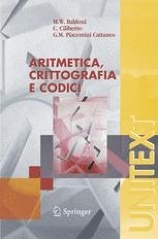
Aritmetica, crittografia e codici = Arithmetic, cryptography and codes
The basic techniques of algebra and number theory useful in recent applications to cryptography and codes are developed, with the aim of being elementary and self-sufficient. The emphasis is on computational problems. This part of the volume can be useful as a textbook for a first course in algebra for mathematicians, computer scientists or engineers. Important applications of algebra and geometry to cryptography and codes are then illustrated. Both, cryptography and codes have significant applications in daily life which are illustrated here. Cryptography is developed in detail in much of its classic and current aspects, and both private and public key cryptography are developed. Cryptography with the use of elliptic curves on finite fields is also illustrated. A chapter introducing the subject is dedicated to linear codes.
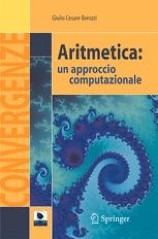
Aritmetica : Un approccio computazionale = Arithmetic : A computational approach
Intended to be a contribution to the algorithmic re-reading of some classic topics of elementary number theory and an invitation to more demanding reading, according to the indications provided by the bibliography annexed to it.
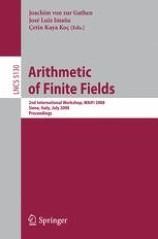
Arithmetic of finite fields ; 2nd International Workshop, WAIFI 2008 Siena, Italy, July 6-9, 2008 Proceedings
This book constitutes the refereed proceedings of the Second International Workshop on the Arithmetic of Finite Fields, WAIFI 2008, held in Siena, Italy, in July 2008.
Arithmetic of finite fields ; 1st International Workshop, WAIFI 2007, Madrid, Spain, June 21-22, 2007, Proceedings
This book presented structures in finite fields, efficient implementation and architectures, efficient finite field arithmetic, classification and construction of mappings over finite fields, curve algebra, cryptography, codes, and discrete structures.

Arakelov Geometry and Diophantine Applications
Bridging the gap between novice and expert, the aim of this book is to present in a self-contained way a number of striking examples of current diophantine problems to which Arakelov geometry has been or may be applied. Arakelov geometry can be seen as a link between algebraic geometry and diophantine geometry.The first chapters provide some background and introduction to the subject. These are followed by a presentation of different applications to arithmetic geometry. The final part describes the recent application of Arakelov geometry to Shimura varieties and the proof of an averaged version of Colmez's conjecture. This book thus blends initiation to fundamental tools of Arakelov geometry with original material corresponding to current research.
Applied Proof Theory : Proof Interpretations and Their Use in Mathematics
Ulrich Kohlenbach presents an applied form of proof theory that has led in recent years to new results in number theory, approximation theory, nonlinear analysis, geodesic geometry and ergodic theory (among others). This applied approach is based on logical transformations (so-called proof interpretations) and concerns the extraction of effective data (such as bounds) from prima facie ineffective proofs as well as new qualitative results such as independence of solutions from certain parameters, generalizations of proofs by elimination of premises. The book first develops the necessary logical machinery emphasizing novel forms of Gödel's famous functional ('Dialectica') interpretation. It then establishes general logical metatheorems that connect these techniques with concrete mathematics. Finally, two extended case studies (one in approximation theory and one in fixed point theory) show in detail how this machinery can be applied to concrete proofs in different areas of mathematics.

Analytic Number Theory : Lectures given at the C.I.M.E. Summer School held in Cetraro, Italy, July 11-18, 2002
The four contributions collected in this volume deal with several advanced results in analytic number theory. Friedlander’s paper contains some recent achievements of sieve theory leading to asymptotic formulae for the number of primes represented by suitable polynomials. Heath-Brown's lecture notes mainly deal with counting integer solutions to Diophantine equations, using among other tools several results from algebraic geometry and from the geometry of numbers. Iwaniec’s paper gives a broad picture of the theory of Siegel’s zeros and of exceptional characters of L-functions, and gives a new proof of Linnik’s theorem on the least prime in an arithmetic progression. Kaczorowski’s article presents an up-to-date survey of the axiomatic theory of L-functions introduced by Selberg, with a detailed exposition of several recent results.
An Introduction to Number Theory
An Introduction to Number Theory provides an introduction to the main streams of number theory. Starting with the unique factorization property of the integers, the theme of factorization is revisited several times throughout the book to illustrate how the ideas handed down from Euclid continue to reverberate through the subject. In particular, the book shows how the Fundamental Theorem of Arithmetic, handed down from antiquity, informs much of the teaching of modern number theory. The result is that number theory will be understood, not as a collection of tricks and isolated results, but as a coherent and interconnected theory. A number of different approaches to number theory are presented, and the different streams in the book are brought together in a chapter that describes the class number formula for quadratic fields and the famous conjectures of Birch and Swinnerton-Dyer. The final chapter introduces some of the main ideas behind modern computational number theory and its applications in cryptography.
An Introduction to Mathematical Cryptography
This self-contained introduction to modern cryptography emphasizes the mathematics behind the theory of public key cryptosystems and digital signature schemes. The book focuses on these key topics while developing the mathematical tools needed for the construction and security analysis of diverse cryptosystems. Only basic linear algebra is required of the reader; techniques from algebra, number theory, and probability are introduced and developed as required.

Algorithmic number theory ; 8th International Symposium, ANTS-VIII Banff, Canada, May 17-22, 2008 Proceedings
This book constitutes the refereed proceedings of the 8th International Algorithmic Number Theory Symposium, ANTS 2008, held in Banff, Canada, in May 2008.
