



الصفحة 3
الصفحة 3

Neuroprotection : Method and protocols
Contains cutting-edge molecular biology methods on neuroprotective mechanisms and specific preclinical models of the CNS injury, iseases and planning translation. Chapters guide readers through neuropathology, neuroprotection, Alzheimer’s disease, amyotrophic lateral sclerosis, ALS, Huntington’s disease , multiple sclerosis, Parkinson’s disease, spinal cord injury, traumatic brain injury, and ischemic brain injury. Written in the highly successful Methods in Molecular Biology series format, chapters include introductions to their respective topics, lists of the necessary materials and reagents, step-by-step, readily reproducible laboratory protocols, and tips on troubleshooting and avoiding known pitfalls.

Neuronal cell death : Methods and protocols
Covers comprehensive methods on ways to assess structural and ultrastructural changes in the mitochondria, cytoskeleton, and microglia using state-of-the-art microscopy techniques including super-resolution imaging, electron microscopy, and ultra-high field MRI. The chapters in this book cover topics such as analysis of neurodegeneration in the post-mortem characterization of preclinical animal models, in vivo modeling in cell death in different model systems and brain organoids, single cell clonal analysis using Mosaic Analysis with Double Markers in genetic mouse models, and genome and proteomic methods for analysis of mRNA dynamics and quantitation of targeted peptides.

Neuroacanthocytosis Syndromes II
Awareness of neuroacanthocytosis disorders has increased significantly in recent years. There have been a number of important developments in the field since the publication of the first volume, Neuroacanthocytosis Syndromes. This book contains the latest research in this area. Recent advances have identified the range of mutations in the causative genes, shedding light on potential phenotypegenotype correlations. Studies of the proteins affected in these disorders have resulted in increased understanding of their functions and distribution. In vitro studies have identified potential protein interactions, which have important implications for pathophysiology. Work on erythrocyte membranes suggests mechanisms for the generation of acanthocytes. Animal models are being generated which will greatly facilitate understanding the role of gene mutations in humans, and provide the foundation for possible therapeutic interventions. In addition, advances in other neurodegenerative disorders, such as Huntington’s and Parkinson’s diseases, have implications for neuroacanthocytosis.

Neural networks and deep learning
Covers both classical and modern models in deep learning. The primary focus is on the theory and algorithms of deep learning. The theory and algorithms of neural networks are particularly important for understanding important concepts, so that one can understand the important design concepts of neural architectures in different applications. Why do neural networks work? When do they work better than off-the-shelf machine-learning models? When is depth useful? Why is training neural networks so hard? What are the pitfalls? The book is also rich in discussing different applications in order to give the practitioner a flavor of how neural architectures are designed for different types of problems.

Neural Networks : Methodology and Applications
Neural networks represent a powerful data processing technique that has reached maturity and broad application. When clearly understood and appropriately used, they are a mandatory component in the toolbox of any engineer who wants make the best use of the available data, in order to build models, make predictions, mine data, recognize shapes or signals, etc. Ranging from theoretical foundations to real-life applications, this book is intended to provide engineers and researchers with clear methodologies for taking advantage of neural networks in industrial, financial or banking applications, many instances of which are presented in the book. For the benefit of readers wishing to gain deeper knowledge of the topics, the book features appendices that provide theoretical details for greater insight, and algorithmic details for efficient programming and implementation. The chapters have been written by experts ands seemlessly edited to present a coherent and comprehensive, yet not redundant, practically-oriented introduction.

Neural Networks : Computational Models and Applications
Neural Networks: Computational Models and Applications covers a wealth of important theoretical and practical issues in neural networks, including the learning algorithms of feed-forward neural networks, various dynamical properties of recurrent neural networks, winner-take-all networks and their applications in broad manifolds of computational intelligence: pattern recognition, uniform approximation, constrained optimization, NP-hard problems, and image segmentation. By presenting various computational models, this book is developed to provide readers with a quick but insightful understanding of the broad and rapidly growing areas in the neural networks domain. Besides laying down fundamentals on artificial neural networks, this book also studies biologically inspired neural networks. Some typical computational models are discussed, and subsequently applied to objection recognition, scene analysis and associative memory. The studies of bio-inspired models have important implications in computer vision and robotic navigation, as well as new efficient algorithms for image analysis.
Neural Information Processing ; 14th International Conference, ICONIP 2007, Kitakyushu, Japan, November 13-16, 2007, Revised Selected Papers, Part II
The 228 revised full papers presented were carefully reviewed and selected from numerous ordinary paper submissions and 15 special organized sessions. The 116 papers of the first volume are organized in topical sections on computational neuroscience, learning and memory, neural network models ,supervised /unsupervised/reinforcement learning, statistical learning algorithms, optimization algorithms, novel algorithms, as well as motor control and vision. The second volume contains 112 contributions related to statistical and pattern recognition algorithms, neuromorphic hardware and implementations, robotics, data mining and knowledge discovery, real world applications, cognitive and hybrid intelligent systems, bioinformatics, neuroinformatics, brain-conputer interfaces, and novel approaches.
Neural Information Processing ; 14th International Conference, ICONIP 2007, Kitakyushu, Japan, November 13-16, 2007, Revised Selected Papers, Part I
The 228 revised full papers presented were carefully reviewed and selected from numerous ordinary paper submissions and 15 special organized sessions. The 116 papers of the first volume are organized in topical sections on computational neuroscience, learning and memory, neural network models, supervised/unsupervised/reinforcement learning, statistical learning algorithms, optimization algorithms, novel algorithms, as well as motor control and vision. The second volume contains 112 contributions related to statistical and pattern recognition algorithms, neuromorphic hardware and implementations, robotics, data mining and knowledge discovery, real world applications, cognitive and hybrid intelligent systems, bioinformatics, neuroinformatics, brain-conputer interfaces, and novel approaches.

Neural and Neuroendocrine Mechanisms in Host Defense and Autoimmunity
This comprehensive volume, written by experts in the integrative fields of neuroscience, endocrinology and immunology, provides insight into the mechanisms by which neural and neuroendocrine factors influence susceptibility to infection and autoimmunity. The book focuses on multiple sclerosis as the prototypic autoimmune disease and discusses infectious diseases including anthrax, influenza virus, herpes virus and human immunodeficiency virus. The effects of stress on experimental models of multiple sclerosis and also clinical observations of stress in multiple sclerosis patients are discussed. Neural and Neuroendocrine Mechanisms in Host Defense and Autoimmunity is an ideal book for researches and professionals in the fields of immunology, neuroscience, infectious disease, psychology, microbiology, virology, public health and pharmaceutical sciences.
NETWORKING 2005. Networking Technologies, Services, and Protocols ; Performance of Computer and Communication Networks ; Mobile and Wireless Communications Systems ; 4th International IFIP-TC6 Networking Conference, Waterloo, Canada, May 2-6, 2005, Proceedings
This book constitutes the refereed proceedings of the 4th International IFIP-TC6 Networking Conference, NETWORKING 2005, held in Waterloo, Canada in May 2005. The 105 revised full papers and 36 posters were carefully reviewed and selected from 430 submissions. The papers are organized in topical sections on peer-to-peer networks, Internet protocols, wireless security, network security, wireless performance, network service support, network modeling and simulation, wireless LAN, optical networks, Internet performance and Web applications, ad-hoc networks, adaptive networks, radio resource management, Internet routing, queuing models, monitoring, network management, sensor networks, overlay multicast, QoS, wirless scheduling, multicast traffic management and engineering, mobility management, bandwith management, DCMA, and wireless resource management.

Networking -- ICN 2005 ; Vol. 3420 : 4th International Conference on Networking, Reunion Island, France, April 17-21, 2005, Proceedings, Part I
The International Conference on Networking (ICN 2005) was the fourth conf- ence in its series aimed at stimulating technical exchange in the emerging and important ?eld of networking. On behalf of the International Advisory C- mittee, it is our great pleasure to welcome you to the proceedings of the 2005 event. Networking faces dramatic changes due to the customer-centric view, the venue of the next generation networks paradigm, the push from ubiquitous n- working, and the new service models. Despite legacy problems, which researchers and industry are still discovering and improving the state of the art, the ho- zon has revealed new challenges that some of the authors tackled through their submissions. In fact ICN 2005 was very well perceived by the international networking community. A total of 651 papers from more than 60 countries were submitted, from which 238 were accepted. Each paper was reviewed by several members of the Technical Program Committee. This year, the Advisory Committee revalidated various accepted papers after the reviews had been incorporated. We perceived a signi?cant improvement in the number of submissions and the quality of the submissions. The ICN 2005 program covered a variety of research topics that are of current interest, starting with Gridnetworks, multicasting, TCP optimizations, QoS and security, emergency services, and network resiliency. The Program Committee selected also three tutorials and invited speakers that addressed the latest - search results from the international industries and academia, and reports on ?ndings from mobile, satellite, and personal communications related to 3rd- and 4th-generation research projects and standardization.

Network Models and Optimization : Multiobjective Genetic Algorithm Approach
Network Models and Optimization: Multiobjective Genetic Algorithm Approach extensively covers algorithms and applications, including shortest path problems, minimum cost flow problems, maximum flow problems, minimum spanning tree problems, travelling salesman and postman problems, location-allocation problems, project scheduling problems, multistage-based scheduling problems, logistics network problems, communication network problem, and network models in assembly line balancing problems, and airline fleet assignment problems.

Network and Parallel Computing ; IFIP International Conference, NPC 2008, Shanghai, China, October 18-20, 2008. Proceedings
This book constitutes the refereed proceedings of the IFIP International Conference on Network and Parallel Computing, NPC 2008, held in Shanghai, China in October 2008.The 32 revised full papers presented were carefully selected from over 140 submissions. The papers are organized in topical sections on network technologies; network applications; network and parallel architectures; parallel and distributed software.
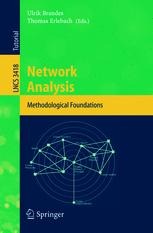
Network Analysis : Methodological Foundations
‘Network’ is a heavily overloaded term, so that ‘network analysis’ means different things to different people. Specific forms of network analysis are used in the study of diverse structures such as the Internet, interlocking directorates, transportation systems, epidemic spreading, metabolic pathways, the Web graph, electrical circuits, project plans, and so on. There is, however, a broad methodological foundation which is quickly becoming a prerequisite for researchers and practitioners working with network models. From a computer science perspective, network analysis is applied graph theory. Unlike standard graph theory books, the content of this book is organized according to methods for specific levels of analysis (element, group, network) rather than abstract concepts like paths, matchings, or spanning subgraphs. Its topics therefore range from vertex centrality to graph clustering and the evolution of scale-free networks. In 15 coherent chapters, this monograph-like tutorial book introduces and surveys the concepts and methods that drive network analysis, and is thus the first book to do so from a methodological perspective independent of specific application areas.

Navigational Surgery of the Facial Skeleton and Skull Base
Computer-assisted techniques in the surgery of the facial skeleton including the skull base are depicted for the very first time in this atlas of navigational surgery. Experienced surgeons as well as trainees will benefit from the detailed and well-illustrated information on the use of computer technology in clinical routine, accompanied by the experimental basis of intraoperative accuracy.The interdisciplinary approach brings together maxillofacial surgeons, plastic surgeons, ENT surgeons, and neurosurgeons. New methods of non-invasive referencing and the use of virtual models in the field of oral and cranio-maxillofacial surgery are demonstrated. Clinical cases illustrate the practical use of this new technique.
Natural Language Processing – IJCNLP 2004 ; 1st International Joint Conference, Hainan Island, China, March 22-24, 2004, Revised Selected Papers
This book constitutes the thoroughly refereed post-proceedings of the First International Joint Conference on Natural Language Processing, IJCNLP 2004, held in Hainan Island, China in March 2004. The 84 revised full papers presented in this volume were carefully selected during two rounds of reviewing and improvement from 211 papers submitted. The papers are organized in topical sections on dialogue and discourse; FSA and parsing algorithms; information extractions and question answering; information retrieval; lexical semantics, ontologies, and linguistic resources; machine translation and multilinguality; NLP software and applications, semantic disambiguities; statistical models and machine learning; taggers, chunkers, and shallow parsers; text and sentence generation; text mining; theories and formalisms for morphology, syntax, and semantics; word segmentation; NLP in mobile information retrieval and user interfaces; and text mining in bioinformatics.

Natural Disasters as Interactive Components of Global-Ecodynamics
This book opens a new approach to the study of global environmental changes having unfavourable character for mankind and other living systems. The main advantage of the book consists in the accumulation of knowledge from different sciences to parametrize the global ecodynamic process. Natural catastrophes are considered as an interactive element of global natural dynamics which are described by means of simulation models of global nature/society. The realization of this approach allows the integration within a complex structure of all international and national means of environmental monitoring and provides a tool for objective evaluation of the environmental quality. The main purpose of this book is to develop a universal information technology to estimate the state of environmental subsystems functioning under various climatic and anthropogenic conditions.

Nanoparticles in Biomedical Imaging : Emerging Technologies and Applications
Fundamental Biomedical Technologies features titles in multidisciplinary, technology-driven areas, providing the foundations for breakthrough advances in medicine and biology. The term technology refers, in a vigorously unrestrictive sense, to a broad array of engineering disciplines, the sciences of computation and informatics, mathematical models exploiting and advancing methods of mathematical physics, and the development of novel, experimental discovery devices. Titles in this series are designed and selected to provide high-level visionary input for specialists, while presenting overviews of emerging fields for those in related areas. Volumes in this series aim to provide technologists with the material to gain competent entry into biomedical research and biomedical researchers to understand and embrace novel technological foundations and tools.

Nano physical pharmaceutics
Nanomedicine is an emerging and rapidly evolving field, which could significantly help in early disease diagnosis, therapeutic improvement, novel therapeutic modality development, and medical expenditure reduction. The challenge remains, however, that the specially designed and carefully synthesized nanomedicines function poorly in animal verification despite great performance in vitro. A deeper understanding of the physicochemical properties of nanomedicine is the key. This book applies physical theories and models to determine the parameters for controlling the physicochemical properties of nanomedicines, including micelles, liposomes, and inorganic nanoparticles. Qualitative and quantitative relationships are established to provide guidance for nanomedicine design, characterization, and analysis. The text also compiles cutting-edge research in nanomedicine from the interdisciplinary team of the Department of Nanomedicine at Naval Medical University, China, which is currently establishing the characteristic discipline called Nano Physical Pharmaceutics. Edited by Wei Li, a prominent nanotechnology researcher, this book will appeal to anyone involved in nanotechnology, medicine, macromolecular science, biology, chemistry, and especially those with an interest in drug delivery or cancer therapy.

Multiwavelength Mapping of Galaxy Formation and Evolution ; Proceedings of the ESO Workshop Held at Venice, Italy, 13-16 October 2003
The possibilities of astronomical observation have dramatically increased over the last decade. Major satellites, like the Hubble Space Telescope, Chandra and XMM Newton, are complemented by numerous large ground-based observatories, from 8m-10m optical telescopes to sub-mm and radio facilities. As a result, observational astronomy has access to virtually the whole electromagnetic spectrum of galaxies, even at high redshifts. Theoretical models of galaxy formation and cosmological evolution now face a serious challenge to match the plethora of observational data. In October 2003, over 170 astronomers from 15 countries met for a 4-day workshop to extensively illustrate and discuss all major observational projects and ongoing theoretical efforts to model galaxy formation and evolution. This volume contains the complete proceedings of this meeting and is therefore a unique and timely overview of the current state of research in this rapidly evolving field.
