



الصفحة 3
الصفحة 3
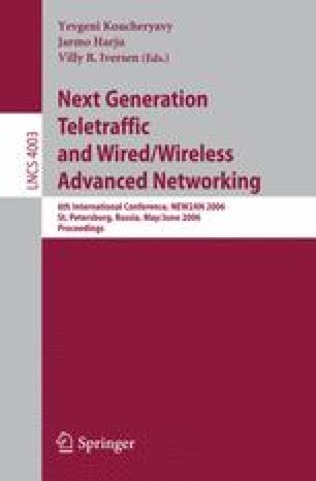
Next Generation Teletraffic and Wired ; 6th International Conference, NEW2AN 2006, St. Petersburg, Russia, May 29-June 2, 2006, Proceedings
This book constitutes the refereed proceedings of the 6th International Conference on Next Generation Teletraffic and Wired/Wireless Advanced Networking, NEW2AN 2006, held in St. Petersburg, Russia in May/June 2006. The book includes 49 revised full papers presented together with 2 keynote talks. The papers are organized in topical sections on teletraffic, traffic characterization and modeling, 3G/UMTS, sensor networks, WLAN, QoS, MANETs, lower layer techniques, PAN technologies, and TCP.

Next Generation Intelligent Optical Networks : From Access to Backbone
Next Generation Intelligent Optical Networks brings together two increasingly important topics: optical networks and network security. It provides a comprehensive treatment of the next generation optical network and a comprehensive treatment of cryptographic algorithms, the quantum optical network (including advanced topics such as teleportation), and how detection and countermeasure strategies may be used.

Next Generation Design and Verification Methodologies for Distributed Embedded Control Systems ; Proceedings of the GM R&D Workshop, Bangalore, India, January 2007
This volume is the proceedings of the workshop “Next Generation Design and Verification Methodologies for Distributed Embedded Control Systems” organised by General Motors R&D, India Science Lab. The workshop was held on January 5-6 2007 at the NIAS auditorium, IISc campus, Bangalore, India. This workshop is the first of its kind to be organised by an automotive major to bring together the leaders in the field of embedded systems development to present state-of-the-art work, and to discuss future strategies for addressing the increasing complexity of embedded control systems. The workshop consisted of invited talks given by leading experts and researchers from academic and industrial organizations.

New trends in computational vision and bio-inspired computing : Selected works presented at the ICCVBIC 2018, Coimbatore, India
Gathers selected, peer-reviewed original contributions presented at the International Conference on Computational Vision and Bio-inspired Computing (ICCVBIC) conference which was held in Coimbatore, India, on November 29-30, 2018. The works included here offer a rich and diverse sampling of recent developments in the fields of Computational Vision, Fuzzy, Image Processing and Bio-inspired Computing. The topics covered include computer vision; cryptography and digital privacy; machine learning and artificial neural networks; genetic algorithms and computational intelligence; the Internet of Things; and biometric systems, to name but a few. The applications discussed range from security, healthcare and epidemic control to urban computing, agriculture and robotics.

New Trends in Applied Artificial Intelligence ; 20th International Conference on Industrial, Engineering, and Other Applications of Applied Intelligent Systems. IEA/AIE 2007, Kyoto, Japan, June 26-29, 2007, Proceedings
The 20 International Conference on Industrial, Engineering and Other Applications of Applied Intelligent S- tems (IEA/AIE-2007) held in Kyoto, Japan presented such work performed by many scientists worldwide. The previous IEA/AIE conference held in Japan was the Ninth International Conference on Industrial and Engineering Applications of Arti?cial Intelligence and Expert systems (IEA/AIE-1996) in Fukuoka in 1996.
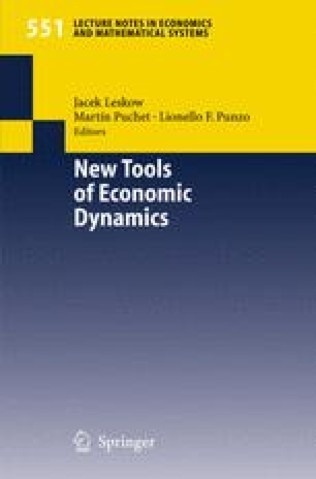
New Tools of Economic Dynamics
New Tools of Economic Dynamics gives an introduction and overview of recently developed methods and tools, most of them developed outside economics, to deal with the qualitative analysis of economic dynamics. It reports the results of a three-year research project by a European and Latin American network on the intersection of economics with mathematical, statistical, and computational methods and techniques. Focusing upon the evolution and manifold structure of complex dynamic phenomena, the book reviews and shows applications of a variety of tools, such as symbolic and coded dynamics, interacting agents models, microsimulation in econometrics, large-scale system analysis, and dynamical systems theory. It shows the potential of a comprehensive analysis of growth, fluctuations, and structural change along the lines indicated by pioneers like Harrod, Haavelmo, Hicks, Goodwin, Morishima, and it highlights the explanatory power of the qualitative approach they initiated.

New Stream Cipher Designs : The eSTREAM Finalists
The goal of eSTREAM was to promote the design of new stream ciphers with a particular emphasis on algorithms that would be either very fast in software or very resource-efficient in hardware. Algorithm designers were invited to submit new stream cipher proposals to eSTREAM, and 34 candidates were proposed from around the world. Over the following years the submissions were assessed with regard to both security and practicality by the cryptographic community, and the results were presented at major conferences and specialized workshops dedicated to the state of the art of stream ciphers.

New perspectives in critical data studies: the ambivalences of data power
Examines the ambivalences of data power. Firstly, the ambivalences between global infrastructures and local invisibilities challenge the grand narrative of the ephemeral nature of a global data infrastructure. They make visible local working and living conditions, and the resources and arrangements required to operate and run them. Secondly, the book examines ambivalences between the state and data justice. It considers data justice in relation to state surveillance and data capitalism, and reflects on the ambivalences between an “entrepreneurial state” and a “welfare state”. Thirdly, the authors discuss ambivalences of everyday practices and collective action, in which civil society groups, communities, and movements try to position the interests of people against the “big players” in the tech industry.

New Horizons of Parallel and Distributed Computing
Parallel and distributed computing is one of the foremost technologies for shaping future research and development activities in academia and industry. Hyperthreading in Intel processors, hypertransport links in next generation AMD processors, multicore silicon in today’s high-end microprocessors, emerging cluster and grid computing, has moved parallel/distributed computing into the mainstream of computing. New Horizons of Parallel and Distributed Computing is a collection of self-contained chapters written by pioneers and researchers to provide solutions for newly emerging problems in this field. This volume will not only provide novel ideas, work in progress and state-of-the-art techniques in the field, but also stimulate future research activities in the area of parallel and distributed computing with applications. New Horizons of Parallel and Distributed Computing is intended for researchers and graduate students in computer science and electrical engineering, as well as researchers and developers in industry. This book can be used as a textbook and a reference for use by students, researchers, and developers.
New Frontiers in Applied Artificial Intelligence ; 21st International Conference on Industrial, Engineering and Other Applications of Applied Intelligent Systems, IEA/AIE 2008 Wrocław, Poland, June 18-20, 2008 Proceedings
The 75 revised full papers presented were carefully reviewed and selected from 302 submissions. The papers are organized in topical sections on computer vision, fuzzy system applications, robot and manufacturing, data mining and KDS, neural networks, machine learning, natural language processing, internet application and education, heuristic search, application systems, agent-based system, evolutionary and genetic algorithms, knowledge management, and other applications. The book concludes with 15 contributions from the following special sessions: knowledge driven manufacturing systems, joint session on adaptive networked systems and fuzzy knowledge bases, and software agents and multi-agent systems.
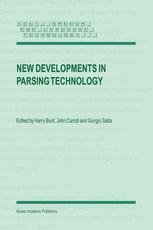
New Developments in Parsing Technology
Parsing can be defined as the decomposition of complex structures into their constituent parts, and parsing technology as the methods, the tools, and the software to parse automatically. Parsing is a central area of research in the automatic processing of human language. Parsers are being used in many application areas, for example question answering, extraction of information from text, speech recognition and understanding, and machine translation. New developments in parsing technology are thus widely applicable. This book contains contributions from many of today's leading researchers in the area of natural language parsing technology. The contributors describe their most recent work and a diverse range of techniques and results. This collection provides an excellent picture of the current state of affairs in this area. This volume is the third in a series of such collections, and its breadth of coverage should make it suitable both as an overview of the current state of the field for graduate students, and as a reference for established researchers.

New Developments in Computational Fluid Dynamics ; Proceedings of the Sixth International Nobeyama Workshop on the New Century of Computational Fluid Dynamics, Nobeyama, Japan, April 21 to 24, 2003
This volume contains 20 papers in Nobeyama Workshop focuses on predicting the next one hundred years of development of Fluid Dynamics, accounting for the current status and future trends of high performance computation and communication.

New Computational Paradigms ; 1st Conference on Computability in Europe, CiE 2005, Amsterdam, The Netherlands, June 8-12, 2005, Proceedings
This book constitutes the refereed proceedings of the first International Conference on Computability in Europe, CiE 2005, held in Amsterdam, The Netherlands in June 2005. The 68 revised full papers presented were carefully reviewed and selected from 144 submissions. Among them are papers corresponding to two tutorials, six plenary talks and papers of six special sessions involving mathematical logic and computer science at the same time as offering the methodological foundations for models of computation. The papers address many aspects of computability in Europe with a special focus on new computational paradigms. These include first of all connections between computation and physical systems (e.g., quantum and analog computation, neural nets, molecular computation), but also cover new perspectives on models of computation arising from basic research in mathematical logic and theoretical computer science.

New Computational Paradigms : Changing Conceptions of What is Computable
This book examines new developments in the theory and practice of computation from a mathematical perspective, with topics ranging from classical computability to complexity, from biocomputing to quantum computing. The book opens with an introduction by Andrew Hodges, the Turing biographer, who analyzes the pioneering work that anticipated recent developments concerning computation’s allegedly new paradigms. The remaining material covers traditional topics in computability theory such as relative computability, theory of numberings, and domain theory, in addition to topics on the relationships between proof theory, computability, and complexity theory.

New Computational Methods in Power System Reliability
Power system reliability is in the focus of intensive study due to its critical role in providing energy supply to the modern society. This book is not aimed at providing the overview of the state of the art in power system reliability. On the contrary, it describes application of some new specific techniques: universal generating function method and its combination with Monte Carlo simulation and with random processes methods, Semi-Markov and Markov reward models and genetic algorithm.

New Challenges in Applied Intelligence Technologies
This book includes 37 chapters which discuss examples of applications of intelligence technologies to five fields, reflecting main streams of practical and scientific interest of computer related community: agent and multi-agent systems; personal assistants and recom mender systems; knowledge modeling and processing; optimization and combinatorial problems; computer and telecommunication systems.

New Algorithms, Architectures and Applications for Reconfigurable Computing
New Algorithms, Architectures and Applications for Reconfigurable Computing consists of a collection of contributions from the authors of some of the best papers from the Field Programmable Logic conference (FPL’03) and the Design and Test Europe conference (DATE’03).

New Algorithms for Macromolecular Simulation
Molecular simulation is a widely used tool in biology, chemistry, physics and engineering. This book contains a collection of articles by leading researchers who are developing new methods for molecular modelling and simulation. Topics addressed here include: multiscale formulations for biomolecular modelling, such as quantum-classical methods and advanced solvation techniques; protein folding methods and schemes for sampling complex landscapes; membrane simulations; free energy calculation; and techniques for improving ergodicity. The book is meant to be useful for practitioners in the simulation community and for those new to molecular simulation who require a broad introduction to the state of the art.

Neuroscribe = نيوروسكرايب
Neuroscribe is a cutting-edge deep learning framework designed to address the complexities and inefficiencies encountered in existing frameworks like PyTorch and TensorFlow. Aimed at streamlining model development and enhancing performance across diverse hardware environments, NeuroScribe offers a lightweight and flexible solution. The framework features a robust tensor library, an auto-differentiation engine, a comprehensive neural network module, and advanced optimization algorithms. With built-in visualization tools and a user-friendly interface, NeuroScribe simplifies both beginner and advanced workflows. Its cross-platform compatibility, supported by CUDA and Metal Performance Shaders (MPS), ensures optimal performance, and in some scenarios, NeuroScribe demonstrates superior speed compared to leading frameworks. Additionally, NeuroScribe introduces unique libraries and features not found in other frameworks, further enhancing its versatility and appeal. The modular architecture and automatic system detection further enhance its adaptability, making NeuroScribe a versatile and powerful tool for deep learning practitioners.

Neural Networks in a Softcomputing Framework
This concise but comprehensive textbook provides a powerful and universal paradigm for information processing. Each chapter provides state-of-the-art descriptions of the important major research results of the respective neural-network methods. A range of relevant computational intelligence topics, such as fuzzy logic and evolutionary algorithms, are introduced. These are powerful tools for neural-network learning. Array signal processing problems are discussed in order to illustrate the applications of each neural-network model.
