



الصفحة 3
الصفحة 3
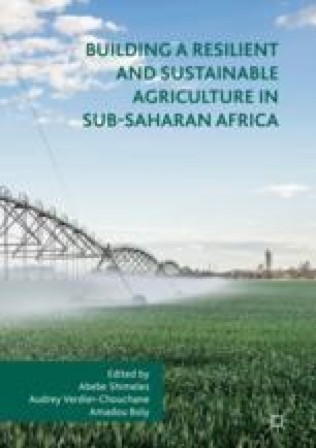
Building a Resilient and Sustainable Agriculture in Sub-Saharan Africa
What are the challenges and action points for agricultural sustainability in Sub-Saharan Africa? This collection of papers offers technical analyses, policy recommendations and an overview of success stories to date. Each carefully selected paper provides valuable insights for improved policy making and defines relevant strategic priorities on Africa’s sustainable transformation process, which is in line with the international development agenda. Although agriculture remains the main source of income for Africa’s population, the sector is rain-fed subjecting it to the vagaries of weather and climate change. This volume demonstrates the rationale of developing a competitive, inclusive and sustainable agribusiness sector for Africa’s food security and structural transformation.
Bringing the Jobless into Work? : Experiences with Activation Schemes in Europe and the US
Over the last decade, many industrialized countries shifted from passive unemployment and welfare benefit regimes and traditional active labor market and social policies to activation strategies by making benefit receipt conditional upon accepting job offers or participation in active labor market schemes. But countries differ with regard to the design of activation instruments and their implementation, the definition of target groups and the effects of activation in the national labor market setting. This volume provides an up-to-date overview of activation strategies in unemployment benefit systems and social assistance in selected European countries and the US. A particular focus lies on the development of activation schemes, governance and implementation as well as on the outcomes of activation in terms of labor market and social integration. The volume is the first to address these issues both from a socio-economic and a legal perspective.

Borderless Knowledge : Understanding the “New” Internationalisation of Research and Higher Education in Norway
this book analyses patterns of internationalisation comprising the national and supranational level, the level of higher education institutions and private companies, as well as the level of individual researchers and graduates. As a laboratory for studying internationalisation the book uses the case of Norway, a small knowledge system set in an open society, political system and economy. The case offers exceptionally good data on the developments in its research and higher education system that record changes over time and across the different parts and levels of a national knowledge system.
Bioeconomy and Global Inequalities Socio-Ecological Perspectives on Biomass Sourcing and Production
This book explores bioeconomy and bioenergy policies across South America, Asia and Europe. It discusses how a transition away from a fossil and towards a bio-based economic order alters, reinforces and challenges socio-ecological inequalities. A series of conceptual discussions and case studies with a multidisciplinary background in the Social Science illuminate how the deployment of biomass sources from the agricultural and forestry sectors affect societal changes concerning knowledge production, land and labour relations, political participation and international trade
Beyond global food supply chains : Crisis, disruption, regeneration
Through a set of incisive essays, this incredibly timely book shows how much the COVID-19 pandemic has exposed both vulnerabilities and opportunities - for (racial) capitalism and its discontents alike to intervene in food supply chains. A most welcome publication! This book takes the upheaval of the global COVID-19 pandemic as a springboard from which to interrogate a larger set of structural, environmental and political fault lines running through the global food system. In a context in which disruptions to the production, distribution, and consumption of food are figured as exceptions to the smooth, just-in-time efficiencies of global supply chains, these essays reveal the global food system as one that is inherently disruptive of human lives and flourishing, and of relationships between people, places, and environments. The pandemic thus represents a particular, acute moment of disruption, offering a lens on a deeper, longer set of systemic processes, and shining new light on transformational possibilities.

Applying the Kaizen in Africa : A New Avenue for Industrial Development
At present, how to develop industries is a burning issue in Africa, where population growth remains high and economic development has thus far failed to provide sufficient jobs for many, especially young people and women. The creation of productive jobs through industrial development ought to be a central issue in steering economic activity across the continent.The authors of this book, consisting of two development economists and five practitioners, argue that the adoption of Kaizen management practices, which originated in Japan and have become widely used by manufacturers in advanced and emerging economies, is decisively the most effective first step for industrial development in Africa.This open access book discusses what Kaizen management is, why it is applicable to Africa, and why it can provide Africa with a springboard for sustainable economic growth and employment generation.
Ages, generations and the social contract : The demographic challenges facing the welfare state
Our societies are ageing. The Family is changing. Labour force behaviour is evolving. How is the organisation of family and collective solidarity adapting in this context of longer life spans, low fertility, and work that is simultaneously scarce and abundant? The welfare states are currently facing three main challenges: ensure satisfactory living conditions for the elderly without increasing the cost burden on the active population, reduce social inequality, and maintain equity between successive generations. In this book, researchers from different countries compare their experiences and offer contrasting views on the future of social protection. They consider the theoretical aspects of the intergenerational debate, relations between generations within the family, the living standards of elderly people, and the question of social time.
A life cycle for clusters? : The dynamics of agglomeration, change, and adaption
The phenomenon of non-random spatial concentrations of firms in one or few related sectors (clusters) is intensively debated in economic theory and policy. The euphoria about successful clusters however neglects that historically, many thriving clusters did deteriorate into old industrial areas. This book studies the determinants of cluster survival by analyzing their adaptability to change in the economic environment. Linking theoretic knowledge with empirical observations, a simulation model (based in the N/K method) is developed, which explains when and why the cluster's architecture assists or hampers adaptability. It is found that architectures with intermediate degrees of division of labour and more collective governance forms foster adaptability. Cluster development is thus path dependent as architectures having evolved over time impact on the likelihood of future survival.
