



الصفحة 3
الصفحة 3

Numerical Techniques for Chemical and Biological Engineers Using MATLAB® : A Simple Bifurcation Approach
This book addresses the bifurcation characteristics of chemical and biological processes as the general case and treats systems with a unique steady state as special cases. It uses a system approach which is the most efficient for knowledge organization and transfer. The book develops mathematical models for many commercial processes utilizing the mass-, momentum-, and heat-balance equations coupled to the rates of the processes that take place within the boundaries of the system. The models are solved numerically through MATLAB codes with emphasis on the design and optimization of the chemical and biological industrial equipment and plants.

Numerical solution of Variational Inequalities by Adaptive Finite Elements
Franz-Theo Suttmeier describes a general approach to a posteriori error estimation and adaptive mesh design for finite element models where the solution is subjected to inequality constraints. This is an extension to variational inequalities of the so-called Dual-Weighted-Residual method (DWR method) which is based on a variational formulation of the problem and uses global duality arguments for deriving weighted a posteriori error estimates with respect to arbitrary functionals of the error. In these estimates local residuals of the computed solution are multiplied by sensitivity factors which are obtained from a numerically computed dual solution. The resulting local error indicators are used in a feed-back process for generating economical meshes which are tailored according to the particular goal of the computation.

Numerical Simulation of Mechatronic Sensors and Actuators
The second edition of this book fully preserves the character of the first edition to combine the detailed physical modeling of mechatronic systems and their precise numerical simulation using the Finite Element (FE) method. Most of the text and general appearance of the previous edition were retained, while the coverage was extended and the presentation improved. A large part of the book describes the application of the developed numerical calculation schemes to industrial problems, e.g.: analysis and optimization of electrodynamic loudspeakers. In these parts, new computational methods are included, and last but not least, this new edition contains a new chapter on computational aeroacoustics to study the complex phenomenon of flow induced noise.
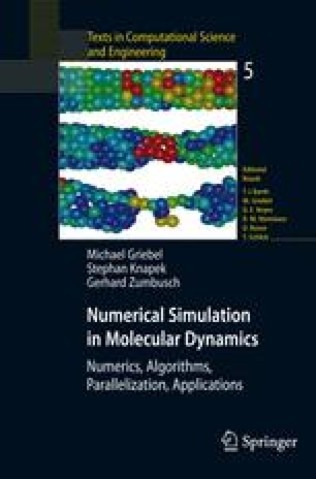
Numerical Simulation in Molecular Dynamics : Numerics, Algorithms, Parallelization, Applications
Particle models play an important role in many applications in physics, chemistry and biology. They can be studied on the computer with the help of molecular dynamics simulations. This book presents in detail both the necessary numerical methods and techniques (linked-cell method, SPME-method, tree codes, multipole technique) and the theoretical background and foundations. It illustrates the aspects modelling, discretization, algorithms and their parallel implementation with MPI on computer systems with distributed memory. Furthermore, detailed explanations are given to the different steps of numerical simulation, and code examples are provided.
Numerical partial differential equations for environmental scientists and engineers : A first practical course
This book concerns the practical solution of Partial Differential Equations (PDEs). It reflects an interdisciplinary approach to problems occurring in natural environmental media: the hydrosphere, atmosphere, cryosphere, lithosphere, biosphere and ionosphere. It assumes the reader has gained some intuitive knowledge of PDE solution properties and now wants to solve some for real, in the context of practical problems arising in real situations. The practical aspect of this book is the infused focus on computation. It presents two major discretization methods - Finite Difference and Finite Element. The blend of theory, analysis, and implementation practicality supports solving and understanding complicated problems. It is divided into three parts. Part I is an overview of Finite Difference Methods. Part II focuses on Finite Element Methods, including an FEM tutorial. Part III deals with Inverse Methods, introducing formal approaches to practical problems which are ill-posed.

Numerical Optimization : Theoretical and Practical Aspects
This book starts with illustrations of the ubiquitous character of optimization, and describes numerical algorithms in a tutorial way. It covers fundamental algorithms as well as more specialized and advanced topics for unconstrained and constrained problems. Most of the algorithms are explained in a detailed manner, allowing straightforward implementation. Theoretical aspects of the approaches chosen are also addressed with care, often using minimal assumptions. It's contains computational exercises in the form of case studies which help understanding optimization methods beyond their theoretical, description, when coming to actual implementation. Besides, the nonsmooth optimization part has been substantially reorganized and expanded.

Numerical methods in computational finance : A partial differential equation (PDE/FDM) approach
This book is a detailed and step-by-step introduction to the mathematical foundations of ordinary and partial differential equations, their approximation by the finite difference method and applications to computational finance.

Numerical Methods for General and Structured Eigenvalue Problems
The purpose of this book is to describe recent developments in solving eig- value problems, in particular with respect to the QR and QZ algorithms as well as structured matrices. Outline Mathematically speaking, the eigenvalues of a square matrix A are the roots of its characteristic polynomial det(A??I). An invariant subspace is a linear subspace that stays invariant under the action of A. In realistic applications, it usually takes a long process of simpli?cations, linearizations and discreti- tions before one comes up with the problem of computing the eigenvalues of a matrix. In some cases, the eigenvalues have an intrinsic meaning, e.g., for the expected long-time behavior of a dynamical system; in others they are just meaningless intermediate values of a computational method. The same applies to invariant subspaces, which for example can describe sets of initial states for which a dynamical system produces exponentially decaying states. Computing eigenvalues has a long history, dating back to at least 1846 when Jacobi [172] wrote his famous paper on solving symmetric eigenvalue problems. Detailed historical accounts of this subject can be found in two papers by Golub and van der Vorst [140, 327].
Numerical Methods for Controlled Stochastic Delay Systems
The Markov chain approximation methods are widely used for the numerical solution of nonlinear stochastic control problems in continuous time. This book extends the methods to stochastic systems with delays. Because such problems are infinite-dimensional, many new issues arise in getting good numerical approximations and in the convergence proofs. Useful forms of numerical algorithms and system approximations are developed in this work, and the convergence proofs are given. All of the usual cost functions are treated as well as singular and impulsive controls. A major concern is on representations and approximations that use minimal memory.
Numerical Continuation Methods for Dynamical Systems : Path following and boundary value problems
The book opens with a foreword by Herbert B. Keller and lecture notes by Sebius Doedel himself that introduce the basic concepts of numerical bifurcation analysis. The other chapters by leading experts discuss continuation for various types of systems and objects and showcase examples of how numerical bifurcation analysis can be used in concrete applications. Topics that are treated include: interactive continuation tools, higher-dimensional continuation, the computation of invariant manifolds, and continuation techniques for slow-fast systems, for symmetric Hamiltonian systems, for spatially extended systems and for systems with delay. Three chapters review physical applications: the dynamics of a SQUID, global bifurcations in laser systems, and dynamics and bifurcations in electronic circuits.

Numeri e Crittografia
Number Theory is one of the most classic fields of Mathematics. The numbers he deals with are those that are called natural 0, 1, 2, ... and that we use since childhood to count. Seemingly simple and harmless, they nevertheless hide some of the most difficult and exciting mysteries of the whole of mathematics. Cryptography, on the other hand, is concerned with hiding the content of confidential communications from prying eyes and corresponds to widespread needs in our society. The Theory of Numbers can help Cryptography in these needs, thanks to the mysteries that still surround it. The text gives an account of this link. It first introduces Modern Cryptography, its goals and priorities. He then goes on to expose arguments of Number Theory, with particular reference to the two problems of recognizing prime numbers, and of decomposing a natural into its prime factors; for each of the two issues it provides a vast panorama of the algorithms that deal with it and try to solve it as effectively as possible. In particular, it presents the very recent AKS procedure for recognizing prime numbers. The book then returns to Cryptography and shows how ideas and methods of Number Theory apply to the construction of reliable procedures for the secure transmission of confidential information.

Nucleic Acids Hybridization : Modern Applications
Several approaches, such as microarray hybridization, have become extremely popular tools for specialists in biochemistry and biomedicine, while the potential of many other advantageous techniques seems to be underestimated. Written by an international team of authors, this book details the current state-of-art in hybridization techniques. Coverage includes experimental protocols along with comprehensive and detailed method descriptions.

Nucleation and Atmospheric Aerosols ; 17th International Conference, Galway, Ireland, 2007
Atmospheric particles are ubiquitous in the atmosphere: they form the seeds for cloud droplets and they form haze layers, blocking out incoming radiation and contributing to a partial cooling of our climate. They also contribute to poor air quality and health impacts. This book brings together the leading experts from the nucleation and atmospheric aerosols research communities to present the current state-of-the-art knowledge in these related fields.

Nuclear pre-mRNA Processing in Plants
In recent years nuclear pre-mRNA processing has taken center stage as an important regulator of gene expression and ultimately growth and development. Large-scale genome and cDNA sequencing projects together with bioinformatic analyses of these sequences have revealed that alternative splicing of pre-mRNAs contributes greatly to transcriptome and proteome complexity in eukaryotes. During the last few years, tremendous progress has been made in understanding various aspects of pre-mRNA processing including alternative splicing and its importance in plant growth and development as well as in plant responses to hormones and stresses. This book, with contributions from leading scientists in this area, summarizes recent advances in nuclear pre-mRNA processing in plants. It provides researchers in the field, as well as those in related areas, with an up-to-date and comprehensive, yet concise, overview of the current status and future potential of this research in understanding plant biology.

Nuclear Medicine Technology : Review Questions for the Board Examinations
Nuclear medicine technology has been a fascinating subject ever since the early rectilinear scanner produced images, and is becoming ever more interesting (and demanding) with the growth of positron emission tomography and other molecular imaging. Taking and passing the exam offered by the Nuclear Medicine Technology Certi? cation Board (NMTCB), or that offered by the American Registry of Radiologic Techno- gists (ARRT), is the ? nal step in reaching the status of Nuclear M edicine Technologist. These exams are both challenging and the breadth of knowledge that they cover mean that a th- ough review is in order before attempting either exam. This book was created to assist in preparation for those exams. In addition to recalling information, the questions require application of information, and analysis of situations.

Nuclear fusion research : Understanding plasma-Surface interactions
It became clear in the early days of fusion research that the effects of the containment vessel (erosion of "impurities") degrade the overall fusion plasma performance. Progress in controlled nuclear fusion research over the last decade has led to magnetically confined plasmas that, in turn, are sufficiently powerful to damage the vessel structures over its lifetime. This book reviews current understanding and concepts to deal with this remaining critical design issue for fusion reactors. It reviews both progress and open questions, largely in terms of available and sought-after plasma-surface interaction data and atomic/molecular data related to these "plasma edge" issues.

Nuclear Fission and Cluster Radioactivity : An Energy-Density Functional Approach
It is the first application to nuclear physics from energy-density functional method, for which Professor Walter Kohn received the Nobel Prize in Chemistry. The book presents a comprehensive extension of the Bohr-Wheeler theory with the present knowledge of nuclear density distribution function.

Novel Trends in Brain Science : Brain Imaging, Learning and Memory, Stress and Fear, and Pain
With the development of neural science, knowledge of the molecules and neurons that comprise the brain has increased exponentially in the past two decades. In Novel Trends in Brain Science, leading neuroscientists from Japan and Taiwan describe the latest and most relevant research in brain science, including state-of-the-art brain-imaging technologies such as fMRI, MR-DTI, TMS, and MEG, and also discuss learning, memory, emotions, and pain. With a wide range of contributors, the book presents valuable insights into functional neuroimaging, white matter tractography, synaptic plasticity, emoti.

Novel drug delivery systems : Fundamentals and applications
Serves as a unique resource on the field of novel drug delivery systems (NDDSs). The evolving nature of diseases and the emergence of new health complications have driven a significant shift in drug therapy. Coupled with changes in human lifestyles and economic conditions, these factors have compelled the pharmaceutical industry to develop novel, efficient, and affordable drug products. The rise of promising technologies aimed at enhancing therapeutic performance further underscores the importance of novel drug delivery systems (NDDSs), making this field one of the most dynamic in pharmaceutical sciences today.

Novel Carrier Systems for Targeted and Controlled Drug Delivery
Presents novel carrier systems for the targeted and controlled drug delivery for the treatment of various diseases which are difficult to be treated with conventional drug delivery systems like cancer, autoimmune disorders, and emerging infectious diseases. It also reviews the origins and applications of stimuli-responsive polymer systems and polymer therapeutics such as polymer-protein and polymer-drug conjugates. The book also explores the potential applications of the parenteral route of administration for the delivery of active pharmaceutical substances with a narrow therapeutic index and poor bioavailability. Further, the book presents common routes of administration for the systemic delivery of peptides and proteins. It also examines the applications of various implantable systems in drug delivery. The book also covers the important colloidal drug delivery systems, including liposomes and niosomes and solid lipid nanoparticles, and nanostructured lipid carriers.
