



الصفحة 3
الصفحة 3

Information and communication technologies and real-life learning : New education for the knowledge society
The IFIP series publishes state-of-the-art results in the sciences and technologies of information and communication. The scope of the series includes: foundations of computer science; software theory and practice; education; computer applications in technology; communication systems; systems modeling and optimization; information systems; computers and society; computer systems technology; security and protection in information processing systems; artificial intelligence; and human-computer interaction. Proceedings and post-proceedings of referred international conferences in computer science and interdisciplinary fields are featured. These results often precede journal publication and represent the most current research. The principal aim of the IFIP series is to encourage education and the dissemination and exchange of information about all aspects of computing.

Industrial applications of semantic web ; Proceedings of the 1st International IFIP/WG12.5 Working Conference on Industrial Applications of Semantic Web, August 25-27, 2005 Jyvaskyla, Finland
The IFIP series publishes state-of-the-art results in the sciences and technologies of information and communication. The scope of the series includes: foundations of computer science; software theory and practice; education; computer applications in technology; communication systems; systems modeling and optimization; information systems; computers and society; computer systems technology; security and protection in information processing systems; artificial intelligence; and human-computer interaction. Proceedings and post-proceedings of referred international conferences in computer science and interdisciplinary fields are featured. These results often precede journal publication and represent the most current research. The principal aim of the IFIP series is to encourage education and the dissemination and exchange of information about all aspects of computing.
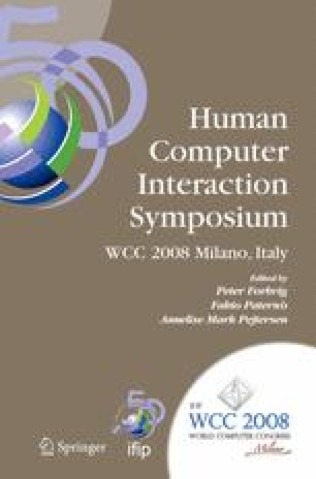
Human-computer interaction Symposium ; IFIP 20th World Computer Congress, Proceedings of the 1st TC 13 Human-Computer Interaction Symposium (HCIS 2008), September 7-10, 2008, Milano, Italy
The IFIP series publishes state-of-the-art results in the sciences and technologies of information and communication. The scope of the series includes: foundations of computer science; software theory and practice; education; computer applications in technology; communication systems; systems modeling and optimization; information systems; computers and society; computer systems technology; security and protection in information processing systems; artificial intelligence; and human-computer interaction. Proceedings and post-proceedings of refereed international conferences in computer science and interdisciplinary fields are featured.

Human work interaction design : Designing for human work ; The 1st IFIP TC 13.6 WG Conference: Designing for Human Work, February 13-15, 2006, Madeira, Portugal
International Federation for Information Processing The IFIP series publishes state-of-the-art results in the sciences and technologies of information and communication. The scope of the series includes: foundations of computer science; software theory and practice; education; computer applications in technology; communication systems; systems modeling and optimization; information systems; computers and society; computer systems technology; security and protection in information processing systems; artificial intelligence; and human-computer interaction. Proceedings and post-proceedings of referred international conferences in computer science and interdisciplinary fields are featured. These results often precede journal publication and represent the most current research. The principal aim of the IFIP series is to encourage education and the dissemination and exchange of information about all aspects of computing.

Home-oriented informatics and telematics ; Proceedings of the IFIP WG 9.3 HOIT2005 Conference
The IFIP series publishes state-of-the-art results in the sciences and technologies of information and communication. The scope of the series includes: foundations of computer science; software theory and practice; education; computer applications in technology; communication systems; systems modeling and optimization; information systems; computers and society; computer systems technology; security and protection in information processing systems; artificial intelligence; and human-computer interaction. Proceedings and post-proceedings of referred international conferences in computer science and interdisciplinary fields are featured. These results often precede journal publication and represent the most current research. The principal aim of the IFIP series is to encourage education and the dissemination and exchange of information about all aspects of computing.

Home Networking ; 1st IFIP WG 6.2 Home Networking Conference (IHN’2007), Paris, France, December 10–12, 2007
The IFIP series publishes state-of-the-art results in the sciences and technologies of information and communication. The scope of the series includes: foundations of computer science; software theory and practice; education; computer applications in technology; communication systems; systems modeling and optimization; information systems; computers and society; computer systems technology; security and protection in information processing systems; artificial intelligence; and human-computer interaction. Proceedings and post-proceedings of referred international conferences in computer science and interdisciplinary fields are featured.

History of Nordic computing ; IFIP WG9.7 ; 1st Working conference on the history of Nordic computing (HiNC1), June 16-18, 2003, Trondheim, Norway
The IFIP series publishes state-of-the-art results in the sciences and technologies of information and communication. The scope of the series includes: foundations of computer science; software theory and practice; education; computer applications in technology; communication systems; systems modeling and optimization; information systems; computers and society; computer systems technology; security and protection in information processing systems; artificial intelligence; and human-computer interaction. Proceedings and post-proceedings of referred international conferences in computer science and interdisciplinary fields are featured. These results often precede journal publication and represent the most current research. The principal aim of the IFIP series is to encourage education and the dissemination and exchange of information about all aspects of computing.

History of Computing and Education 3 (Hce3) ; IFIP 20th World Computer Congress, Proceedings of the Third IFIP Conference on the History of Computing and Education WG 9.7/TC9, History of Computing, September 7–10, 2008, Milano, Italy
The IFIP series publishes state-of-the-art results in the sciences and technologies of information and communication. The scope of the series includes: foundations of computer science; software theory and practice; education; computer applications in technology; communication systems; systems modeling and optimization; information systems; computers and society; computer systems technology; security and protection in information processing systems; artificial intelligence; and human-computer interaction. Proceedings and post-proceedings of refereed international conferences in computer science and interdisciplinary fields are featured. These results often precede journal publication and represent the most current research.

History of computing and education 2 (HCE2) ; IFIP 19th World Computer Congress, WG 9.7, TC 9: History of computing, Proceedings of the 2nd Conference on the history of computing and education, August 21-24, Santiago, Chile
International Federation for Information Processing The IFIP series publishes state-of-the-art results in the sciences and technologies of information and communication. The scope of the series includes: foundations of computer science; software theory and practice; education; computer applications in technology; communication systems; systems modeling and optimization; information systems; computers and society; computer systems technology; security and protection in information processing systems; artificial intelligence; and human-computer interaction. Proceedings and post-proceedings of referred international conferences in computer science and interdisciplinary fields are featured. These results often precede journal publication and represent the most current research. The principal aim of the IFIP series is to encourage education and the dissemination and exchange of information about all aspects of computing.

High performance computational science and engineering : IFIP TC5 Workshop on High Performance Computational Science and Engineering (HPCSE), World Computer Congress, August 22-27, 2004, Toulouse, France
The IFIP series publishes state-of-the-art results in the sciences and technologies of information and communication. The scope of the series includes: foundations of computer science; software theory and practice; education; computer applications in technology; communication systems; systems modeling and optimization; information systems; computers and society; computer systems technology; security and protection in information processing systems; artificial intelligence; and human-computer interaction. Proceedings and post-proceedings of referred international conferences in computer science and interdisciplinary fields are featured. These results often precede journal publication and represent the most current research. The principal aim of the IFIP series is to encourage education and the dissemination and exchange of information about all aspects of computing.

Handbook of neurochemistry and molecular neurobiology : Neurotransmitter Systems
The brain is the organ that collects information from the environment, processes and stores the information, and generates behavior as and when needed. In essence, the brain makes us who we are. For this reason, understanding the biology of brain function is a great challenge and a major goal of modern science. The brain is one of the last great frontiers in science, and the unraveling of its mysteries is comparable in complexity to efforts in space exploration. A fundamental goal of neuroscience is to understand how neurons generate behavior and the pathophysiology of different mental and neurological diseases. This requires, among other things, information about where these neurons are located, how they are connected, and how they communicate with each other in various physiological and pathophysiological conditions. Our aim is to describe recent discoveries about the basic operations of the brain and to provide an introduction to the adaptations for specific types of information processing.

Handbook of mathematics
This guide book to mathematics contains in handbook form the fundamental working knowledge of mathematics which is needed as an everyday guide for working scientists and engineers, as well as for students. Easy to understand, and convenient to use, this guide book gives concisely the information necessary to evaluate most problems which occur in concrete applications. In the newer editions emphasis was laid on those fields of mathematics that became more important for the formulation and modeling of technical and natural processes, namely Numerical Mathematics, Probability Theory and Statistics, as well as Information Processing. For the 5th edition, the chapters "Computer Algebra Systems" and "Dynamical Systems and Chaos" were fundamentally revised, updated and expanded. In the chapter "Algebra and Discrete Mathematics" a section on "Finite Fields and Shift Registers" was added.

Fuzzy systems and knowledge discovery ; Vol. 3614 ; 2nd International Conference, FSKD 2005, Changsha, China, August 27-29, 2005, Proceedings, Part II
This book and its sister volume, LNAI 3613 and 3614, constitute the proce- ings of the Second International Conference on Fuzzy Systems and Knowledge Discovery (FSKD 2005), jointly held with the First International Conference on Natural Computation (ICNC 2005, LNCS 3610, 3611, and 3612) from - gust 27–29, 2005 in Changsha, Hunan, China. FSKD 2005 successfully attracted 1249 submissions from 32 countries/regions (the joint ICNC-FSKD 2005 received 3136 submissions). After rigorous reviews, 333 high-quality papers, i. e. , 206 long papers and 127 short papers, were included in the FSKD 2005 proceedings, r- resenting an acceptance rate of 26. 7%. The ICNC-FSKD 2005 conference featured the most up-to-date research - sults in computational algorithms inspired from nature, including biological, e- logical, and physical systems. It is an exciting and emerging interdisciplinary area in which a wide range of techniques and methods are being studied for dealing with large, complex, and dynamic problems. The joint conferences also promoted cross-fertilization over these exciting and yet closely-related areas, which had a signi?cant impact on the advancement of these important technologies. Speci?c areas included computation with words, fuzzy computation, granular com- tation, neural computation, quantum computation, evolutionary computation, DNA computation, chemical computation, information processing in cells and tissues, molecular computation, arti?cial life, swarm intelligence, ants colony, arti?cial immune systems, etc. , with innovative applications to knowledge d- covery, ?nance, operations research, and more.

Fuzzy systems and knowledge discovery ; Vol. 3613 ; 2nd International Conference, FSKD 2005, Changsha, China, August 27-29, 2005, Proceedings, Part I
This book and its sister volume, LNAI 3613 and 3614, constitute the proce- ings of the Second International Conference on Fuzzy Systems and Knowledge Discovery (FSKD 2005), jointly held with the First International Conference on Natural Computation (ICNC 2005, LNCS 3610, 3611, and 3612) from - gust 27–29, 2005 in Changsha, Hunan, China. FSKD 2005 successfully attracted 1249 submissions from 32 countries/regions (the joint ICNC-FSKD 2005 received 3136 submissions). After rigorous reviews, 333 high-quality papers, i. e. , 206 long papers and 127 short papers, were included in the FSKD 2005 proceedings, r- resenting an acceptance rate of 26. 7%. The ICNC-FSKD 2005 conference featured the most up-to-date research - sults in computational algorithms inspired from nature, including biological, e- logical, and physical systems. It is an exciting and emerging interdisciplinary area in which a wide range of techniques and methods are being studied for dealing with large, complex, and dynamic problems. The joint conferences also promoted cross-fertilization over these exciting and yet closely-related areas, which had a signi?cant impact on the advancement of these important technologies. Speci?c areas included computation with words, fuzzy computation, granular com- tation, neural computation, quantum computation, evolutionary computation, DNA computation, chemical computation, information processing in cells and tissues, molecular computation, arti?cial life, swarm intelligence, ants colony, arti?cial immune systems, etc. , with innovative applications to knowledge d- covery, ?nance, operations research, and more.

Fundamentals of quantum optics and quantum information
This book is an introduction to the two closely related subjects of quantum optics and quantum information. Essentially, the physical aspects of quantum information processing have now become an integral part of quantum optics.

Frontiers in Algorithmics ; 2nd Annual International Workshop, FAW 2008, Changsha, China, June 19-21, 2008, Proceeedings
This book constitutes the refereed proceedings of the Second International Frontiers of Algorithmics Workshop, FAW 2008, held in Changsha, China, in June 2008.The 33 revised full papers presented together with the abstracts of 3 invited talks were carefully reviewed and selected from 80 submissions. The papers were selected for 9 special focus tracks in the areas of biomedical informatics, discrete structures, geometric information processing and communication, games and incentive analysis.

Frontiers in Algorithmics ; 1st Annual International Workshop, FAW 2007, Lanzhou, China, August 1-3, 2007, Proceedings
This book constitutes the refereed proceedings of the First Annual International Frontiers of Algorithmics Workshop, FAW 2007, held in Lanzhou, China in August 2007. The 33 revised full papers presented were carefully reviewed and selected from 141 submissions.

From Specification to Embedded Systems Application
Application documents recent approaches and results presented at the International Embedded Systems Symposium (IESS 2005), which was held in August 2005 in Manaus (Brazil) and sponsored by International Federation for Information Processing (IFIP). The topics which have been chosen for this working conference are very timely: design methodology, modeling, specification, software synthesis, power management, formal verification, testing, network, communication systems, distributed control systems, resource management and special aspects in system design.

From model-driven design to resource management for distributed embedded systems ; IFIP TC 10 Working conference on distributed and parallel embedded systems (DIPES 2006) October 11-13, 2006, Braga, Portugal
From Model-Driven Design to Resource Management for Distributed Embedded Systems contains 16 original contributions as well as 12 invited papers by distinguished invited speakers. These papers were presented at the Working Conference on Distributed and Parallel Embedded Systems (DIPES 2006), which was held in October 2006 in Braga, Portugal, and sponsored by the International Federation for Information Processing (IFIP). This volume covers the following very timely topics: model-driven design, test and evolution of embedded systems, timing analysis and predictability, scheduling, allocation, communication and resource management in distributed real-time systems.

Fourth IFIP International Conference on Theoretical Computer Science - TCS 2006 ; IFIP 19th World Computer Congress, TC-1, Foundations of Computer Science, August 23-24, 2006, Santiago, Chile
The IFIP series publishes state-of-the-art results in the sciences and technologies of information and communication. The scope of the series includes: foundations of computer science; software theory and practice; education; computer applications in technology; communication systems; systems modeling and optimization; information systems; computers and society; computer systems technology; security and protection in information processing systems; artificial intelligence; and human-computer interaction. Proceedings and post-proceedings of referred international conferences in computer science and interdisciplinary fields are featured. These results often precede journal publication and represent the most current research. The principal aim of the IFIP series is to encourage education and the dissemination and exchange of information about all aspects of computing.
