



الصفحة 3
الصفحة 3

High performance computing for computational science - VECPAR 2004 ; 6th International conference, Valencia, Spain, June 28-30, 2004, Revised Selected and Invited Papers
VECPAR is a series of international conferences dedicated to the promotion and advancement of all aspects of high-performance computing for computational science, as an industrial technique and academic discipline, extending the fr- tier of both the state of the art and the state of practice. The audience for and participants in VECPAR are seen as researchers in academic departments, g- ernment laboratories and industrial organizations. There is now a permanent website for the series, http://vecpar.fe.up.pt, where the history of the conf- ences is described. ThesixtheditionofVECPARwasthe?rsttimetheconferencewascelebrated outside Porto – at the Universitad Politecnica de Valencia (Spain), June 28–30, 2004.
High performance computing - HiPC 2007 ; 14th International Conference, Goa, India, December 18-21, 2007, Proceedings
This book constitutes the refereed proceedings of the 14th International Conference on High-Performance Computing, HiPC 2007, held in Goa, India, in December 2007. The 53 revised full papers presented together with the abstracts of five keynote talks were carefully reviewed and selected from 253 submissions.
High performance computing – HiPC 2005 ; 12th International Conference, Goa, India, December 18-21, 2005, Proceedings
Contains the refereed proceedings of the 12th International Conference on High-Performance Computing. Beginning with the keynote section and the presentation of the 2 awarded best contributions, this book is organized in topical sections on algorithms, applications, architecture, systems software, communication networks, and systems and networks.

High performance computing - HiPC 2004 ; 11th International Conference, Bangalore, India, December 19-22, 2004, Proceedings
Keynote Addresses.- Rethinking Computer Architecture Research.- Event Servers for Crisis Management.- DIET: Building Problem Solving Environments for the Grid.- The Future Evolution of High-Performance Microprocessors.- Low Power Robust Computing.- Networks and Games.- Plenary Session - Best Papers.- An Incentive Driven Lookup Protocol for Chord-Based Peer-to-Peer (P2P) Networks.- A Novel Battery Aware MAC Protocol for Ad Hoc Wireless Networks, and other

High Order Difference Methods for Time Dependent PDE
Many books have been written on ?nite difference methods (FDM), but there are good reasons to write still another one. The main reason is that even if higher order methods have been known for a long time, the analysis of stability, accuracy and effectiveness is missing to a large extent. For example, the de?nition of the formal high order accuracy is based on the assumption that the true solution is smooth, or expressed differently, that the grid is ?ne enough such that all variations in the solution are well resolved. In many applications, this assumption is not ful?lled, and then it is interesting to know if a high order method is still effective. Another problem that needs thorough analysis is the construction of boundary conditions such that both accuracy and stability is upheld. And ?nally, there has been quite a strongdevelopmentduringthe last years, inparticularwhenit comesto verygeneral and stable difference operators for application on initial–boundary value problems.

Hexagonal image processing : A practical approach
Hexagonal Image Processing provides an introduction to the processing of hexagonally sampled images, includes a survey of the work done in the field, and presents a novel framework for hexagonal image processing (HIP) based on hierarchical aggregates. Digital image processing is currently dominated by the use of square sampling lattices, however, hexagonal sampling lattices can also be used to define digital images. The strengths offered by hexagonal lattices over square lattices are considerable: • higher packing density, • uniform connectivity of points (pixels) in the lattice, • better angular resolution by virtue of having more nearest neighbours, and • superlative representation of curves. The utility of the HIP framework is demonstrated by implementing several basic image processing techniques (for the spatial and frequency domain) and some applications. The HIP framework serves as a tool for comparing processing of images defined on a square vs hexagonal grid, to determine their relative merits and demerits. The theory and algorithms covered are supplemented by attention to practical details such as accommodating hardware that support only images sampled on a square lattice. Including a Foreword written by Professor Narendra Ahuja, an eminent researcher in the field of Image Processing and Computer Vision, the book’s fresh approach to the subject offers insight and workable know-how to both researchers and postgraduates.

Handel an Regelenergie- und Spotmärkten : Methoden zur Entscheidungsunterstützung für Netz- und Kraftwerksbetreiber = Trading on balancing energy and spot markets : Methods for decision support for grid and power plant operators
Nach der Deregulierung der Elektrizitätsmärkte in Deutschland stehen die Netz- und Kraftwerksbetreiber vor neuen Planungsaufgaben unter unsicheren Rahmenbedingungen. Neben dem Wandel von der Kostenminimierung hin zur Gewinnmaximierung gewinnt insbesondere der adäquate Umgang mit Risiken an Bedeutung. Dementsprechend rückt die Handelsplanung in den Fokus der operativen Geschäftstätigkeit.

Handbook on Information Technology in Finance
This Handbook contains surveys of state-of-the-art concepts, systems, applications, best practices as well as contemporary research in the intersection between IT and finance. Included are recent trends and challenges, IT systems and architectures in finance, essential developments and case studies on management information systems, service oriented architecture modelling, IT architectures for securities trading, IT-systems in banking, process-oriented systems in corporate treasuries, grid computing and networking. The IT applications in banking, trading and insurance cover risk management and controlling, financial portals, electronic payment and others. In addition, also finance-related IT applications in non-financial companies are considered. The concept-oriented part of the book focuses on IT methods in finance like financial models and modelling financial data, planning and processes, security, algorithms and complexity.

Handbook of smart cities
This Handbook presents a comprehensive and rigorous overview of the state-of-the-art on Smart Cities. It provides the reader with an authoritative, exhaustive one-stop reference on how the field has evolved and where the current and future challenges lie. From the foundations to the many overlapping dimensions (human, energy, technology, data, institutions, ethics etc.)

Grid-based problem solving environments ; IFIP TC2/WG2.5 Working Conference on Grid-based problem solving environments : Implications for development and deployment of numerical software, July 17-21, 2006, Prescott, Arizona, USA
The IFIP series publishes state-of-the-art results in the sciences and technologies of information and communication. The principal aim of the IFIP series is to encourage education and the dissemination and exchange of information about all aspects of computing.

Grid Middleware and Services : Challenges and Solutions
This book aims to strengthen and advance scientific and technological excellence in the area of Grid Computing. The main focus in this volume is on Grid middleware and service level agreement.Grid middleware and Grid services are two pillars of grid computing systems and applications. This book includes high-level contributions by leading researchers in both areas and presents current solutions together with future challenges. This volume includes sections on knowledge and data management on grids, Grid resource management and scheduling, Grid information, resource and workflow monitoring services, and service level agreements.

Grid economics and business models ; 5th International workshop, GECON 2008, Las Palmas de Gran Canaria, Spain, August 26, 2008. Proceedings
This volume constitutes the refereed proceedings of the 5th International Workshop on Grid Economics and Business Models, GECON 2008, held in Las Palmas de Gran Canaria, Spain, August 2008.The 10 full papers included in this volume were carefully selected from 27 submission. They aim at presenting current results and innovative research in the area of grid economics. The papers are organized in topical sections on grid business modeling, market mechanisms for the grid, grid markets, and grid architectures.The proceedings are rounded off by 9 project reports that give an overview of the current and ongoing research in grid economics.

Grid economics and business models ; 4th International workshop, GECON 2007, Rennes, France, August 28, 2007, Proceedings
In the third contribution, Altmann and colleagues formulate a taxonomical - proach to Grid business models. They survey the development and origin of Grid technologies and focus on the importance of business-directed values when trying to commercialize today’s Grids. Therein, they identify the reduction of costs, the - provement of efficiency, the creation of novel products and services as well as the quality and collaboration between companies as key factors for the differentiation of Grid business models.

Grid Computing Security
In this book Chakrabarti has structured the issues pertaining to grid computing security into three main categories: architecture-related, infrastructure-related, and management-related issues. He discusses all three categories in detail, presents existing solutions, standards, and products, and pinpoints their shortcomings and open questions.

Grid computing in life science ; 1st International Workshop on Life Science Grid, LSGRID 2004 Kanazawa, Japan, May 31-June 1, 2004, Revised Selected and Invited Papers
Researchers in the ?eld of life sciences rely increasingly on information te- nology to extract and manage relevant knowledge. The complex computational and data management needs of life science research make Grid technologies an attractive support solution. However, many important issues must be addressed before the Life Science Grid becomes commonplace. The 1st International Life Science Grid Workshop (LSGRID 2004) was held in Kanazawa Japan, May 31–June 1, 2004. This workshop focused on life s- ence applications of grid systems especially for bionetwork research and systems biology which require heterogeneous data integration from genome to phenome, mathematical modeling and simulation from molecular to population levels, and high-performance computing including parallel processing, special hardware and grid computing.
Grid Computing : Software Environments and Tools
The book provides: • Discussion of software engineering and modelling tools for the Grid • Analysis of issues inherent in enabling distributed computing across the Grid • Consideration of the software engineering support necessary for managing Grid applications • Proposal of a posited software engineering lifecycle to support application development for Grid Environments (along with associated tools). • Identification of novel concepts, methods and tools within Grid computing which can be put to work in the context of existing experiments and application case studies
Grid computing : Experiment management, Tool Integration, and Scientific Workflows
Grid computing has become a topic of significant interest in the scientific community as a means of enabling application developers to aggregate resources scattered around the globe for solving large-scale scientific problems. This monograph addresses four critical software development aspects for the engineering and execution of applications on parallel and Grid architectures.

Grid computing : Achievements and prospects
Grid Computing: Achievements and Prospects, the 9th edited volume of the CoreGRID series, includes selected papers from the CoreGRID Integration Workshop, held April 2008 in Heraklion-Crete, Greece. This event brings together representatives of the academic and industrial communities performing Grid research in Europe. The workshop was organized in the context of the CoreGRID Network of Excellence in order to provide a forum for the presentation and exchange of views on the latest developments in grid technology research.
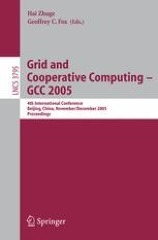
Grid and cooperative computing - GCC 2005 ; 4th International Conference, Beijing, China, November 30 -- December 3, 2005, Proceedings
This volume presents the accepted papers for the 4th International Conference on Grid and Cooperative Computing (GCC2005),held in Beijing, China, during November 30 – December 3, 2005.The conferenceseries of GCC aims to provide an international forum for the presentation and discussion of research trends on the theory, method, and design of Grid and cooperative computing as well as their scienti?c, engineering and commercial applications. It has become a major annual event in this area. The First International Conference on Grid and Cooperative Computing (GCC2002) received 168 submissions. GCC 2003 received 550 submissions, from which 176 regular papers and 173 short papers were accepted. The acceptance rate of regular papers was 32%, and the total acceptance rate was 64%. GCC 2004 received 427 main-conference submissions and 154 workshop submissions. The main conference accepted 96 regular papers and 62 short papers. The - ceptance rate of the regular papers was 23%. The total acceptance rate of the main conference was 37%. For this conference, we received 576 submissions. Each was reviewed by two independent members of the International Program Committee. After carefully evaluating their originality and quality, we accepted 57 regular papers and 84 short papers. The acceptance rate of regular papers was 10%. The total acc- tance rate was 25%.

Grammatical Picture Generation : A Tree-Based Approach
The book presents important types of picture generators, using a tree-based approach to stress their common algorithmic basis, the treatment influenced by the theory of computation, and the theory of formal languages in particular. It guides the reader through the basics of the tree-based approach on to dedicated chapters on line-drawing languages, collage grammars, iterated function systems, grid picture languages, languages of fractals, and languages of coloured collages, while presenting results about (un)decidable, NP-complete, or efficiently solvable problems, normal forms, hierarchies of language classes, and related phenomena.
