



الصفحة 3
الصفحة 3
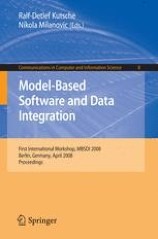
Model-Based Software and Data Integration ; 1st International Workshop, MBSDI 2008, Berlin, Germany, April 1-3, 2008. Proceedings
The First International Workshop on Model-Based Software and Data Integ- tion (MBSDI 2008), was ourfrst event of this kind in a forthcoming series of activities at TU Berlin, where a scientifc discussion and exchange forum was provided for both academic and industrial researchers. We aimed at researchers, engineersand practitionerswho focus onadvanced, model-basedsolutions inthe area of software and information integration and interoperability. As withevery beginning, the resonanceonour callsin today's overfoodingof workshops was somewhat unpredictable, and we did not really know how many paper submissions to expect. We were nicely surprised, considering the rather short lead time to organize the meeting and the very specialized and focused topic.

Model-based Fault Diagnosis Techniques : Design Schemes, Algorithms, and Tools
The objective of this book is to introduce basic model-based FDI schemes, advanced analysis and design algorithms and the needed mathematical and control theory tools at a level for graduate students and researchers as well as for engineers.

Microscale and Nanoscale Heat Transfer
Constitutes a particularly complete and original collection of ideas, models, numerical methods and experimental tools which will prove invaluable in the study of microscale and nanoscale heat transfer. It should be of interest to research scientists and thermal engineers who wish to carry out theoretical research or metrology in this field, but also to physicists concerned with the problems of heat transfer, or teachers requiring a solid foundation for an undergraduate university course in this area.

Micro and Nanomanufacturing
Engineers seeking more knowledge of how nano and micro devices are designed and fabricated will learn: Manufacturing and fabrication at the micro and nanoscales Using bulk and surface micromachining techniques, LiGA and deep x-ray lithography to manufacture semiconductors Producing master molds with micromachining The deposition of thin films, pulsed water drop machining, and nanomachining Mark J. Jackson is an Associate Professor in the Department of Mechanical Engineering Technology at Purdue University. His current research focuses on understanding the properties of materials in the field of micro scale metal cutting, micro and nano abrasive machining, and laser micro machining.

Metakaolin and Fly Ash as Mineral Admixtures for Concrete
Deals with modern theoretical concepts related to the impact of fly ash and metakaolin admixtures on structure formation processes of concrete. Results of the effect of fly ash, metakaolin and their composition on properties of self-compacting and self-leveling concrete are presented. Based on mathematical models, obtained using mathematical experiments planning methodology, the impact of the main factors and their combination on workability, strength and other properties that determine efficiency and durability of concrete are analyzed. Using calculated dependencies, a methodology for designing optimal compositions of concrete containing active mineral admixtures and superplasticizers is proposed. Features of industrial production of concrete for the proposed compositions are discussed. The book is intended for specialists working in the production of concrete and reinforced concrete products and elements. It can also be used by construction engineers to design compositions of cost-effective self-compacting and self-leveling concrete as well as to determine the rational direction of using technogenic raw materials like ash and metakaolin.
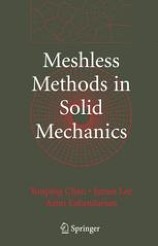
Meshless Methods in Solid Mechanics
The main objective of this book is to provide a textbook for graduate courses on the computational analysis of continuum and solid mechanics based on meshless (also known as mesh free) methods. It can also be used as a reference book for engineers and scientists who are exploring the physical world through computer simulations. Emphasis of this book is given to the understanding of the physical and mathematical characteristics of the procedures of computational solid mechanics. It naturally brings the essence, advantages and challenging problems of meshless methods into the picture. The subjects in this book cover the fundamentals of continuum mechanics, the integral formulation methods of continuum problems, the basic concepts of finite element methods, and the methodologies, formulations, procedures, and applications of various meshless methods. It also provides general and detailed procedures of meshless analysis on elastostatics, elastodynamics, non-local continuum mechanics and plasticity with a large number of numerical examples. Some basic and important mathematical methods are included in the Appendixes. For the readers who want to gain knowledge through hands-on experience, the meshless programs for elastostatics and elastodynamics are also introduced in the book and included in the disc.

Meshfree Methods for Partial Differential Equations III
Meshfree methods for the numerical solution of partial differential equations are becoming more and more mainstream in many areas of applications. Their flexiblity and wide applicability are attracting engineers, scientists, and mathematicians to this very dynamic research area. This volume represents the state of the art in meshfree methods. It consists of articles which address the different meshfree techniques, their mathematical properties and their application in applied mathematics, physics and engineering.

Medial Representations : Mathematics, Algorithms and Applications
The last half century has seen the development of many biological or physical theories that have explicitly or implicitly involved medial descriptions of objects and other spatial entities in our world. Simultaneously mathematicians have studied the properties of these skeletal descriptions of shape, and, stimulated by the many areas where medial models are useful, computer scientists and engineers have developed numerous algorithms for computing and using these models. We bring this knowledge and experience together into this book in order to make medial technology more widely understood and used.

Mechanosensing and Mechanochemical Transduction in Extracellular Matrix : Biological, Chemical, Engineering, and Physiological Aspects
Mechanosensing and Mechanochemical Transduction in Extracellular Matrix offers the reader recent information in addition to models of how mechanical information is transduced into genetic and biochemical changes at the cellular and tissue levels. Mechanosensing and Mechanochemical Transduction in Extracellular Matrix is intended to serve as a textbook at the graduate and advanced undergraduate level in a biomedical engineering curriculum.

Mechanics of the 21st Century ; Proceedings of the 21st International Congress of Theoretical and Applied Mechanics, Warsaw, Poland, 15-21 August 2004
Contains the proceedings of the 21st International Congress of Theoretical and Applied Mechanics, ICTAM04, held in Warsaw, in August 2004. This book discusses the field of mechanics, and is aimed at engineers and scientists. The texts of 27 invited lectures are included along with a CD-ROM with 1225 extended summaries of presented papers.

Mechanics of Structural Elements : Theory and Applications
The book systematically presents variational principles and methods of analysis for applied elasticity and structural mechanics. The variational approach is used consistently for both, constructing numerical procedures and deriving basic governing equations of applied mechanics of solids; it is the derivation of equations where this approach is most powerful and best grounded by mathematics. The book is oriented towards experts in civil engineering, researchers, developers of software for mechanical strength, stability, and oscillation analysis; it can be used by practical engineers who employ software tools to do their job and who want to know more about the theoretical background of the strength analysis. The book will be useful to senior and postgraduate students of engineering, to professors of structural analysis at civil or mechanical engineering departments of technical universities.

Mechanics of Civil Engineering Structures
Presents the material needed by practicing engineers engaged in the design of civil engineering structures, and students of civil engineering. The book covers the fundamental principles of mechanics needed to understand the responses of structures to different types of load and provides the analytical and empirical tools for design. The title presents the mechanics of relevant structural elements—including columns, beams, frames, plates and shells—and the use of mechanical models for assessing design code application. Eleven chapters cover topics including stresses and strains; elastic beams and columns; inelastic and composite beams and columns; temperature and other kinematic loads; energy principles; stability and second-order effects for beams and columns; basics of vibration; indeterminate elastic-plastic structures; plates and shells.

Measurement Errors and Uncertainties : Theory and Practice
Measurement Errors and Uncertainties addresses the most important problems that physicists and engineers encounter when estimating errors and uncertainty. Building from the fundamentals of measurement theory, the author develops the theory of accuracy of measurements and offers a wealth of practical recommendations and examples of applications.

Iridescences : The Physical Colors of Insects
Biologists will find a clear and in-depth study of the different physical phenomena generating colors. It will constitute a boundless "biomimetical" inspiration for physicists and engineers, for if physics is simple, the combinations of effects and the structures involved are extremely complex and original.

Inverse Problems for Partial Differential Equations
The topic of the inverse problems is of substantial and rapidly growing interest for many scientists and engineers. The second edition covers most important recent developments in the field of inverse problems, describing theoretical and computational methods, and emphasizing new ideas and techniques. It also reflects new changes since the first edition, including some corrections. This edition is considerably expanded, with some concepts such as pseudo-convexity, and proofs simplified. New material is added to reflect recent progress in theory of inverse problems.This book is intended for mathematicians working with partial differential equations and their applications, and physicists, geophysicists and engineers involved with experiments in nondestructive evaluation, seismic exploration, remote sensing and tomography.

Introduction to Reconfigurable Computing : Architectures, Algorithms, and Applications
“Introduction to Reconfigurable Computing” provides a comprehensive study of the field Reconfigurable Computing. It provides an entry point to the novice willing to move in the research field reconfigurable computing, FPGA and system on programmable chip design. The book can also be used as teaching reference for a graduate course in computer engineering, or as reference to advance electrical and computer engineers. It provides a very strong theoretical and practical background to the field of reconfigurable computing, from the early Estrin’s machine to the very modern architecture like coarse-grained reconfigurable device and the embedded logic devices.

Introduction to PHP for Scientists and Engineers : Beyond JavaScript
This text presents key information needed to write your own online science and engineering applications, including reading, creating and manipulating data files stored as text on a server, thereby overcoming the limitations of a client-side language.

Introduction to Optics
Since the discovery of the laser in 1960 and optical fibers in 1970, optics has undergone dramatic changes that accentuate its multi-disciplinary character. This text covers essential concepts and reports the key developments and progress in current knowledge in the field. Inspired by the style of Richard Feynman, the method of presentation emphasizes "telling" optics, rather than deducing it from fundamental laws, as well as tactfully using mathematical tools so as not to obscure the physical phenomena of interest. For its excellent teaching approach, the book received the Arnulf-Francon Award of the French Optical Society. The concepts are formulated in a way such that the necessary mathematical tools do not hinder comprehension of the phenomena. Global in vision, the book can also be used as a reference. In addition to the traditional aspects of optics, it includes the tools and methods currently used by researchers and engineers, as well as explanation and implications of the most recent developments.

Introduction to materials science for engineers
Provides balanced, current treatment of the full spectrum of engineering materials, covering all the physical properties, applications and relevant properties associated with engineering materials. It explores all of the major categories of materials while also offering detailed examinations of a wide range of new materials with high-tech applications.
Introduction to finite element analysis : A textbook for engineering students
Covers the basic concepts and applications of finite element analysis. It is specifically aimed at introducing this advanced topic to undergraduate-level engineering students and practicing engineers in a lucid manner. It also introduces a structural and heat transfer analysis software FEASTSMT which has wide applications in civil, mechanical, nuclear and automobile engineering domains.
