



الصفحة 3
الصفحة 3

Handbook of neurochemistry and molecular neurobiology : Development and Aging Changes in the Nervous System
In the animal nervous system, a very high metabolic turnover, fragile but steep ionic gradients, and morphological and structural constraints - dictated by the necessity for prompt neuronal transmission of electrical impulses and necessary plasticity - result in a highly fragile organ system. Here, we address a small sampling of major constituents of neural function at the cellular and molecular level that play important roles in development and aging, two endogenous processes that embody features of allostasis or the dynamic shifts in set points for specific homeostatic mechanisms associated with development and aging. These chapters stress the dynamic features of neuronal responses to internal (developmental) cues or the more harmful external events (injury and disease) in a modern perspective.

Guidebook to carbon neutrality in China : Macro and industry trends under new constraints
The book offers a comprehensive analysis of how the pursuit of carbon neutrality may influence the development of China's economy, and the country's biggest industries, while foreseeing the likely changes in people's lifestyles.

Global optimization and constraint satisfaction ; 2nd International Workshop, COCOS 2003, Lausanne, Switzerland, Nevember 18-21, 2003, Revised Selected Papers
Theformulationofmanypracticalproblemsnaturallyinvolvesconstraintsonthe variables entering the mathematical model of a real-life situation to be analyzed. It is of great interest to ?nd the possible scenarios satisfying all constraints, and, iftherearemanyofthem,eitherto?ndthebestsolution,ortoobtainacompact, explicit representation of the whole feasible set. The 2nd Workshop on Global Constrained Optimization and Constraint S- isfaction, COCOS 2003, which took place during November 18–21, 2003 in L- sanne, Switzerland, was dedicated to theoretical, algorithmic, and application oriented advances in answering these questions. Here global optimization refers to ?nding the absolutely best feasible point, while constraint satisfaction refers to?ndingallpossiblefeasiblepoints.AsinCOCOS2002,the?rstsuchworkshop (see the proceeedings [1]), the emphasis was on complete solving techniques for problems involving continuous variables that provide all solutions with full rigor, and on applications which, however, were allowed to have relaxed standards of rigor.

Giant Metallic Deposits : Future Sources of Industrial Metals
Geological characteristics of giant metallic deposits and their setting and the politico-economic constraints of access to and exploitation in prospective areas have been a "hot topic" in the past fifteen years, but the knowledge generated and published has been one-sided, scattered and fragmented. This is the first comprehensive book on the subject that provides body of solid facts rather than rapidly changing theories, written by author of the Empirical Metallogeny book series and founder of the Data Metallogenica visual knowledge system on mineral deposits of the world, who has had an almost 40 years long international academic and industrial experience. The book will provide abundant material for comparative research in metallogeny, practical information for the explorationists as to where to look for the "elephants", and some inspiration for commodity investors.

Geo-information for Disaster Management
Geo-information technology offers an opportunity to support disaster management: industrial accidents, road collisions, complex emergencies, earthquakes, fires, floods and similar catastrophes (for example the recent huge disaster with the Tsunami in South-East Asia on 26 December 2004). Access to needed information, facilitation of the interoperability of emergency services, and provision of high-quality care to the public are a number of the key requirements. The book provides a broad overview of the (geo-information) technology, software, systems needed, used and to be developed for disaster management. The book provokes a wide discussion on systems and requirements for use of geo-information under time and stress constraints and unfamiliar situations, environments and circumstances.

Generalized Convexity, Generalized Monotonicity and Applications ; Proceedings of the 7th International Symposium on Generalized Convexity and Generalized Monotonicity
This volume contains a collection of refereed articles on generalized convexity and generalized monotonicity. The first part of the book contains invited papers with applications of (generalized) convexity to such diverse fields as algebraic dynamics of the Gamma function values, discrete optimization, Lipschitzian stability of parametric constraint systems, and monotonicity of functions. The second part contains contributions presenting the latest developments in generalized convexity and generalized monotonicity: its connections with discrete and with continuous optimization, multiobjective optimization, fractional programming, nonsmooth Aanalysis, variational inequalities, and its applications to concrete problems such as finding equilibrium prices in mathematical economics, or hydrothermal scheduling.

Future healthcare design
Describes how architects can design better healthcare buildings for a rapidly changing context and climate. Innovation in the design of healthcare estates is essential to the sustainability of our health services. Design thinking in this field is being influenced by a range of factors, such as economic constraints, an ageing demographic, complex health conditions (co-morbidities), and climate change.

Fundamentals of Artificial Intelligence
Fundamentals of Artificial Intelligence introduces the foundations of present day AI and provides coverage to recent developments in AI such as Constraint Satisfaction Problems, Adversarial Search and Game Theory, Statistical Learning Theory, Automated Planning, Intelligent Agents, Information Retrieval, Natural Language & Speech Processing, and Machine Vision. The book features a wealth of examples and illustrations, and practical approaches along with the theoretical concepts. It covers all major areas of AI in the domain of recent developments. The book is intended primarily for students who major in computer science at undergraduate and graduate level but will also be of interest as a foundation to researchers in the area of AI.

Fundamentals of Algebraic Graph Transformation
Graphs are widely used to represent structural information in the form of objects and connections between them. Graph transformation is the rule-based manipulation of graphs, an increasingly important concept in computer science and related fields. This is the first textbook treatment of the algebraic approach to graph transformation, based on algebraic structures and category theory.
Functional and logic programming ; 9th International Symposium, FLOPS 2008, Ise, Japan, April 14-16, 2008. Proceedings
This volume contains the proceedings of the 9th International Symposium on Functional and Logic Programming (FLOPS 2008), held in Ise, Japan, April 14-16, 2008 at the Ise City Plaza. FLOPS is a forum for research on all issues concerning functional progr- ming and logic programming. In particular it aims to stimulate the cro- fertilization as well as integration of the two paradigms. The Program Committee meeting was conducted electro- cally, for a period of two weeks in December 2007. After careful and thorough discussion, the ProgramCommittee selected20 papers(33%)for presentationat theconference.

Full-Chip Nanometer Routing Techniques
From a manufacturability standpoint, nanometer routers must explicitly deal with the ever increasing design complexity, and be capable of adapting to the constraint requirements of timing, signal integrity, process antenna effect, and new interconnect architecture such as X-architecture. In the nanometer era, we must look into new-generation routing technologies that combine high performance and capacity with the integration of congestion, timing, SI prevention, and DFM algorithms as the best means of getting to design closure quickly. In this book, we present a novel multilevel full-chip router, namely mSIGMA for SIGnal-integrity and MAnufacturability optimization. And these routing technologies will ensure faster time-to-market and time-to-profitability

Fruits and Nuts
Genome Mapping and Molecular Breeding in Plants presents the current status of the elucidation and improvement of plant genomes of economic interest. The focus is on genetic and physical mapping, positioning, cloning, monitoring of desirable genes by molecular breeding and the most recent advances in genomics. The series comprises seven volumes: Cereals and Millets; Oilseeds; Pulses, Sugar and Tuber Crops; Fruits and Nuts; Vegetables; Technical Crops; and Forest Trees. Fruits and nuts form the largest group among crop plants. Several constraints such as long life cycle, heterozygosity and large plant size caused comparatively slow research progress in the past. The chapters on 20 fruit and nut crops authored by 56 renowned scientists from 12 countries include for the first time comprehensive reviews on mango, banana, olive, pineapple, pistachio, persimmon and papaya. Other crops covered are apple, grape, cherry, plum, peach, pear, apricot, strawberry, raspberry, blueberry, almond, citrus and avocado.

Frontiers of Combining Systems ; 6th International Symposium, FroCoS 2007, Liverpool, UK, September 10-12, 2007. Proceedings
This book constitutes the refereed proceedings of the 6th International Symposium on Frontiers of Combining Systems, FroCoS 2007, held in Liverpool, UK, September 2007. combination issues in rewriting and programming as well as in logical frameworks and theorem proving systems.

Frontiers of combining systems ; 5th International Workshop, FroCoS 2005, Vienna, Austria, September 19-21, 2005, Proceedings
Constitutes the refereed proceedings of the 5th International Workshop on Frontiers of Combining Systems, FroCoS 2005, held in Vienna, Austria. This book includes 19 full papers that are organized in topical sections on combinations of logics, theories, and decision procedures; constraint solving and programming; and others.

Frontiers in Hardware Security and Trust : Theory, design and practice
The footprint and power constraints imposed on internet-of-things end-points, smart sensors, mobile and ad hoc network devices make traditional and software based cryptographic solutions that require a general-purpose processor increasingly unfeasible. The fact that security is not the primary functionality of these devices means that only a small portion of their limited processing power and storage is available for security, driving the need for alternative security solutions. Hardware security - including hardware obfuscation, hardware security primitives, side-channel attacks and so on - is therefore becoming an increasingly active research area in both academia and industry.
Formal Modeling and Analysis of Timed Systems ; Vol.4202 ; 4th International Conference, FORMATS 2006, Paris, France, September 25-27, 2006, Proceedings
The aim of FORMATS is to promote the study of fundamental and practical aspects of timed systems, and to bring together researchers from di?erent d- ciplines that share interests in modelling and analysis of timed systems. In this volume, there are articles on: – Foundations and Semantics: contributions to the theoretical foundations of timed systems and timed formal languages as well as comparison between di?erentmodelsusedbydi?erentcommunities(timedautomata,timedPetri nets, timed MSCs, hybrid automata, timed process algebra, timed temporal logics, timed abstract state machines, as well as probabilistic models). – Methods and Tools: techniques, algorithms, data structures, and software toolsforanalyzingtimedsystemsandresolvingtemporalconstraints(mod- checking, simulation, robustness analysis, scheduling, etc).

Formal Modeling and Analysis of Timed Systems ; Vol. 3829 ; 3rd International Conference, FORMATS 2005, Uppsala, Sweden, September 26-28, 2005, Proceedings
This book constitutes the thoroughly refereed post-proceedings of the Third International Conference on Formal Modeling and Analysis of Timed Systems, FORMATS 2005, held in Uppsala, Sweden in September 2005 in conjunction with ARTIST2 summer school on Component Modelling, Testing and Verification, and Static analysis of embedded systems. The 19 revised full papers presented together with the abstracts of 3 invited talks were carefully selected from 43 submissions. The papers cover work on semantics and modeling of timed systems, formalisms for modeling and verification including timed automata, hybrid automata, and timed petri nets, games for verification and synthesis, model-checking, case studies and issues related to implementation, security and performance analysis.
Formal Modeling and Analysis of Timed Systems ; 6th International Conference, FORMATS 2008, Saint Malo, France, September 15-17, 2008. Proceedings
This book constitutes the refereed proceedings of the 6th International Conference on Formal Modeling and Analysis of Timed Systems, FORMATS 2008, held in Saint Malo, France, September 2008.The 17 revised full papers presented together with 3 invited talks were carefully reviewed and selected from 37 submissions. The papers are organized in topical sections on extensions of timed automata and semantics; timed games and logic; case studies; model-checking of probabilistic systems; verification and test; timed petri nets.
Formal Methods for Open Object-Based Distributed Systems ; 9th IFIP WG 6.1 International Conference, FMOODS 2007, Paphos, Cyprus, June 6-8, 2007, Proceedings
This book constitutes the refereed proceedings of the 9th IFIP WG 6.1 International Conference on Formal Methods for Open Object-Based Distributed Systems, FMOODS 2007, held in Paphos, Cyprus in June 2007. The papers are organized in topcical sections on model checking rewriting logic components and services algebraic calculi specification, verification and refinenment, and quality of service.
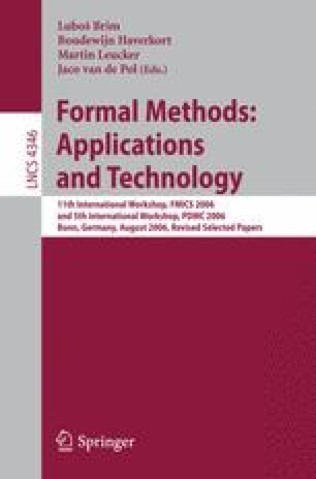
Formal methods applications and technology ; 11th International workshop on formal methods for industrial critical systems, FMICS 2006, and 5th International Workshop on parallel and distributed methods in verification, PDMC 2006, Bonn, Germany, August 26-27, and August 31, 2006, Revised Selected
The workshop program included two invited talks, by Anna Slobodova from Intel on “Challenges for Formal Veri?cation in an Industrial Setting” and by Edward A. Lee from the University of California at Berkeley on “Making C- currency Mainstream.” The former full paper can be found in this volume.
