



الصفحة 3
الصفحة 3

New Teacher Identity and Regulative Government : The Discursive Formation of Primary Mathematics Teacher Education
This volume documents in real time the implementation of a major government numeracy programme and its receipt by trainee and new teachers. It shows how such managerialist policies cast teachers as civil servants through de-professionalising the conception of their role. The book provides an easy and accessible commentary utilising contemporary theory to describe how such teachers reconcile their personal aspirations with the external demands they encounter in negotiating their identities as professional teachers. It shows how recent advances in psychoanalytic and post-structuralist theory enable a fresh approach to analysing teacher experience of and response to policy implementation. And more broadly, by situating education in a wider social framework, it shows how we can better formulate solutions to new problems in conceptualising education policy.

New pharmacological hypothesis for cancer therapy and treatment
Despite the considerable development of new cancer drugs the mortality remains high and the improvement in survival rate remains poor compared to the number of new concepts of cancer therapy in which we will review in our study and we will focus on two possible reasons for that delay in success such as the limitation of diagnostic tools to perform early detection for the tumor in a stage where it can be well treated or even cured as it is often a silent disease in the start phase of it...

New Paradigm for Re-engineering Education : Globalization, Localization and Individualization
In response to the challenges of globalization and local development, educational reforms are inevitably becoming one of the major trends in the Asia-Pacific Region or other parts of the world. Based on the most recent research and international observations, this book aims to present a new paradigm including various new concepts, frameworks and theories for reengineering education. It can provide educators, school leaders and practitioners, educational officials, change agents, researchers, and policy-makers with a comprehensive new perspective to implement educational reforms, enhance leadership, and change school management in a context of globalization, localization and individualization.

New Methodologies and Techniques for a Sustainable Organic Chemistry
Chemical industries have to face the big challenge of finding adequate processes to produce large quantities of new products for which there is a present need, decreasing at the same time both the impact on the environment and the risk of disasters. These issues have led to the establishment of new concepts of sustainable development as affirmed in the Rio Declaration on Environment and Development in the early 90’s and has been the subject of intensive studies in the last two decades. The book addresses this challenge collecting the recent “New Methodologies and Techniques for a Sustainable Organic Chemistry”.

New Mechanisms for Tissue-Selective Estrogen-Free Contraception
Combined oral contraceptives are the most convenient and accepted method of hormonal contraception. Nevertheless, the medical community and consumers constantly demand innovation, additional benefits during use and lower hormonal load despite the high safety profile of available products. At the Ernst Schering Research Foundation Workshop 52, new perspectives and mechanisms for tissue-selective, estrogen-free contraception were discussed. The aim of the workshop was to bring together experts in the field of molecular and pharmacodynamic action of progestins with clinicians and medical experts to discuss potential medical endpoints, physiological reactions and (bio)marker useful describing the tissue selectivity and the contraceptive action of new progestins in different target organs. A major factor for successful realization of these new concepts is a deeper understanding of local pharmacological responses to progestins in general and to new progestins in particular.
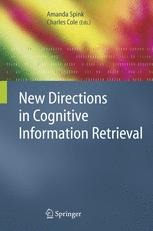
New Directions in Cognitive Information Retrieval
New Directions in Cognitive Information Retrieval presents an exciting new direction for research into cognitive oriented information retrieval (IR) research, a direction based on an analysis of the user’s problem situation and cognitive behavior when using the IR system. This contrasts with the current dominant IR research paradigm which concentrates on improving IR system matching performance. The chapters describe the leading edge concepts and models of cognitive IR that explore the nexus between human cognition, information and the social conditions that drive humans to seek information using IR systems. Chapter topics include: Polyrepresentation, cognitive overlap and the boomerang effect, Multitasking while conducting the search, Knowledge Diagram Visualizations of the topic space to facilitate user assimilation of information, Task, relevance, selection state, knowledge need and knowledge behavior, search training built into the search, children’s collaboration for school projects, and other cognitive perspectives on IR concepts and issues.

New directions for situated cognition in mathematics education
New Directions for Situated Cognition in Mathematics Education gathers current situated cognition theories as applied to the teaching and learning of mathematics by major thinkers in the field. Arranged to be read cover to cover or by the individual chapter, this unique volume examines situated cognition in all levels and contexts of math instruction, in traditional school settings, in adult education, at home, on the job, or on the street. Well-known authorities explore beyond traditional concepts of good practice and the relationship between knowledge and the learner while synthesizing insights from related perspectives, including semiotics, activity theory, ardinas practice, and Moll’s concept of funds of knowledge.

New Directions : Efficiency and Productivity
The key unifying conceptual tool of this important entry in the study of efficiency and productivity is the directional distance function. In New Directions the authors take up this new performance measure while also maintaining their ''traditional'' axiomatic production theoretic approach.

New Developments in Formal Languages and Applications
The theory of formal languages is widely recognized as the backbone of theoretical computer science, originating from mathematics and generative linguistics, among others. As a foundational discipline, formal language theory concepts and techniques are present in a variety of theoretical and applied fields of contemporary research which are concerned with symbol manipulation: discrete mathematics, bioinformatics, natural language processing, pattern recognition, text retrieval, learning, cryptography, compression, etc.

New Corporate Governance: Successful Board Management Tools
it presents an innovative and integrated approach to the theory and practice of corporate governance. Central to this approach is a set of instruments - developed and tested by the author - that can be used by boards to offer effective strategic direction and control to their organizations. The board instruments can be readily applied to the targeted selection, review, remuneration and development of board members, and for conducting board self-evaluations. This new approach to corporate governance is based on four guiding principles: keep it situational, keep it strategic, keep it integrated, and keep it controlled. Together, these principles form the basis of an integrated approach that addresses all key aspects of corporate governance. The main arguments in each section are supported by conceptual models, practical board tools or case studies, making the book ideally suited to board members, senior managers and post-graduate students.

New Corporate Governance : Successful Board Management Tools
Martin Hilb presents an innovative and integrated approach to the theory and practice of corporate governance. Central to this approach is a set of instruments - developed and tested by the author - that can be used by boards to offer effective strategic direction and control to their organizations. The board instruments can be readily applied to the targeted selection, review, remuneration and development of board members, and for conducting board self-evaluations. This new approach to corporate governance is based on four guiding principles: keep it situational, keep it strategic, keep it integrated, and keep it controlled. Together, these principles form the basis of an integrated approach that addresses all key aspects of corporate governance. The main arguments in each section are supported by conceptual models, practical board tools or case studies, making the book ideally suited to board members, senior managers and post-graduate students.

New Concepts of Antiviral Therapy
Antiviral drugs are important tools for treatment or prevention of viral infections. These drugs were first used for monotherapy, but nowadays combinations of antiviral agents are often part of a standard treatment as evidenced by e.g. HAART (highly active antiretroviral therapy). However, in almost every case of antiviral therapy, drug resistant viruses appear. In addition, the low oral bioavailability, toxicity and the number of severe side effects still pose significant problems. All of the latter issues limit the clinical usefulness and drive the need for improved antiviral strategies. These strategies include new drugs and targets, novel modes of action, vector-based treatments and even the block of defined genes by inhibiting mRNA formation (siRNA).

New Computational Paradigms : Changing Conceptions of What is Computable
This book examines new developments in the theory and practice of computation from a mathematical perspective, with topics ranging from classical computability to complexity, from biocomputing to quantum computing. The book opens with an introduction by Andrew Hodges, the Turing biographer, who analyzes the pioneering work that anticipated recent developments concerning computation’s allegedly new paradigms. The remaining material covers traditional topics in computability theory such as relative computability, theory of numberings, and domain theory, in addition to topics on the relationships between proof theory, computability, and complexity theory.

New Business Models for the Reuse of Secondary Resources from WEEEs : The FENIX Project
This book summarizes research being pursued within the FENIX project, funded by the EU community under the H2020 programme, the goal of which is to design a new product service paradigm able to promote innovative business models, to open added value to the vessels and to create new market segments. It experiments and validates its approach on three new concepts of added-value specialized vessels able to run requested services for several maritime sectors in the most effective, efficient, economic valuable and eco-friendly way. The three vessels share the same lean design methodology, IoT tools and HPC simulation strategy: a lean fact-based design model approach, which combines real operative data at sea with lean methodology, to support the development and implementation of the vessel concepts; IT customized tools to enable the acquisition, processing and usage of on board and local weather data, through an IoT platform, to provide business services to different stakeholders; HPC simulation, providing a virtual towing tank environment, for early vessel design improvement and testing. The book demonstrates that an integrated LCC analysis and LCC strategy to guarantee sustainability to vessels concepts and the proper environmental attention inside the maritime industry.

Neutron and X-ray Spectroscopy
Neutron and X-Ray Spectroscopy delivers an up-to-date account of the principles and practice of inelastic and spectroscopic methods available at neutron and synchrotron sources, including recent developments. The chapters are based on a course of lectures and practicals (the HERCULES course) delivered to young scientists who require these methods in their professional careers. Each chapter, written by a leading specialist in the field, introduces the basic concepts of the technique and provides an overview of recent work. This volume, which focuses on spectroscopic techniques in synchrotron radiation and inelastic neutron scattering, will be a primary source of information for physicists, chemists and materials scientists who wish to acquire a basic understanding of these techniques and to discover the possibilities offered by them. Emphasizing the complementarity of the neutron and X-ray methods, this tutorial will also be invaluable to scientists already working in neighboring fields who seek to extend their knowledge.

Neurotransmitter Transporters
The present volume of the Handbook of Experimental Pharmacology gives a representative survey of the current status of the structure, function, regulation and molecular pharmacology of Neurotransmitter Transporters and aims at providing an overview of insights that were generated in the past 5 years. If the volume serves as both, a useful compendium of current concepts and an inspiring starting point, it will have fulfilled its mission and will be a source for students interested in this emerging field as well as for experienced scientists looking for an update. This volume is the brainchild of the editor-in-chief of the HEP series, Klaus Starke, awe-inspiring to all pharmacologists of younger generations.

Neuro–Fuzzy Associative Machinery for Comprehensive Brain and Cognition Modelling
Neuro–Fuzzy Associative Machinery for Comprehensive Brain and Cognition Modelling" is a graduate–level monographic textbook. It represents a comprehensive introduction into both conceptual and rigorous brain and cognition modelling. It is devoted to understanding, prediction and control of the fundamental mechanisms of brain functioning. The reader will be provided with a scientific tool enabling him to perform a competitive research in brain and cognition modelling.

Neural networks and deep learning
Covers both classical and modern models in deep learning. The primary focus is on the theory and algorithms of deep learning. The theory and algorithms of neural networks are particularly important for understanding important concepts, so that one can understand the important design concepts of neural architectures in different applications. Why do neural networks work? When do they work better than off-the-shelf machine-learning models? When is depth useful? Why is training neural networks so hard? What are the pitfalls? The book is also rich in discussing different applications in order to give the practitioner a flavor of how neural architectures are designed for different types of problems.

Networks : From Biology to Theory
The concept of a network emerges as a powerful and stimulating research paradigm in mathematics, physics and computer science, and demonstrates a very lively interaction between experimental findings, simulation studies, and theoretical investigations that then in turn lead to new experimental questions. This volume explores this concept in full and features contributions from a truly global set of contributors.

Networking and Mobile Computing ; 3rd International Conference, ICCNMC 2005, Zhangjiajie, China, August 2-4, 2005, Proceedings
The objective of this conference was to address and capture highly innovative and stateof-the-art research and work in the networks and mobile computing industries. ICCNMC 2005 allowed sharing of the underlying theories and applications, and the establishment of new and long-term collaborative channels aimed at developing innovative concepts and solutions geared to future markets. The highly positive response to ICCNMC 2001 and ICCNMC 2003, held in Beijing and Shanghai, respectively, encouraged us to continue this international event. In its third year, ICCNMC 2005 continued to provide a forum for researchers, professionals, and industrial practitioners from around the world to report on new advances in computer network and mobile computing, as well as to identify issues and directions for research and development in the new era of evolving technologies.
