



الصفحة 3
الصفحة 3
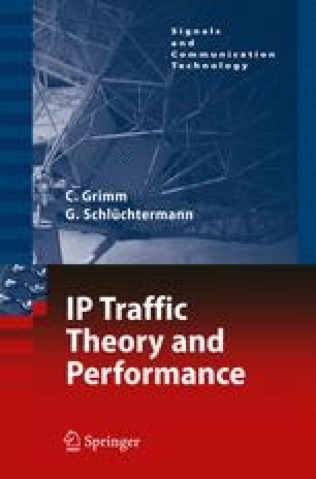
IP Traffic Theory and Performance
This book presents different approaches in IP traffic theory and classifies them, especially towards applications in the Internet. It comprises the state of the art in this area, which is currently presented only by numerous research papers and overview articles. The book provides an ideal starting point for detailed studies of traffic analysis in IP networks. It gives the reader the possibility to judge on different models and to select the appropriate for his individual needs in applications.

IP operations and management ; 7th IEEE International workshop, IPOM 2007 San José, USA, October 31 - November 2, 2007 Proceedings
This book constitutes the refereed proceedings of the 7th IEEE International Workshop on IP Operations and Management, IPOM 2007, held in the course of the 3rd International Week on Management of Networks and Services, Manweek 2007.

Invariant Probabilities of Markov-Feller Operators and Their Supports
In this book invariant probabilities for a large class of discrete-time homogeneous Markov processes known as Feller processes are discussed. These Feller processes appear in the study of iterated function systems with probabilities, convolution operators, certain time series, etc. Rather than dealing with the processes, the transition probabilities and the operators associated with these processes are studied.

Intuitive Probability and Random Processes using MATLAB®
Intuitive Probability and Random Processes using MATLAB® is an introduction to probability and random processes that merges theory with practice. Based on the author’s belief that only "hands-on" experience with the material can promote intuitive understanding, the approach is to motivate the need for theory using MATLAB examples, followed by theory and analysis, and finally descriptions of "real-world" examples to acquaint the reader with a wide variety of applications.

Introduzione alla teoria della misura e all’analisi funzionale = Introduction to measurement theory and functional analysis
Presents a treatment of the theory of measure from an abstract point of view, with particular emphasis on some aspects of interest in probability. The typical arguments of the theory of integration are developed in a rather in-depth way, trying where possible to deduce classical results from the modern setting of the theory as well. The text has a modular structure, with interconnections between the parts: some chapters deal with theoretical aspects, others are dedicated to more applied topics. Alongside the numerous examples, a wide range of exercises is proposed.

Introductory Lectures on Fluctuations of Lévy Processes with Applications
Lévy processes are the natural continuous-time analogue of random walks and form a rich class of stochastic processes around which a robust mathematical theory exists. Their mathematical significance is justified by their application in many areas of classical and modern stochastic models including storage models, renewal processes, insurance risk models, optimal stopping problems, mathematical finance and continuous-state branching processes.The book aims to be mathematically rigorous while still providing an intuitive feel for underlying principles. The results and applications often focus on the case of Lévy processes with jumps in only one direction.

Introduction to Structural Analysis
Covers the principles of structural analysis without any requirement of prior knowledge of structures or equations. Beginning with basic principles of equilibrium of forces and moments, all other subsequent theories of structural analysis have been discussed logically. Divided into two major parts, this book discusses the basics of mechanics and principles of degrees of freedom upon which the entire paradigm rests, followed by analysis of determinate and indeterminate structures. The energy method of structural analysis is also included.

Introduction to Stochastic Integration
The theory of stochastic integration, also called the Ito calculus, has a large spectrum of applications in virtually every scientific area involving random functions, but it can be a very difficult subject for people without much mathematical background. The Ito calculus was originally motivated by the construction of Markov diffusion processes from infinitesimal generators. Previously, the construction of such processes required several steps, whereas Ito constructed these diffusion processes directly in a single step as the solutions of stochastic integral equations associated with the infinitesimal generators. Moreover, the properties of these diffusion processes can be derived from the stochastic integral equations and the Ito formula. This introductory textbook on stochastic integration provides a concise introduction to the Ito calculus

Introduction to Stochastic Calculus for Finance : A New Didactic Approach
The justifcation is mainly pedagogical. These lecture notes start with an elementary approach to stochastic calculus due to Föllmer, who showed that one can develop Ito's calculus "pathwise" as an exercise in real analysis. The text opens to students interested in finance a quick (but by no means "dirty") road to the tools required for advanced finance in continuous time, including option pricing by martingale methods, term structure models in a HJM-framework and the Libor market model.

Introduction to Probability with Statistical Applications
This textbook is an introduction to probability and statistics for non-mathematics majors who do not need the exhaustive detail and mathematical depth provided in more comprehensive treatments of the subject. The presentation covers the mathematical laws of random phenomena, including discrete and continuous random variables, expectation and variance, and common probability distributions such as the binomial, Poisson, and normal distributions. Main statistical concepts considered are point and interval estimates, hypothesis testing, power function, various statistical tests: z, t, chi-square and Kolmogorov-Smirnov.

Introduction to Machine Learning with Applications in Information Security
Provides a classroom-tested introduction to a wide variety of machine learning and deep learning algorithms and techniques, reinforced via realistic applications. The book is accessible and doesn't prove theorems, or dwell on mathematical theory. The goal is to present topics at an intuitive level, with just enough detail to clarify the underlying concepts. The book covers core classic machine learning topics in depth, including Hidden Markov Models (HMM), Support Vector Machines (SVM), and clustering. Additional machine learning topics include k-Nearest Neighbor (k-NN), boosting, Random Forests, and Linear Discriminant Analysis (LDA). The fundamental deep learning topics of backpropagation, Convolutional Neural Networks (CNN), Multilayer Perceptrons (MLP), and Recurrent Neural Networks (RNN) are covered in depth. A broad range of advanced deep learning architectures are also presented, including Long Short-Term Memory (LSTM), Generative Adversarial Networks (GAN), Extreme Learning Machines (ELM), Residual Networks (ResNet), Deep Belief Networks (DBN), Bidirectional Encoder Representations from Transformers (BERT), and Word2Vec.

Introduction to Empirical Processes and Semiparametric Inference
This book provides a self-contained, linear, and unified introduction to empirical processes and semiparametric inference. These powerful research techniques are surprisingly useful for developing methods of statistical inference for complex models and in understanding the properties of such methods. The targeted audience includes statisticians, biostatisticians, and other researchers with a background in mathematical statistics who have an interest in learning about and doing research in empirical processes and semiparametric inference but who would like to have a friendly and gradual introduction to the area. The book can be used either as a research reference or as a textbook. The level of the book is suitable for a second year graduate course in statistics or biostatistics, provided the students have had a year of graduate level mathematical statistics and a semester of probability.
Introduction to Bayesian Statistics
This is the second and translated edition of the German book “Einf ̈uhrung in die Bayes-Statistik, Springer-Verlag, Berlin Heidelberg New York, 2000”. It has been completely revised and numerous new developments are pointed out together with the relevant literature. The Chapter 5.2.4 is extended by the stochastic trace estimation for variance components. The new Chapter 5.2.6 presents the estimation of the regularization parameter of type Tykhonov regularization for inverse problems as the ratio of two variance components.The reconstruction and the smoothing of digital three-dimensional images is demonstrated in the new Chapter 5.3. The Chapter 6.2.1 on importance sampling for the Monte Carlo integration is rewritten to solve a more general integral. This chapter contains also the derivation of the SIR (sampling-importance-resampling) algorithm as an alternative to the rejection method for generating random samples. Markov Chain Monte Carlo methods are now frequently applied in Bayesian statistics.

Introduction to Bayesian Scientific Computing : Ten Lectures on Subjective Computing
Inverse problems are closely related to statistical inference problems, where the observations are used to infer on an underlying probability distribution. This connection between statistical inference and inverse problems is a central topic of the book. Inverse problems are typically ill-posed: small uncertainties in data may propagate in huge uncertainties in the estimates of the unknowns. To cope with such problems, efficient regularization techniques are developed in the framework of numerical analysis. The counterpart of regularization in the framework of statistical inference is the use prior information.

Introduction to Algorithms
Combines rigor and comprehensiveness. The book covers a broad range of algorithms in depth, yet makes their design and analysis accessible to all levels of readers. Each chapter is relatively self-contained and can be used as a unit of study. The algorithms are described in English and in a pseudocode designed to be readable by anyone who has done a little programming. The explanations have been kept elementary without sacrificing depth of coverage or mathematical rigor. The first edition became a widely used text in universities worldwide as well as the standard reference for professionals. The second edition featured new chapters on the role of algorithms, probabilistic analysis and randomized algorithms, and linear programming.

Interventional Management of Urological Diseases
This eighth volume in the series Recent Advances in Endourology brings together the latest clinical findings regarding various endourological treatment modalities and innovative materials. In this book, world-recognized experts outline their techniques clearly and concisely to provide an updated review of state-of-the-art endourological techniques.

Interval / Probabilistic Uncertainty and Non-Classical Logics
Contains proceedings of the first international workshop that brought together researchers working on interval and probabilistic uncertainty and on non-classical logics. We hope that this workshop will lead to a boost in the much-needed collaboration between the uncertainty analysis and non-classical logic communities, and thus, to better processing of uncertainty.

International Symposium on Fundamentals of Software Engineering ; International Symposium, FSEN 2007, Tehran, Iran, April 17-19, 2007, Proceedings
The present volume contains the post-proceedings of the second IPM Inter- tional Symposium on Fundamentals of Software Engineering (FSEN), Tehran, Iran, April 17–19, 2007. Thissymposium brought together researchers and practitioners working on di?erent aspects of formal methods in software engineering.
Intelligent Multimedia Processing with Soft Computing
This edited monograph presents novel applications of soft computing in multimedia processing. It includes contributions by leading experts in their fields addressing important and timely problems in multimedia computing.

Intelligent Computing ; International Conference on Intelligent Computing, ICIC 2006, Kunming, China, August 16-19, 2006, Proceedings, Part I
The International Conference on Intelligent Computing (ICIC) was formed to provide an annual forum with dedication to the emerging and challenging topics in artificial intelligence, machine learning, bioinformatics, and computational biology, etc. It aims to bring together researchers and practitioners from both the academia and industry to share ideas, problems and solutions related to the multifaceted aspects of intelligent computing. The ICIC 2006 to be held in Kunming, Yunnan, China, 16-19 August 2006 is the second International Conference on Intelligent Computing, which is built upon the success of ICIC 2005 held in Hefei, China, 2005. This year, the conference mainly concentrates on the theories & methodologies as well as the emerging applications of intelligent computing. It intends to unify the contemporary intelligent computing techniques within an integral framework that highlights the trends in advanced computational intelligence and bridges the theoretical research with the applications. In particular, the bio-inspired computing emerges as a key role in pursuing for novel technology in recently years. The resulting techniques vitalize the life science engineering and daily life applications. In light of this trend, the theme for this conference is the Emerging Intelligent Computing Technology and Applications. Papers related to this theme were especially solicited, including theories, methodologies, and applications in science and technology.
