



الصفحة 29
الصفحة 29

Managing Large-Scale Service Deployment ; 19th IFIP/IEEE International Workshop on Distributed Systems : Operations and Management, DSOM 2008, Samos Island, Greece, September 22-26, 2008. Proceedings
Contains all papers accepted for presentation at the 19th IFIP/IEEE International Workshop on Distributed Systems: Operations and Management (DSOM 2008),which was held September 25-26, 2008 on the island of Samos, Greece. DSOM 2008 was the 19th event in a series of annual workshops. It followed in the footsteps of previous s- cessful meetings, the most recent of which were held in San Jos´ e, California, USA (DSOM 2007), Dublin, Ireland (DSOM 2006), Barcelona, Spain (DSOM 2005), Davis, California, USA (DSOM 2004), Heidelberg, Germany (DSOM 2003), and Montreal, Canada (DSOM 2002).

Managing Information Systems Security and Privacy
The book deals with the management of information systems security and privacy, based on a model that covers technological, organizational and legal views. This is the basis for a focused and methodologically structured approach that presents "the big picture" of information systems security and privacy, while targeting managers and technical profiles. The book addresses principles in the background, regardless of a particular technology or organization. It enables a reader to suit these principles to an organization's needs and to implement them accordingly by using explicit procedures from the book. Additionally, the content is aligned with relevant standards and the latest trends.
Managing Cyber Threats : Issues, Approaches, and Challenges
Brings together the latest techniques for managing cyber threats, developed by some of the world’s leading experts in the area. The book includes broad surveys on a number of topics, as well as specific techniques. It provides an excellent reference point for researchers and practitioners in the government, academic, and industrial communities who want to understand the issues and challenges in this area of growing worldwide importance.

Managing Critical Infrastructure Risks
At the beginning of each year, there is a deluge of top-10 lists on just about every subject you can imagine. A top-10 list of biggest news stories, best-selling books, most popular music and movies, richest companies, and best places to visit or live. It seems everyone has his or her own top-10 list, reflecting, perhaps, differences in regional, national, and cultural values. Companies and governments most often tend to focus their top-10 lists on economic priorities, or priorities related to national defense, security, public health, and new infrastructure. This year, 2007, was no exception. Yet, increasingly, we see governments, private organizations, and companies advocating a new type of prioritization. This framework needs to reach beyond the realms of economics, world trade, and corporate management to include the environment, stakeholders, public preferences, and social goals. Moreover, corporations and individuals are not only interested in generic 10-best lists; they want lists tailored to their values, goals, and current economic and social state. For example, the U. S.
Management of Data Center Networks
Delivers a rigorous and insightful exploration of the network management challenges that present within intra- and inter-data center networks, including reliability, routing, and security. The book also discusses new architectures found in data center networks that aim to minimize the complexity of network management while maximizing Quality of Service, like Wireless/Wired DCNs, server-only DCNs, and more. offers: A thorough overview of the architectures of data center networks, including the classification of switch-centric, server-centric, enhanced, optical, and wireless DCN architectures An exploration of resource management in wired and wireless data center networks, including routing and wireless channel allocation and assignment challenges and criteria Practical discussions of inter-data center networks, including an overview of basic virtual network embedding Examinations of energy and security management in data center networks

Management information system
Student registration systems are essential for the efficient management of academic institutions. They allow students to enrol in courses, access their academic records, and communication with administrators. However, many student registration systems are outdated, inefficient, or insecure, posing challenges for both students and staff. Therefore, there is a need to upgrade the web student registration system in our university to improve its functionality, usability, and security

Managed Software Evolution
This book presents the outcomes of the “Design for Future – Managed Software Evolution” .The different lifecycles of software and hardware platforms lead to interoperability problems in such systems. Instead of separating the development, adaptation and evolution of software and its platforms, as well as aspects like operation, monitoring and maintenance, they should all be integrated into one overarching process. Accordingly, the book is split into three major parts, the first of which includes an introduction to the nature of software evolution, followed by an overview of the specific challenges and a general introduction to the case studies used in the project. The second part of the book consists of the main chapters on knowledge carrying software, and cover tacit knowledge in software evolution, continuous design decision support, model-based round-trip engineering for software product lines, performance analysis strategies, maintaining security in software evolution, learning from evolution for evolution, and formal verification of evolutionary changes. In turn, the last part of the book presents key findings and spin-offs. The individual chapters there describe various case studies, along with their benefits, deliverables and the respective lessons learned. An overview of future research topics rounds out the coverage.
Manage IT! : Organizing IT Demand and IT Supply
Discusses the IT management tasks and the objects involved. This book outlines traditional IT management; deals with controlling IT; and, tackles the financial, personnel, purchasing, legal and security aspects in IT. It explains the effects of striving for 'utility computing' and control of IT by means of 'IT portfolio management'.

Malware Detection
Malware Detection, based on the Special ARO/DHS Workshop on Malware Detection at Rosslyn, VA, in 2005, captures the state of the art research in the area of malicious code detection, prevention and mitigation.

Machine Learning, Image Processing, Network Security and Data Sciences ; 2nd International conference, MIND 2020, Silchar, India, July 30 - 31, 2020, Proceedings, Part II
This two-volume set (CCIS 1240-1241) constitutes the refereed proceedings of the Second International Conference on Machine Learning, Image Processing, Network Security and Data Sciences, MIND 2020, held in Silchar, India. Due to the COVID-19 pandemic the conference has been postponed to July 2020. The 79 full papers and 4 short papers were thoroughly reviewed and selected from 219 submissions. The papers are organized according to the following topical sections: data science and big data; image processing and computer vision; machine learning and computational intelligence; network and cyber security.

Machine learning, image processing, network security and data sciences ; 2nd International conference, MIND 2020, Silchar, India, July 30 - 31, 2020, Proceedings, Part I
This two-volume set (CCIS 1240-1241) constitutes the refereed proceedings of the Second International Conference on Machine Learning, Image Processing, Network Security and Data Sciences, MIND 2020, held in Silchar, India. Due to the COVID-19 pandemic the conference has been postponed to July 2020. The 79 full papers and 4 short papers were thoroughly reviewed and selected from 219 submissions. The papers are organized according to the following topical sections: data science and big data; image processing and computer vision; machine learning and computational intelligence; network and cyber security.
Machine Learning Techniques and Analytics for Cloud Security
covers new methods, surveys, case studies, and policy with almost all machine learning techniques and analytics for cloud security solutions

Machine learning for cyber security ; 3rd International Conference, ML4CS 2020, Guangzhou, China, October 8–10, 2020, Proceedings, Part III
Constitutes the proceedings of the Third International Conference on Machine Learning for Cyber Security, ML4CS 2020, held in Xi’an, China in October 2020. The 118 full papers and 40 short papers presented were carefully reviewed and selected from 360 submissions. The papers offer a wide range of the following subjects: Machine learning, security, privacy-preserving, cyber security, Adversarial machine Learning, Malware detection and analysis, Data mining, and Artificial Intelligence.

Machine Learning for Cyber Security ; 3rd International Conference, ML4CS 2020, Guangzhou, China, October 8–10, 2020, Proceedings, Part II
Constitutes the proceedings of the Third International Conference on Machine Learning for Cyber Security, ML4CS 2020, held in Xi’an, China in October 2020. The 118 full papers and 40 short papers presented were carefully reviewed and selected from 360 submissions. The papers offer a wide range of the following subjects: Machine learning, security, privacy-preserving, cyber security, Adversarial machine Learning, Malware detection and analysis, Data mining, and Artificial Intelligence.

Machine Learning for Cyber Security ; 3rd International Conference, ML4CS 2020, Guangzhou, China, October 8–10, 2020, Proceedings, Part I
Constitutes the proceedings of the Third International Conference on Machine Learning for Cyber Security, ML4CS 2020, held in Xi’an, China in October 2020. The 118 full papers and 40 short papers presented were carefully reviewed and selected from 360 submissions. The papers offer a wide range of the following subjects: Machine learning, security, privacy-preserving, cyber security, Adversarial machine Learning, Malware detection and analysis, Data mining, and Artificial Intelligence.

Machine Learning for Cyber Agents : Attack and Defence
The cyber world has been both enhanced and endangered by AI. On the one hand, the performance of many existing security services has been improved, and new tools created. On the other, it entails new cyber threats both through evolved attacking capacities and through its own imperfections and vulnerabilities. Moreover, quantum computers are further pushing the boundaries of what is possible, by making machine learning cyber agents faster and smarter.
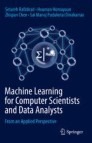
Machine Learning for Computer Scientists and Data Analysts: From an Applied Perspective
Describes traditional as well as advanced machine learning algorithms / Enables students to learn which algorithm is most appropriate for the data being handled / Includes numerous, practical case-studies; implementation codes in Python available for readers
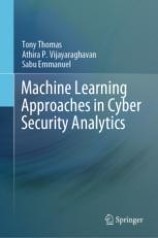
Machine Learning Approaches in Cyber Security Analytics
Introduces various machine learning methods for cyber security analytics. With an overwhelming amount of data being generated and transferred over various networks, monitoring everything that is exchanged and identifying potential cyber threats and attacks poses a serious challenge for cyber experts. Further, as cyber attacks become more frequent and sophisticated, there is a requirement for machines to predict, detect, and identify them more rapidly. Machine learning offers various tools and techniques to automate and quickly predict, detect, and identify cyber attacks.

Machine learning approach for cloud data analytics in IoT
Covers the multidimensional perspective of machine learning through the perspective of cloud computing and Internet of Things ranging from fundamentals to advanced applications. Elucidates some of the best practices and their respective outcomes in cloud and fog computing environments. It focuses on all the various research issues related to big data storage and analysis, large-scale data processing, knowledge discovery and knowledge management, computational intelligence, data security and privacy, data representation and visualization, and data analytics. The featured technologies presented in the book optimizes various industry processes using business intelligence in engineering and technology. Light is also shed on cloud-based embedded software development practices to integrate complex machines so as to increase productivity and reduce operational costs. The various practices of data science and analytics which are used in all sectors to understand big data and analyze massive data patterns are also detailed in the book.

Machine Learning and Knowledge Extraction ; 5th IFIP TC 5, TC 12, WG 8.4, WG 8.9, WG 12.9 International Cross-Domain Conference, CD-MAKE 2021, Virtual Event, August 17–20, 2021, Proceedings
Constitutes the refereed proceedings of the 5th IFIP TC 5, TC 12, WG 8.4, WG 8.9, WG 12.9 International Cross-Domain Conference, CD-MAKE 2021, held in virtually in August 2021. The 20 full papers and 2 short papers presented were carefully reviewed and selected from 48 submissions. The cross-domain integration and appraisal of different fields provides an atmosphere to foster different perspectives and opinions; it will offer a platform for novel ideas and a fresh look on the methodologies to put these ideas into business for the benefit of humanity.
