



الصفحة 28
الصفحة 28

Formal Techniques for Networked and Distributed Systems - FORTE 2006 ; 26th IFIP WG 6.1 International Conference, Paris, France, September 26-29, 2006, Proceedings
This book constitutes the refereed proceedings of the 26th IFIP WG 6.1 International Conference on Formal Techniques for Networked and Distributed Systems, FORTE 2006, held in Paris, France, in September 2006. The 26 revised full papers and 4 short papers presented together with 3 invited lectures were carefully reviewed and selected from 177 submissions. The papers focus on the construction of middleware and services using formalised and verified approaches.

Formal techniques for computer systems and business processes ; European performance engineering workshop, EPEW 2005 and International workshop on web services and formal methods, WS-FM 2005, Versailles, France, September 1-3, 2005, Proceedings
This book constitutes the refereed proceedings of two colocated international workshops EPEW 2005 (European Performance Engineering Workshop) and WS-FM 2005 (Web Services and Formal Methods) held in Versailles, France in September 2005. The 20 revised full papers presented were carefully reviewed and selected from 59 submissions. For EPEW 2005 only 10 papers - of the 32 submitted - were accepted for presentation; they deal with queueing theory, bounding techniques, stochastic model checking, communication schemes analysis for high-speed LAN, QOS analysis in wireless ad-hoc networks and optical networks analysis. The main topics of the 10 papers accepted for WS-FM 2005 - from 27 submissions - include: protocols and standards for WS (SOAP, WSDL, UDDI, etc.); languages and description methodologies for Choreography/Orchestration/Workflow (BPML, XLANG and BizTalk, WSFL, WS-BPEL, etc.); coordination techniques for WS (transactions, agreement, coordination services, etc.); semantics-based dynamic WS discovery services (based on Semantic Web/Ontology Techniques or other semantic theories); security, performance evaluation and quality of service of WS; semi-structured data and XML related technologies; comparisons with different related technologies/approaches.
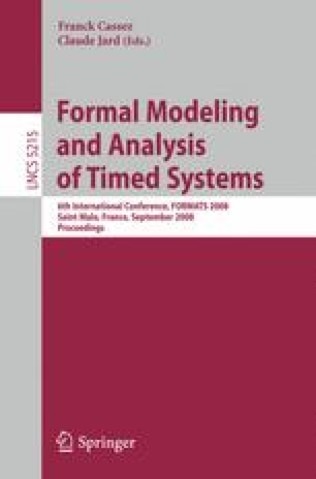
Formal Modeling and Analysis of Timed Systems ; 6th International Conference, FORMATS 2008, Saint Malo, France, September 15-17, 2008. Proceedings
This book constitutes the refereed proceedings of the 6th International Conference on Formal Modeling and Analysis of Timed Systems, FORMATS 2008, held in Saint Malo, France, September 2008.The 17 revised full papers presented together with 3 invited talks were carefully reviewed and selected from 37 submissions. The papers are organized in topical sections on extensions of timed automata and semantics; timed games and logic; case studies; model-checking of probabilistic systems; verification and test; timed petri nets.
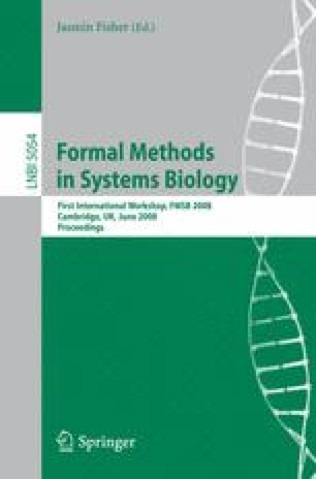
Formal Methods in Systems Biology ; 1st International Workshop, FMSB 2008, Cambridge, UK, June 4-5, 2008. Proceedings
This book constitutes the refereed proceedings of the First International Workshop on Formal Methods in Systems Biology, FMSB 2008, held in Cambridge, UK, in June, 2008.The 9 revised full papers presented were carefully reviewed and selected from the workshop lectures that all were invited contributions. The purpose of this meeting was to identify techniques for the specification, development and verification of biological models. It also focused on the design of tools to execute and analyze biological models that can significantly advance our understanding of biological systems.
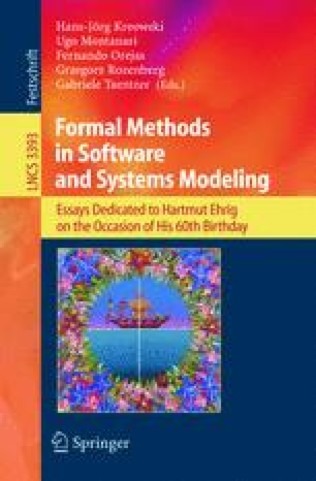
Formal Methods in Software and Systems Modeling : Essays Dedicated to Hartmut Ehrig on the Occasion of His 60th Birthday
By presenting state-of-the-art research results on various aspects of formal and visual modeling of software and systems, this book commemorates the 60th birthday of Hartmut Ehrig. The 24 invited reviewed papers are written by students and collaborators of Hartmut Ehrig who are established researchers in their fields. Reflecting the scientific interest and work of Hartmut Ehrig, the papers fall into three main parts on graph transformation, algebraic specification and logic, and formal and visual modeling.
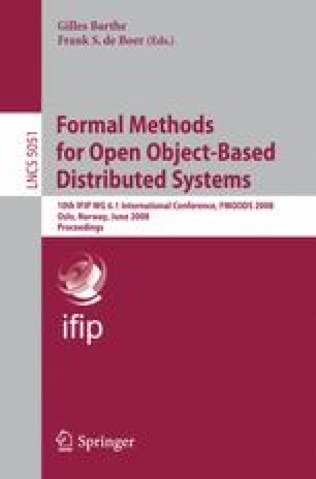
Formal Methods for Open Object-Based Distributed Systems ; 10th IFIP WG 6.1 International Conference, FMOODS 2008, Oslo, Norway, June 4-6, 2008 Proceedings
This book constitutes the refereed proceedings of the 10th IFIP WG 6.1 International Conference on Formal Methods for Open Object-Based Distributed Systems, FMOODS 2008, held in Oslo, Norway, in June 2008.The 14 revised full papers presented together with 1 invited lecture were carefully reviewed and selected from 35 submissions. The papers cover topcics such as semantics of object-oriented programming; formal techniques for specification, analysis, and refinement; model checking; theorem proving and deductive verification.

Formal Methods and Testing : An Outcome of the FORTEST Network, Revised Selected Papers
This book constitutes the thoroughly refereed and peer-reviewed outcome of the Formal Methods and Testing (FORTEST) network - formed as a network established under UK EPSRC funding that investigated the relationships between formal (and semi-formal) methods and software testing - now being a subject group of two BCS Special Interest Groups: Formal Aspects of Computing Science (BCS FACS) and Special Interest Group in Software Testing (BCS SIGIST).

Formal Methods and Stochastic Models for Performance Evaluation ; 4th European Performance Engineering Workshop, EPEW 2007, Berlin, Germany, September 27-28, 2007, Proceedings
This book constitutes the refereed proceedings of the 4th European Performance Engineering Workshop, EPEW 2007, held in Berlin, Germany, September 27-28, 2007.The 20 revised full papers presented were carefully reviewed and selected from 53 submissions.

Formal Methods and Software Engineering ; 10th International Conference on Formal Engineering Methods, ICFEM 2008, Kitakyushu-City, Japan, October 27-31, 2008. Proceedings
This book constitutes the refereed proceedings of the 10th International Conference on Formal Engineering Methods, ICFEM 2008, held in Kitakyushu-City, Japan, October 2008.The 20 revised full papers together with 3 invited talks presented were carefully reviewed and selected from 62 submissions. The papers address all current issues in formal methods and their applications in software engineering. They are organized in topical sections on specification and verification; testing; verification; model checking and analysis; tools; application of formal methods; semantics.
Formal concept analysis ; Vol. 3874 ; 4th International Conference, ICFCA 2006, Dresden, Germany, Feburary 13-17, 2006, Proceedings
This book constitutes the refereed proceedings of the 4th International Conference on Formal Concept Analysis, held in February 2006. The 17 revised full papers presented together with four invited papers were carefully reviewed and selected for inclusion in the book. The papers show advances in applied lattice and order theory and in particular scientific advances related to formal concept analysis and its practical applications: data and knowledge processing including data visualization, information retrieval, machine learning, data analysis and knowledge management.

Formal approaches to software testing ; Vol. 3395 ; 4th International workshop, FATES 2004, Linz, Austria, September 21, 2004, Revised Selected Papers
Testing often accounts for more than 50% of the required e?ort during system development.Thechallengeforresearchistoreducethesecostsbyprovidingnew methods for the speci?cation and generation of high-quality tests. Experience has shown that the use of formal methods in testing represents a very important means for improving the testing process. Formal methods allow for the analysis andinterpretationofmodelsinarigorousandprecisemathematicalmanner.The use of formal methods is not restricted to system models only. Test models may alsobeexamined.Analyzingsystemmodelsprovidesthepossibilityofgenerating complete test suites in a systematic and possibly automated manner whereas examining test models allows for the detection of design errors in test suites and their optimization with respect to readability or compilation and execution time. Due to the numerous possibilities for their application, formal methods have become more and more popular in recent years. The Formal Approaches in Software Testing (FATES) workshop series also bene?ts from the growing popularity of formal methods. After the workshops in Aalborg (Denmark, 2001), Brno (Czech Republic, 2002) and Montr´ eal (Canada, 2003), FATES 2004 in Linz (Austria) was the fourth workshop of this series. Similar to the workshop in 2003, FATES 2004 was organized in a?liation with the IEEE/ACM Conference on Automated Software Engineering (ASE 2004). FATES 2004 received 41 submissions. Each submission was reviewed by at least three independent reviewers from the Program Committee with the help of some additional reviewers. Based on their evaluations, 14 full papers and one wo- in-progress paper from 11 di?erent countries were selected for presentation.

Forest Trees
Genome Mapping and Molecular Breeding in Plants presents the current status of the elucidation and improvement of plant genomes of economic interest. The focus is on genetic and physical mapping, positioning, cloning, monitoring of desirable genes by molecular breeding and the most recent advances in genomics. The series comprises seven volumes: Cereals and Millets; Oilseeds; Pulses, Sugar and Tuber Crops; Fruits and Nuts; Vegetables; Technical Crops; and Forest Trees. Forest trees cover one third of the global land surface, constitute many ecosystems and play a pivotal role in the world economy. Despite their importance in the economy, ecology and environment, genetic analysis and breeding efforts have lagged behind. Presented here are chapters on Populus trees, pines, Fagaceae trees, eucalypts, spruces, Douglas fir and black walnut, and a first-ever detailed review of Cryptomeria japonica. Innovative strategies to address the inherent problems of genome analysis of tree species are thoroughly discussed.

Forest Landscape Ecology : Transferring Knowledge to Practice
Forest Landscape Ecology: Transferring Knowledge to Practice is the first book to introduce landscape ecologists to the discipline of knowledge transfer. The book considers knowledge transfer in general, critically examines aspects of transfer that are unique to forest landscape ecology, and reviews several case studies of successful applications for policy developers and forest managers in North America. Readers are encouraged to recognize the value of sharing their knowledge, and to understand their role in active knowledge transfer. The intent is to connect, as seamlessly and effectively as possible, ecological principles to policy and practice.

Forensic Pathology Reviews ; Vol. 5
In this volume of the globally recognized Forensic Pathology Reviews, Dr. Michael Tsokos has gathered chapters from the top experts in the field to reveal both the applied and scientific areas of expertise along the broad spectrum of forensics studies.

Forensic Pathology Reviews ; Vol. 4
Building on the excellent foundation laid in earlier volumes of the series, leading forensic pathologists from the United States and around the world again provide in Forensic Pathology Reviews, Volume 4 evidence-based accounts of special topics of current interest from various fields of forensic pathology and death-scene investigation. The authors offer cutting-edge insights into death from environmental conditions (lightning and elder abuse), homicide by sharp force, death from natural causes (asthma, Marfan syndrome, and peliosis of the liver and spleen), and pathology of human endothelium in septic organ failure.

Forensic pathology reviews ; Vol. 3
Maintaining the high quality achieved in earlier volumes, leading national and international forensic pathologists provide in Forensic Pathology Reviews, Volume 3 evidence-based accounts of special topics of current interest from various fields of forensic pathology and death-scene investigation. The authors offer cutting-edge insights into the medicolegal investigation of bodies found in water, the forensic aspects of the human immunodeficiency virus (HIV)-1 infection of the central nervous system, deaths in a head-down position, and forensic bitemark analysis. Additional chapters address taphonomic changes in human bodies during the early postmortem interval, arrhythmogenic ventricular dysplasia that produces sudden death in young people, the postmortem diagnosis of death in anaphylaxis, and iatrogenic deaths. The forensic aspects of suicide, murder-suicide, and suicide trends in the United States are also discussed, along with the evaluation of fatal pulmonary thromboembolism and the use of radiology in medicolegal investigations. A comprehensive, up-to-date review of the international literature is given for each chapter. Evidence-based and state-of-the-art, Forensic Pathology Reviews, Volume 3 synthesizes the practical advances made in a variety of important subspecialties of forensic pathology, demonstrating how the latest medical and scientific advances are being applied to solve current problems of high interest to forensic pathologists today.

Food-Borne Parasitic Zoonoses : Fish and Plant-Borne Parasites
The focus of this book is on those zoonoses that are transmitted by fish, plant and invertebrate foods. While people, especially those living in developed countries, are commonly aware of meat-borne zoonoses such as trichinellosis and cysticercosis, fewer are acquainted with parasitic diseases caused by liver, lung and intestinal flukes, fish-borne tapeworms, and tissue roundworms. This book reviews not only the prevalence and distribution of these zoonoses, including available health and economic impact data, but also highlights gaps in our knowledge base that must be filled in order to gain insights on approaches to prevention. The topics on epidemiology, diagnosis, and clinical aspects emphasize knowledge gaps that limit a full understanding of these zoonoses, and target where greater research investments on these parasitic diseases should be focused.

Food Safety : A Practical and Case Study Approach
The ISEKI-Food book series is a collection where various aspects of food safety and environmental issues are introduced and reviewed by scientists specializing in the field. In all of the books special emphasis is placed on including case studies applicable to each specific topic. The books are intended for graduate students and senior level undergraduate students as well as professionals and researchers interested in food safety and environmental issues applicable to food safety."ISEKI-Food" is an acronym for "Integrating Safety and Environmental Knowledge Into Food Studies".

Food preservation and safety of natural products
Food Preservation and Safety of Natural Products addresses the most common causes of food spoilage that create significant loss to global food production while also discussing how food serves as a vehicle for the transmission of pathogenic microorganisms responsible for mild to debilitating health conditions in humans. The book provides essential information for food safety professionals on issues relating to foodborne diseases and offers potential solutions by presenting various methods of incorporating natural products in food production to prevent the spread of foodborne pathogenic organisms. The demand for green consumerism and consumers general distaste for synthetic food additives poses a serious challenge to food safety and preservation. Natural products are used as green and sustainable source of bioactive compounds that can be applied in various fields including food. The use of plant and other natural products in food preservation is on the rise, hence this book reviews microbial mediated food spoilage, foodborne pathogens and food contamination and offers applications of natural products in food preservation.

Food powders : Physical properties, processing, and functionality
Food Powders: Physical Properties, Processing, and Functionality is a comprehensive review on the characterization of ingredients, semi-processed and finished products when they are in a powdered form. It includes the description of different industrial unit operations such as drying, grinding, mixing, agglomeration, and encapsulation that supply food powders of different composition and microstructure. It also includes several analytical tools to characterize food powders by their particle size, size distribution, physical properties, and functionality.
