



الصفحة 26
الصفحة 26

Geoenvironmental Engineering : Geoenvironmental impact management ; Proceedings of the third conference organized by the British Geotechnical Association and Cardiff School of Engineering, Cardiff University, and held in Edinburgh on 17–19 September 2001
Geoenvironmental engineering contains the collected papers from the third Geoenvironmental Engineering Conference, organised by the British Geotechnical Association and Cardiff School of Engineering, Cardiff University. Authors from around the world have submitted the papers in this volume. They aim to share knowledge and experience to the international geoenvironmental engineering community. The main theme of this third conference is Geoenvironmental Impact Management.

Geodetic Deformation Monitoring : From Geophysical to Engineering Roles ; IAG Symposium Jaén, Spain, March 7-19,2005
Geodesy is the science dealing with the determination of the position of points in space, the shape and gravity field of the Earth and with their time variations. A consequence is that geodesists feel as a permanent subject of research, the detection, analysis and interpretation of spatial deformation as well as gravity field variation. This book collects 36 selected papers from the International Symposium on Geodetic Deformation Monitoring held in Jaén (Spain) from 17th to 19th March 2005. The main topics covered in the symposium were: mathematical and statistical models for crustal deformation analysis, deformation monitoring from GPS and InSAR data: analysis and geophysical interpretation, geodetic monitoring of movements in civil engineering, integration of spatial and terrestrial techniques in deformation studies, geodynamical applications of gravimetric observations and present-day geodetic instrumentation for deformation monitoring. This volume is a good overview of theoretical matters, models and results.

Geodetic and geophysical observations in Antarctica : An overview in the IPY perspective
This book is a collection of papers on various aspects of the scientific investigation and observation techniques of the polar regions at both temporary and permanent observatories. Most papers focus on regional models based on data acquired in polar regions. Geodetic satellite positions systems (GNSS: GPS, GLONASS, GALILEO) will also be discussed as well as other space techniques (DORIS, VLBI). Gravimetry, absolute gravimetry, and tidal gravimetry are also discussed, as well as seismology and meteorology.

Genome Mapping and Genomics in Arthropods
Mapping of animal genomes has generated huge databases and several new concepts and strategies, which are useful to elucidate origin, evolution and phylogeny. Genetic and physical maps of genomes further provide precise details on chromosomal location, function, expression and regulation of academically and economically important genes. The series "Genome Mapping and Genomics in Animals" provides comprehensive and up-to-date reviews on genomic research on a large variety of selected animal systems, contributed by leading scientists from around the world.Insects and other arthropods, the largest group of animals in number of species, have global impact on agriculture, industry, human health and environment. They are of particular economic importance for food production as pollinators, for natural products like silk and also as pests and parasites. Arthropods covered in this volume include honeybee, bumblebee, the parasitic Jewel Wasp, silkworm, pea aphid, mosquito, Hessian fly and tick.

Genome Editing : Gene Therapy or Gene Optimization?
Genome editing technology is considered one of the most revolutionary techniques lately. The ability of modifying the human genome has been one of the biggest dreams for therapist for the reason that the genetic modification with exogenous DNA can be considered a problem solver for many diseases and disorders (genetic disorders), especially those with high risks and low survival rates, on this case, gene therapy appears as the tool to be used, with its many protocols and approaches. Gene therapy is based on delivering a therapeutic gene throw suitable vectors, which is most of the time-modified viruses to carry the therapeutic genes to the target cells and so on providing the functional copy of the defective gene.

Genetics and regulation of nitrogen fixation in free-Living bacteria
This book is the second volume of a seven-volume series, which covers all fields of research related to nitrogen fixation - from basic studies through applied aspects to environmental impacts. Volume II provides a comprehensive and detailed source of information concerning the genetics and regulation of biological nitrogen fixation in free-living prokaryotes.

Genetic programming : Theory and practice II
This volume explores the emerging interaction between theory and practice in the cutting-edge, machine learning method of Genetic Programming (GP). The contributions developed from a second workshop at the University of Michigan's Center for the Study of Complex Systems where leading international genetic programming theorists from major universities and active practitioners from leading industries and businesses met to examine how GP theory informs practice and how GP practice impacts GP theory. Chapters include such topics as financial trading rules, industrial statistical model building, population sizing, the roles of structure in problem solving by computer, stock picking, automated design of industrial-strength analog circuits, topological synthesis of robust systems, algorithmic chemistry, supply chain reordering policies, post docking filtering, an evolved antenna for a NASA mission and incident detection on highways.

Genetic Democracy : Philosophical Perspectives
GENETIC DEMOCRACY involves an in-depth analysis of the ethical, social and philosophical issues related to modern genetic research and gene technology. The aim of the book is to introduce systematic research on the social and ethical impacts of the use and development of genetically modified organisms (GMOs) as well as the acquisition, use and storage of human genetic information (HGI). The book contributes into enhancing public discussion and reaching fair and democratic decision-making practices in GMO and HGI use and development both on local and global level.

Generalized Curvatures
The central object of this book is the measure of geometric quantities describing N a subset of the Euclidean space (E ,), endowed with its standard scalar product. Let us state precisely what we mean by a geometric quantity. Consider a subset N S of points of the N-dimensional Euclidean space E , endowed with its standard N scalar product. LetG be the group of rigid motions of E . We say that a 0 quantity Q(S) associated toS is geometric with respect toG if the corresponding 0 quantity Q[g(S)] associated to g(S) equals Q(S), for all g?G . For instance, the 0 diameter ofS and the area of the convex hull ofS are quantities geometric with respect toG . But the distance from the origin O to the closest point ofS is not, 0 since it is not invariant under translations ofS. It is important to point out that the property of being geometric depends on the chosen group. For instance, ifG is the 1 N group of projective transformations of E , then the property ofS being a circle is geometric forG but not forG , while the property of being a conic or a straight 0 1 line is geometric for bothG andG . This point of view may be generalized to any 0 1 subsetS of any vector space E endowed with a groupG acting on it.

Generalized Convexity, Generalized Monotonicity and Applications ; Proceedings of the 7th International Symposium on Generalized Convexity and Generalized Monotonicity
This volume contains a collection of refereed articles on generalized convexity and generalized monotonicity. The first part of the book contains invited papers with applications of (generalized) convexity to such diverse fields as algebraic dynamics of the Gamma function values, discrete optimization, Lipschitzian stability of parametric constraint systems, and monotonicity of functions. The second part contains contributions presenting the latest developments in generalized convexity and generalized monotonicity: its connections with discrete and with continuous optimization, multiobjective optimization, fractional programming, nonsmooth Aanalysis, variational inequalities, and its applications to concrete problems such as finding equilibrium prices in mathematical economics, or hydrothermal scheduling.

Gender, Health and Ageing : European Perspectives on Life Course, Health Issues and Social Challenges
The objective of this book is to provide an overview of gender, health and ageing. Important theoretical concepts, such as life course and "Lebenslagen" in old age, or differences in men's health, are introduced. It is increasingly important to build a European basis of knowledge, to conduct discussions on European research findings, and to develop European research frameworks. In this volume, central theoretical debates on gender impacts on life course and old-age health, and vital issues of health research in the context of gender and old age are introduced. Specific aspects, such as the impact of gender and age on cardiovascular health, elder abuse and mental health, or care between gender relations, gender roles and gender constructs, are pointed out.

Gallium Nitride Electronics
Gallium Nitride Electronics covers developments in III-N semiconductor-based electronics with a focus on high-power and high-speed RF applications. Material properties of III-N semiconductors and substrates; the state-of-the-art of devices and circuits, epitaxial growth, device technology, modelling and characterization; and circuit examples are discussed. The book concludes with device reliability aspects and an overview of integration and packaging. This comprehensive monograph and tutorial is based on more than a decade of research on materials, devices, and circuits.

Galling Arthropods and Their Associates ; Ecology and Evolution
The book addresses recent developments in the ecology, evolution, systematics, physiology, and biodiversity of gall-inducing arthropods, with individual contri butions ranging in scope from detailed descriptions to profoundly synthetic stud ies. One underlying theme of the book is the various impacts of gall induction that indirectly affect insect communities on the host plant. The other important contri bution is the highly intricate and dynamic interactions between galling arthropods and their uniquely specialized host plants. Included also are chapters that discuss biodiversity and distribution patterns of gall-inducing arthropods, and biological control of invasive gall-inducing arthropods and of invasive trees. We believe that this book makes an important contribution to the knowledge of galling arthropods and their associates and to the development of robust, general principles of the ecology and evolution of these organisms.

Galaxy Formation and Evolution
An Astronomical Life – Observing the Depths of the Universe” Though science as a subject can be di?cult, what has been more important for me is that its practice can also be rewarding fun! This book is crafted to expose the reader to the excitement of modern observational cosmology through the study of galaxy evolution over space and cosmic time. Recent extragalactic research has led to many rapid advances in the ?eld. Even a suitable skeptic of certain pronouncements about the age and structure of the Universe should be pleased with the large steps that have been taken in furthering our understanding of the Universe since the early 1990’s. My personal involvement in galaxy research goes back to the 1960’s. At that point, galaxies were easily recognized and partially understood as organized c- lections of stars and gas. What their masses were presented a problem, which I supposed would just fade away. But fade it didn’t. Distant active nuclei and quasars were discovered in the mid-1960’s. A c- mon view of QSOs was that they have large redshifts, but what use are they for cosmology or normal galaxy astrophysics? I shared that conclusion. My expec- tions fell below their potential utility. In short, the Universe of our expectations rarely matches the Universe as it is discovered.

Galaxy Formation
This second edition of Galaxy Formation is an up-to-date text on astrophysical cosmology, expounding the structure of the classical cosmological models from a contemporary viewpoint. This forms the background to a detailed study of the origin of structure and galaxies in the Universe. The derivations of many of the most important results are derived by simple physical arguments which illuminate the results of more advanced treatments. A very wide range of observational data is brought to bear upon these problems, including the most recent results from WMAP, the Hubble Space Telescope, galaxy surveys like the Sloan Digital Sky Survey and the 2dF Galaxy Redshift Survey, studies of Type 1a supernovae, and many other observations.

Galaxies in Turmoil : The Active and Starburst Galaxies and the Black Holes That Drive Them
Active galaxies involve some of the most extreme conditions and some of the most intriguing phenomena found anywhere in the universe. Research students - and even established research astronomers - will also find this book invaluable as a quick reference to the properties of, and phenomena within, those types of active galaxies that may be outside their specialisms.

Galaxies in the Local Vol.
Studies of Nearby Galaxies are currently the focus of many observations and numerical simulations. This book presents an overview of the galaxies within the Local Volume (D < 10 Mpc), including the Local Group (D < 1 Mpc) and our closest neighbours, the Andromeda Galaxy and the Magellanic Clouds. Presented are the latest results from radio, infrared and optical surveys as well as detailed multi-wavelength studies of individual galaxies. Accurate distances are now available for the majority of Local Volume galaxies providing a true 3-dimensional view of their distribution and flow pattern as well as their star formation.

Fuzzy systems and knowledge discovery ; Vol. 3614 ; 2nd International Conference, FSKD 2005, Changsha, China, August 27-29, 2005, Proceedings, Part II
This book and its sister volume, LNAI 3613 and 3614, constitute the proce- ings of the Second International Conference on Fuzzy Systems and Knowledge Discovery (FSKD 2005), jointly held with the First International Conference on Natural Computation (ICNC 2005, LNCS 3610, 3611, and 3612) from - gust 27–29, 2005 in Changsha, Hunan, China. FSKD 2005 successfully attracted 1249 submissions from 32 countries/regions (the joint ICNC-FSKD 2005 received 3136 submissions). After rigorous reviews, 333 high-quality papers, i. e. , 206 long papers and 127 short papers, were included in the FSKD 2005 proceedings, r- resenting an acceptance rate of 26. 7%. The ICNC-FSKD 2005 conference featured the most up-to-date research - sults in computational algorithms inspired from nature, including biological, e- logical, and physical systems. It is an exciting and emerging interdisciplinary area in which a wide range of techniques and methods are being studied for dealing with large, complex, and dynamic problems. The joint conferences also promoted cross-fertilization over these exciting and yet closely-related areas, which had a signi?cant impact on the advancement of these important technologies. Speci?c areas included computation with words, fuzzy computation, granular com- tation, neural computation, quantum computation, evolutionary computation, DNA computation, chemical computation, information processing in cells and tissues, molecular computation, arti?cial life, swarm intelligence, ants colony, arti?cial immune systems, etc. , with innovative applications to knowledge d- covery, ?nance, operations research, and more.
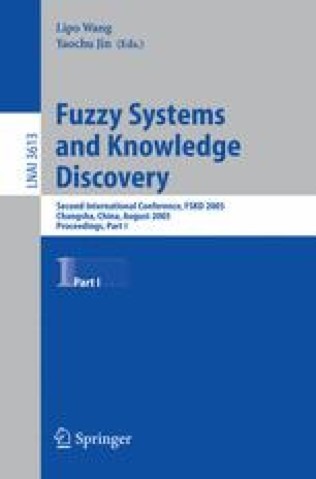
Fuzzy systems and knowledge discovery ; Vol. 3613 ; 2nd International Conference, FSKD 2005, Changsha, China, August 27-29, 2005, Proceedings, Part I
This book and its sister volume, LNAI 3613 and 3614, constitute the proce- ings of the Second International Conference on Fuzzy Systems and Knowledge Discovery (FSKD 2005), jointly held with the First International Conference on Natural Computation (ICNC 2005, LNCS 3610, 3611, and 3612) from - gust 27–29, 2005 in Changsha, Hunan, China. FSKD 2005 successfully attracted 1249 submissions from 32 countries/regions (the joint ICNC-FSKD 2005 received 3136 submissions). After rigorous reviews, 333 high-quality papers, i. e. , 206 long papers and 127 short papers, were included in the FSKD 2005 proceedings, r- resenting an acceptance rate of 26. 7%. The ICNC-FSKD 2005 conference featured the most up-to-date research - sults in computational algorithms inspired from nature, including biological, e- logical, and physical systems. It is an exciting and emerging interdisciplinary area in which a wide range of techniques and methods are being studied for dealing with large, complex, and dynamic problems. The joint conferences also promoted cross-fertilization over these exciting and yet closely-related areas, which had a signi?cant impact on the advancement of these important technologies. Speci?c areas included computation with words, fuzzy computation, granular com- tation, neural computation, quantum computation, evolutionary computation, DNA computation, chemical computation, information processing in cells and tissues, molecular computation, arti?cial life, swarm intelligence, ants colony, arti?cial immune systems, etc. , with innovative applications to knowledge d- covery, ?nance, operations research, and more.

Fuzzy Chaotic Systems : Modeling, Control, and Applications
"Fuzzy Chaotic Systems" provides original heuristic research achievements and insightful ideas on the interactions or intrinsic relationships between fuzzy logic and chaos theory. It presents the fundamental concepts of fuzzy logic and fuzzy control, chaos theory and chaos control, as well as thedefinition of chaos on the metric space of fuzzy sets. This monograph discusses and illustrates fuzzy modeling and fuzzy control of chaotic systems, synchronization, anti-control of chaos, intelligent digital redesign, spatiotemporal chaos and synchronization in complex fuzzy systems; as well as a practical application example of fuzzy-chaos-based cryptography. Like other very good books, this book may raise more questions than it can provide answers. It therefore generates a great potential to attract more attention to combine fuzzy systems with chaos theory and contains important seeds for future scientific research and engineering applications.
