



الصفحة 26
الصفحة 26

EU Accession - Financial Sector Opportunities and Challenges for Southeast Europe
A distinguished international group of central bankers, commercial bankers, entrepreneurs, academic advisors, policymakers, and representatives of development finance organizations and donor agencies, brought together by KfW, examines in this book the future of financial sector development in Southeast Europe. They explore ways to strengthen the banking sector in Southeast Europe, further promote SMEs, and improve access to financial services in the region. Experts and decision-makers assess the opportunities and challenges presented by the EU accession process and Basel II, and offer candid insight into the expanding role of the private sector in developing the financial landscape. The perspectives presented in this book will prompt discussion and intellectual exchange that will serve as a new starting point for further successful cooperative initiatives.

Ethnobotany : A phytochemical perspective
Explores the chemistry behind hundreds of plant medicines, dyes, fibers, flavors, poisons, insect repellants, and many other uses of botanicals. Bridging the gap between ethnobotany and chemistry, this book presents an introduction to botany, ethnobotany, and phytochemistry to clearly join these fields of study and highlight their importance in the discovery of botanical uses in modern industry and research. Part I. Ethnobotany, explores the history of plant exploration, current issues such as conservation and intellectual property rights, and a review of plant anatomy. An extensive section on plant taxonomy highlights particularly influential and economically important plants from across the plant kingdom. Part II. Phytochemistry, provides fundamentals of secondary metabolism, includes line drawings of biosynthetic pathways and chemical structures, and describes traditional and modern methods of plant extraction and analysis. The last section is devoted to the history of native plants and people and case studies on plants that changed the course of human history from five geographical regions: Africa, the Americas, Asia, Europe, and Ocean. Throughout the entire book, vivid color photographs bring science to life, capturing the essence of human botanical knowledge and the beauty of the plant kingdom.

Ethical and Social Issues in the Information Age
This book takes off where the second ended to examine ethical, social, and policy challenges stemming from the emergence of cyberspace, the convergence of telecommunication and computing technologies, and the miniaturalization of computing, telecommunication, and information-enabling devices. This accessible volume broadly surveys thought-provoking questions about the impact of these new technologies, with particular emphasis on the rapid growth of a multitude of computer networks, including the Internet. It assumes only a very modest familiarity with the basic computer literacy.

E-Service Intelligence : Methodologies, Technologies and Applications
Business organizations and governments are nowadays developing and providing internet based electronic services (e-services) featuring various intelligent functions. E-Service Intelligence integrates intelligent techniques into e-service systems for realizing intelligent internet information searching, presentation, provision, recommendation, online system design, implementation, and assessment to internet users. This book offers a thorough introduction and systematic overview of the new field and covers the state-of-the-art of the research and development in E-Service Intelligence ranging from e-services and/or intelligent techniques to web information presentation, search, and mining, to personalization, privacy, and trust in e-services, to e-service evaluation, optimization and knowledge discovery, and to intelligent e-service system developments.

Ergonomics and Health Aspects of Work with Computers ; International Conference, EHAWC 2007, Held as Part of HCI International 2007, Beijing, China, July 22-27, Proceedings
This book address the latest research and development efforts and highlight the human aspects of design and use of computing systems. It cover the entire field of Human-Computer Interaction, addressing major - vances in knowledge and effective use of computers in a variety of application areas. This volume contains thematic area of Ergonomics and Health Aspects of Work with Computers, addressing the following major topics:Health and Well Being in the Working Environment, Ergonomics and Design

Epilepsy and Intellectual Disabilities
Epilepsy and Intellectual Disabilities brings together findings from research and clinical practice, with comprehensive coverage of the important aspects of epilepsy in persons with intellectual disabilities.

Environments for Multi-Agent Systems III ; 3rd International Workshop, E4MAS 2006, Hakodate, Japan, May 8, 2006, Selected Revised and Invited Papers
This book are organized in topical sections on models, architecture, and design, mediated interaction and stigmery, governing environment, and applications.

Environments for Multi-Agent Systems II ; 2nd International Workshop, E4MAS 2005, Utrecht, The Netherlands, July 25, 2005, Selected Revised and Invited Papers
This book constitutes the thoroughly refereed post-proceedings of the Second International Workshop on Environments for Multiagent Systems, E4MAS 2005, held in July 2005. The 16 revised papers presented were carefully reviewed and selected from the lectures given at the workshop.

Environments for Multi-Agent Systems ; 1st International Workshop, E4MAS, 2004, New York, NY, July 19, 2004, Revised Selected Papers
The modern ?eld of multiagent systems has developed from two main lines of earlier research. Its practitioners generally regard it as a form of arti?cial intelligence (AI). Some of its earliest work was reported in a series of workshops in the US dating from1980,revealinglyentitled,“DistributedArti?cialIntelligence,”andpioneers often quoted a statement attributed to Nils Nilsson that “all AI is distributed. ” The locus of classical AI was what happens in the head of a single agent, and much MAS research re?ects this heritage with its emphasis on detailed modeling of the mental state and processes of individual agents. From this perspective, intelligenceisultimatelythepurviewofasinglemind,thoughitcanbeampli?ed by appropriate interactions with other minds. These interactions are typically mediated by structured protocols of various sorts, modeled on human conver- tional behavior. But the modern ?eld of MAS was not born of a single parent. A few - searchershavepersistentlyadvocatedideasfromthe?eldofarti?ciallife(ALife). These scientists were impressed by the complex adaptive behaviors of commu- ties of animals (often extremely simple animals, such as insects or even micro- ganisms). The computational models on which they drew were often created by biologists who used them not to solve practical engineering problems but to test their hypotheses about the mechanisms used by natural systems. In the ar- ?cial life model, intelligence need not reside in a single agent, but emerges at the level of the community from the nonlinear interactions among agents. - cause the individual agents are often subcognitive, their interactions cannot be modeled by protocols that presume linguistic competence.

Entrepreneurship and innovation : Theory, practice and context, 4th
Provides an overview of the theory, Practice and context of entrepreneurship and innovation at both the industry and firm level. It provides a foundation of ideas and understandings designed to shape the reader’s thinking and behaviour to better appreciate the role of innovation and entrepreneurship in modern economies, And to recognise their own abilities in this regard. The book provides the reader with an overview of these elements and how they combine to create new value in the market.

Entrepreneurship : Digital transformation, education, opportunities and challenges ; Vol. 28
Digital transformation and artificial intelligence play an important role in entrepreneurship. this book adopts a multidisciplinary approach to entrepreneurship, exploring how entrepreneurial processes contribute to developing new products and services and innovative business models. recent shifts in business models focus on digital transformation and well-being. entrepreneurship is evolving with innovative approaches, and artificial intelligence is revolutionizing marketing strategies and market engagement. this volume presents a comprehensive overview of entrepreneurship, digital transformation, and entrepreneurial education.

Enterprise Management with SAP SEM™
In order to make strategy happen there is a need for powerful management information systems. SAP focuses on the application of modern business administration concepts, e.g. Value Based Management, the Balanced Scorecard, the Management Cockpit or flexible planning methods. The book describes the methodology and implementation of a powerful tool for enterprise management. Practical examples show how SAP Strategic Enterprise Management/Business Analytics (SAP SEM/BA) can help to improve cross functional planning, reporting and analyzing. SAP SEM/BA is a leading edge IT-solution for top management and related departments in large enterprises and groups. It demonstrates the state of the art of modern management information and decision support systems.

Enterprise Information Systems VII
The purpose of the 7th International Conference on Enterprise Information Systems (ICEIS) was to bring together researchers, engineers and practitioners interested in the advances and business applications of information systems. Five simultaneous tracks have been held, covering different aspects of Enterprise Information Systems Applications, including Enterprise Database Technology, Systems Integration, Artificial Intelligence, Decision Support Systems, Information Systems Analysis and Specification, Internet Computing, Electronic Commerce and Human Factors.

Enterprise Information Systems VI
This book contains the best papers of the Sixth International Conference on Enterprise Information Systems (ICEIS 2004), held in Porto (Portugal) and organized by INSTICC (Institute for Systems and Technologies of Information, Communication and Control) in collaboration with PORTUCALENSE UNIVERSITY, who hosted the event. Following the route started in 1999, ICEIS has become a major point of contact between research scientists, engineers and practitioners on the area of business applications of information systems. This conference has received an increased interest every year, from especially from the international academic community, and it is now one of the world largest conferences in its area. This year, five simultaneous tracks were held, covering different aspects related to enterprise computing, including: “Databases and Information Systems Integration”,

Enterprise Information Systems V
ICEIS focuses on real world applications and aims at bringing together researchers, engineers and practitioners interested in the advances and business applications of information systems. As in previous years, ICEIS’2003 held four simultaneous tracks covering different aspects of enterprise computing: Databases and Information Systems Integration, Artificial Intelligence and Decision Support Systems, Information Systems Analysis and Specification and Software Agents and Internet Computing. Although ICEIS’2003 received 546 paper submissions from over 50 countries, only 80 were accepted as full papers and presented in 30-minutes oral presentations. With an acceptance rate of 15%, these numbers demonstrate the intention of preserving a high quality forum for future editions of this conference. From the articles accepted as long papers for the conference, only 32 were selected for inclusion in this book Additional keynote lectures, tutorials and industrial sessions were also held during ICEIS’2003, and, for the first time this year, the 1st Doctoral Consortium on Enterprise Information Systems gave PhD students an opportunity to present their work to an international audience of experts in the field of information systems.
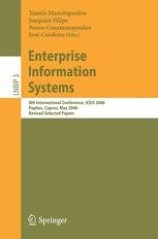
Enterprise Information Systems ; 8th International Conference, ICEIS 2006, Paphos, Cyprus, May 23-27, 2006, Revised Selected Papers
This book contains the carefully selected best papers of the 8th International Conference on Enterprise Information Sysetms, ICEIS 2006, held in Paphos, Cyprus, in May 2006.The 4 invited papers and 27 revised and selected papers presented in this volume cover different aspects related to enterprise computing. They were selected from 63 accepted papers (out of more than 400 submissions). The contributions are grouped in sections on databases and information systems integration.

Enterprise Artificial Intelligence Transformation
AI is everywhere. From doctor's offices to cars and even refrigerators, AI technology is quickly infiltrating our daily lives. AI has the ability to transform simple tasks into technological feats at a human level. This will change the world, plain and simple. That's why AI mastery is such a sought-after skill for tech professionals.

Ensembles ordonnés finis : concepts, résultats et usages = Finite ordered sets : concepts, results and uses
The concepts of order, classification, storage are presented in many activities and human situations. The mathematical formalization of these notions first allowed the great development of the theory of lattices, then that of more general ordered structures, in particular those relating to discrete mathematics.

Ennio De Giorgi : Selected Papers
The book contains a selection of 43 scientific papers by the great mathematician Ennio De Giorgi (1928-1996), which display the broad range of his achievements and his entire intellectual career as a problem solver and as a proponent of deep and ambitious mathematical theories. All papers are written in English and 17 of them appear also in their original Italian version in order to give an impression of De Giorgi’s original style. The editors also provide a short biography of Ennio De Giorgi and a detailed account of his scientific achievements, ranging from his seminal paper on the solution of Hilbert’s 19th problem to the theory of perimeter and minimal surfaces, the theory of G-convergence and the foundations of mathematics.

Enhancing Cognitive Assistance Systems with Inertial Measurement Units
The primary goal of this book is the specification, design and testing of an inertially stabilized camera platform for assistance systems with the focus on adaptive inertial measurement.
