



الصفحة 26
الصفحة 26

Accreditation and Evaluation in the European Higher Education Area
This volume presents a rich account of the development of accreditation and evaluation in 20 European countries. The authors are leaders in the field and they have cooperated in this effort by writing richly different, often deep and insightful analyses of the situation in their country. The two editors have added a synopsis detailing the main trends, and sketching commonalities as well as contrasts in the developments across Europe. The book shows how accreditation is becoming a main mechanism in the steering of higher education all over Europe. The book is unique in its analysis of forces driving towards the spread of different models of accreditation in the emerging European Higher Education area. Readers will obtain an up-to-date picture of the state of affairs of accreditation in the framework of evaluation activities in Europe.

Accounting, Cash Flow and Value Relevance
Investigates the value relevance of the operating cash flow as reported under the International Financial Reporting Standards (IAS/IFRS) for the largest European listed companies and US listed companies in the past recent years. Using the model based on the valuation theory developed by Ohlson, which measures the market value of equity as a function of accounting variables, the author concludes that operating cash flow represents a significant variable in determining the value relevance of the largest European and US listed companies. These findings provide siginificant implications for standard setters and support the continued requirements for disclosure of cash flow information under IAS 7.
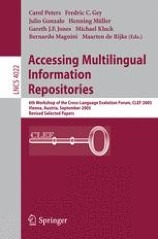
Accessing Multilingual Information Repositories ; 6th Workshop of the Cross-Language Evaluation Forum, CLEF 2005, Vienna, Austria, 21-23 September, 2005, Revised Selected Papers
The sixth campaign of the Cross Language Evaluation Forum (CLEF) for European languages was held from January to September 2005. CLEF is by now an established international evaluation initiative and 74 groups from all over the world submitted results for one or more of the different evaluation tracks in 2005, compared with 54 groups in 2004. There were eight distinct evaluation tracks, designed to test the performance of a wide range of systems for multilingual information access. Full details regarding the design of the tracks, the methodologies used for evaluation, and the results obtained by the participants can be found in the different sections of these proceedings.

Abuse of Dominant Position : New Interpretation, New Enforcement Mechanisms?
As part of its review of competition law that started in the late 1990s, the European Commission proposes to revise its interpretation and application of the Treaty’s prohibition of abuses of dominant positions. Also, it has instigated a debate about the promotion of private enforcement of EC competition law. The chapters in this volume critically appraise the Commission’s proposals, including the most recent ones. The authors also highlight the repercussions of the proposed ‘more economic approach’ to abuses of dominant positions on private litigants’ opportunities to bring damages actions in national courts for such abuses.

A Trading Desk View of Market Quality
"Market quality" is a complex, ambiguous term that means different things to different people. How should it be defined, measured, monitored, and improved? What is the evidence about the current state of our markets? How effective have recent innovations been? How can we better meet investor needs? These are some of the questions that we address in this book, along with a broad range of issues concerning equity market structure, regulation, and the quest for best execution. Throughout, particular attention is given to the perspective of front line participants on the buy-side and sell-side trading desks.
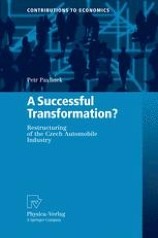
A Successful Transformation? : Restructuring of the Czech Automobile Industry
This book investigates the complex processes of the post-1990 transformation in the Czech automotive industry and its selective integration in the West European automobile manufacturing system. The post-1990 restructuring of the Czech automotive industry is analyzed in the context of its pre-1990 development and in the context of the Central and East European automobile industry as a whole. Specifically, the book examines the development and post-1990 restructuring of the Czech passenger car industry, the components industry and truck manufacturing. Major topics covered include the development of the Czech automotive industry before 1990, the detailed case study of Škoda Auto, the effects of the post-1990 privatization in the Czech automotive industry, the role and effects of foreign direct investment during the post-1990 restructuring, the restructuring of the Czech truck industry, and the rapid development of the automotive components manufacturing.

A practical guide on behaviour change support for self-managing chronic disease
Developed under the auspices of the Train4Health project, funded by the Erasmus+ program of the European Union, the book contains six chapters written by international contributors from different disciplines. Chapter one introduces the competencies necessary for delivering effective behavior change support, based on an established program of work, and related learning outcomes. The four following chapters describe how these competencies can be acquired, focusing on concepts and theories, assessing self-management behaviors, implementing change strategies and person-centered communication, using a practical approach.

A new deal for an effective European research policy : The design and impacts of the 7th Framework programme
It underlines an important truth: that science has always advanced most rapidly when it is a collective endeavour, with a strong circulation of knowledge.This book will show how the new Framework Programme was put together and explain why it took the shape it did. It will also set out its potential impacts and the conditions necessary for it to be a success.
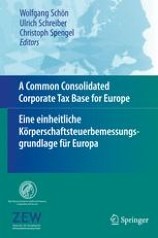
A Common Consolidated Corporate Tax Base for Europe = Eine einheitliche Körperschaftsteuerbemessungsgrundlage für Europa
This book contains the proceedings of the International Tax Conference on the c- th th mon consolidated corporate tax base (CCCTB) that was held in Berlin Three panels of tax experts evaluated the common tax base with respect to structural elements, consolidation, allocation, international aspects and administration.

A basic guide to international business law
Gives students an understanding as well as practical knowledge of legal problems arising in the area of international business, and to equip them with the skills needed to prevent and tackle these problems. All chapters employ the same didactic structure. Introductory case studies, examples, annotated case law, glossaries, diagrams, summaries and exercises are all designed to familiarize students quickly with relevant aspects of international (business) law.
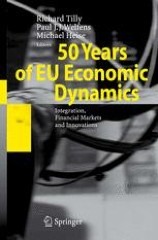
50 Years of EU Economic Dynamics : Integration, Financial Markets and Innovations
On the occasion of the 50th anniversary of the European Union experts present their analyses of historical developments and new economic challenges for the EU. After a reflection on historical dynamics, the contributors point out the dramatic economic shifts between Europe, Asia and the US. Representatives from major central banks (including the ECB), other leading banks, and academia analyze the dynamics of the Eurozone and financial market integration in the context of globalization and economic growth. Furthermore, the authors discuss the challenges of information and communication technologies by means of various country analyses. Moreover, the Schumpeterian prospects for Europe and the Lisbon Agenda, the long-term challenges of EU pension reforms, emission trading systems in the EU, and options for a new EU constitution are highlighted. At the bottom line of this EU analysis are major implications for investors, managers, policy-makers and the public at large in both the EU and the global economy.
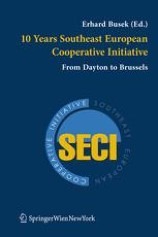
10 Years Southeast European Cooperative Initiative : From Dayton to Brussels
The Southeast European Cooperative Initiative (SECI) was the first international instrument for "peace keeping and peace making". Conceived by the United States with full partnership and participation of the European Union, SECI was a response to the Dayton Agreement. SECI was convinced that sending troops and diplomats did not suffice. It called for a new strategy and approach that would promote economic and social development through regional cooperation. SECI understood that despite their differences, the countries of South East Europe shared many mutual concerns. For the international community, SECI was a prelude to a broader instrument - the Stability Pact for South Eastern Europe, launched in 1999. The approach was a success! This compendium of documents, agreements, analyses and essays gives a glimpse into decision-making processes and results achieved.
