



الصفحة 25
الصفحة 25

General ultrasound in the critically ill
General ultrasound in the critically ill describes a bedside tool destined for use by the intensivist and any physician involved in emergencies. It specifically deals with findings of immediate clinical relevance throughout the body. New emergency applications of ultrasound in the abdomen, the vessels, the head and the heart are considered. The major topic, the lung, is extensively discussed. Interventional ultrasound forms part of nearly every chapter. Flow charts simplify daily concerns: acute dyspnea, shock, unexplained fever, etc. The strong points and pitfalls of ultrasound are reviewed. Technical notes are mingled with general considerations. Benefiting from the extensive experience of an intensivist intimately familiar with ultrasound, this book accurately answers most daily problems arising in the critically ill. it offers not only an exhaustive atlas but also a permanent aid to the therapeutic decision. All in all, General ultrasound in the critically ill provides a key for practicing a kind of visual medicine. Since 1990 Daniel Lichtenstein has been an intensivist in a medical ICU which already occupied a pioneering place in echocardiography. He has from the beginning devoted his efforts to the development of general ultrasound. He regularly publishes studies on lung ultrasound, his main topic, in the international literature.

General Theory of Information Transfer and Combinatorics
This book constitutes the thoroughly refereed research papers contributed to a research project on the `General Theory of Information Transfer and Combinatorics' that was hosted from 2001-2004 at the Center for Interdisciplinary Research (ZIF) of Bielefeld University and also papers of several incorporated meetings thereof. The 63 revised full papers presented were carefully reviewed and selected for inclusion in the book. The papers are organized in topical sections on probabilistic models, cryptology, pseudo random sequences, quantum models, statistics, probability theory, information measures, error concepts, performance criteria, search, sorting, ordering, planning, language evolution, pattern discovery, reconstructions, network coding, combinatorial models, and a problem section.

General Principles of Tumor Immunotherapy : Basic and Clinical Applications of Tumor Immunology
Brings together the world’s leading authorities on tumor immunology. This book describes the basic immunology principles that form the foundation of understanding how the immune system recognizes and rejects tumor cells. The role of the innate and adaptive immune responses is discussed and the implications of these responses for the design of clinical strategies to combat cancer are illustrated through both experimental clinical trials and review of current standard of care therapeutic agents. This information will be invaluable to both students of immunology and cancer research and practicing physicians who have patients with cancer. The book provides a comprehensive overview of the field, demonstrates how advances in basic immunology can and are being applied to cancer, and describes the current status of approved immunotherapy regimens.

General principles of law : the role of the judiciary
Examines the role played by domestic and international judges in the “flexibilization” of legal systems through general principles. It features revised papers that were presented at the Annual Conference of the European-American Consortium for Legal Education, held at the University of Parma.The second section contains studies on the role of general principles in selected legal systems, including International Law, European Union Law as well as Common Law systems.

Gene Therapy of Autoimmune Disease
Gene Therapy of Autoimmune Diseases comprehensively reviews research in gene therapy for autoimmune diseases with viral or non-viral vectors. Gene therapy offers the possibility of long-term, continuous delivery of a wide variety of immunosuppressive, anti-inflammatory, or tolerance-inducing agents. Moreover, highly specific genetically modified cells can be produced. This book discusses the most promising avenues in this exciting new field.

Gene Therapy and Gene Delivery Systems
Advances in Biochemical Engineering/Biotechnology reviews actual trends in modern biotechnology. Its aim is to cover all aspects of this interdisciplinary technology where knowledge, methods and expertise are required for chemistry, biochemistry, micro-biology, genetics, chemical engineering and computer science

Gender and migration : IMISCOE short reader
This short reader offers a critical review of the debates on the transformation of migration and gendered mobilities primarily in Europe, though also engaging in wider theoretical insights. Building on empirical case studies and grounded in an analytical framework that incorporates both men and women, masculinities, sexualities and wider intersectional insights, this reader provides an accessible overview of conceptual developments and methodological shifts and their implications for a gendered understanding of migration in the past 30 years. It explores different and emerging approaches in major areas, such as: gendered labour markets across diverse sectors beyond domestic and care work to include skilled sectors of social reproduction; the significance of families in migration and transnational families.

Gap Junctions in Development and Disease
Starting with a comprehensive review of the various mouse and human genes encoding the channel-forming protein connexin, further chapters describe the most important connexin mutations that lead to diseases such as hereditary deafness and female infertility in humans. Erroneous signaling mediated via connexin-protein interactions, thought to be responsible for disfunction of organs such as heart, muscle, brain, skin, lens, placenta, and endocrine tissue in mice and men, is also addressed.

Ganong's review of medical physiology
Focuses particularly on including only material that is of the highest yield. We have thoroughly revised the learning objectives for every chapter, reorganized and updated the text to ensure that all objectives are clearly addressed in a logical order, aligned chapter summaries so that the take-home messages quickly address each learning objective in turn, and expanded the number of review questions so that readers also have the ability to check their understanding and retention of every objective covered.

Galaxies and How to Observe Them
Satisfies the need for a modern, comprehensive review in combining the three major aspects: the physical background on the nature and data of galaxies, the relevant instrumentation and viewing techniques, and finally the targets and their individual appearance in telescopes of various apertures. To illustrate the latter, a comprehensive sample of galaxies, including quasars, groups and clusters of galaxies is presented. This combination of theoretical knowledge and practical information guarantees successful observing sessions. The book could become a standard source on galaxy observing for all kinds of amateur observers, from the beginner to the experienced.

Fuzzy systems and knowledge discovery ; Vol. 3614 ; 2nd International Conference, FSKD 2005, Changsha, China, August 27-29, 2005, Proceedings, Part II
This book and its sister volume, LNAI 3613 and 3614, constitute the proce- ings of the Second International Conference on Fuzzy Systems and Knowledge Discovery (FSKD 2005), jointly held with the First International Conference on Natural Computation (ICNC 2005, LNCS 3610, 3611, and 3612) from - gust 27–29, 2005 in Changsha, Hunan, China. FSKD 2005 successfully attracted 1249 submissions from 32 countries/regions (the joint ICNC-FSKD 2005 received 3136 submissions). After rigorous reviews, 333 high-quality papers, i. e. , 206 long papers and 127 short papers, were included in the FSKD 2005 proceedings, r- resenting an acceptance rate of 26. 7%. The ICNC-FSKD 2005 conference featured the most up-to-date research - sults in computational algorithms inspired from nature, including biological, e- logical, and physical systems. It is an exciting and emerging interdisciplinary area in which a wide range of techniques and methods are being studied for dealing with large, complex, and dynamic problems. The joint conferences also promoted cross-fertilization over these exciting and yet closely-related areas, which had a signi?cant impact on the advancement of these important technologies. Speci?c areas included computation with words, fuzzy computation, granular com- tation, neural computation, quantum computation, evolutionary computation, DNA computation, chemical computation, information processing in cells and tissues, molecular computation, arti?cial life, swarm intelligence, ants colony, arti?cial immune systems, etc. , with innovative applications to knowledge d- covery, ?nance, operations research, and more.
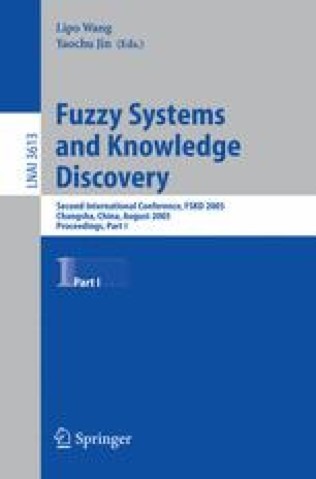
Fuzzy systems and knowledge discovery ; Vol. 3613 ; 2nd International Conference, FSKD 2005, Changsha, China, August 27-29, 2005, Proceedings, Part I
This book and its sister volume, LNAI 3613 and 3614, constitute the proce- ings of the Second International Conference on Fuzzy Systems and Knowledge Discovery (FSKD 2005), jointly held with the First International Conference on Natural Computation (ICNC 2005, LNCS 3610, 3611, and 3612) from - gust 27–29, 2005 in Changsha, Hunan, China. FSKD 2005 successfully attracted 1249 submissions from 32 countries/regions (the joint ICNC-FSKD 2005 received 3136 submissions). After rigorous reviews, 333 high-quality papers, i. e. , 206 long papers and 127 short papers, were included in the FSKD 2005 proceedings, r- resenting an acceptance rate of 26. 7%. The ICNC-FSKD 2005 conference featured the most up-to-date research - sults in computational algorithms inspired from nature, including biological, e- logical, and physical systems. It is an exciting and emerging interdisciplinary area in which a wide range of techniques and methods are being studied for dealing with large, complex, and dynamic problems. The joint conferences also promoted cross-fertilization over these exciting and yet closely-related areas, which had a signi?cant impact on the advancement of these important technologies. Speci?c areas included computation with words, fuzzy computation, granular com- tation, neural computation, quantum computation, evolutionary computation, DNA computation, chemical computation, information processing in cells and tissues, molecular computation, arti?cial life, swarm intelligence, ants colony, arti?cial immune systems, etc. , with innovative applications to knowledge d- covery, ?nance, operations research, and more.

Fuzzy Quantifiers : A Computational Theory
Almost all", "many", "some": fuzzy quantifiers are vital for effective communication in natural language (NL). This monograph pursues an axiomatic method to achieve a reliable interpretation of these quantifiers in technical applications of fuzzy quantification. Unlike existing work in this area, it targets a much broader class of quantificational phenomena which includes all cases usually considered in linguistics. The topics addressed in the monograph run the gamut from the introduction of the theoretical framework for analysing fuzzy quantification, the formalization of semantical requirements on models of fuzzy quantification, the construction and detailed study of prototypical models which conform to the linguistic desiderata, the development of algorithms for implementing the main types of quantifiers in these models, and finally a preview to fuzzy branching quantifications which might be necessary for modelling NL sentences involving more than one quantifier.

Fuzzy Logic and Applications ; Vol. 2955 ; 5th International Workshop, WILF 2003, Naples, Italy, October 9-11, 2003, Revised Selected Papers
This volume constitutes the thoroughly refereed post-workshop proceedings of the 5th International Workshop on Fuzzy Logic and Applications held in Naples, Italy, in October 2003. The 40 revised full papers presented have gone through two rounds of reviewing and revision. All current issues of theoretical, experimental and applied fuzzy logic and related techniques are addressed with special attention to rough set theory, neural networks, genetic algorithms and soft computing.

Fuzzy Logic : A Spectrum of Theoretical & Practical Issues
This book exclusively surveys the active on-going research of the current maturity of fuzzy logic over the last four decades. Many world leaders of fuzzy logic have enthusiastically contributed their best research results into five theoretical, philosophical and fundamental sub areas and nine distinctive applications, including two PhD dissertations from two world class universities dealing with cutting-edge research areas of bioinformatics and geological science. Beyond the scope of survey and collection of the book, one important spin off is the emerging and recognition of a major scientific paradigm shift from the conventional mathematics to the mathematics of uncertainty, which arguably holds the key to solving very difficult and complex problems in biological and social sciences alike. The book, loaded with historical perspective, creative thinking, critical reviewing, and uniquely constructed strategy for future growth of this dynamic research area, is an invaluable resource for active researchers at all levels, university administrators, foundation directors, funding agency program chiefs, research & development planners and technological assessors.

Future data and security engineering ; 7th International conference, FDSE 2020, Quy Nhon, Vietnam, November 25–27, 2020, Proceedings
This book constitutes the proceedings of the 7th International Conference on Future Data and Security Engineering, FDSE 2020, which was supposed to be held in Quy Nhon, Vietnam, in November 2020, but the conference was held virtually due to the COVID-19 pandemic. The 24 full papers (of 53 accepted full papers) presented together with 2 invited keynotes were carefully reviewed and selected from 161 submissions. The other 29 accepted full and 8 short papers are included in CCIS 1306. The selected papers are organized into the following topical headings: security issues in big data; big data analytics and distributed systems; advances in big data query processing and optimization; blockchain and applications; industry 4.0 and smart city: data analytics and security; advanced studies in machine learning for security; and emerging data management systems and applications.

Future data and security engineering : Big data, security and privacy, smart city and industry 4.0 applications ; 7th International Conference, FDSE 2020, Quy Nhon, Vietnam, November 25–27, 2020, Proceedings
This book constitutes the proceedings of the 7th International Conference on Future Data and Security Engineering, FDSE 2020, held in Quy Nhon, Vietnam, in November 2020.* The 29 full papers and 8 short were carefully reviewed and selected from 161 submissions. The selected papers are organized into the following topical headings: big data analytics and distributed systems; security and privacy engineering; industry 4.0 and smart city: data analytics and security; data analytics and healthcare systems; machine learning-based big data processing; emerging data management systems and applications; and short papers: security and data engineering.

Fungi as an Alternative Source of Anticancer and Antioxidant
Fungi are an " excellent but underexplored source " for new therapeutic compounds. The limited availability of bioactive principles in plant sources could be surpassed by exploiting the chemical entities in the endophytes fungi . fungi represent a rich source of bioactive metabolite that can manipulated to produce desirable novel analogs. In addition to the active substances that can be extracted from the fungi, so that they are useful in several mechanisms. Exploring and exploiting of metabolites from endophytic in terrestrial, mangrove and marine habitats may provide an avenue for discovery of drug candidates against deadly human disease. This review focuses on the production of antioxidant and anticancer from severa fungi habitats.

Fungal Immunology: From an Organ Perspective
This book will serve as a comprehensive review of all known immune mechanisms for common medically important fungal pathogens. Its novelty lies in the organization: Rather than chapters devoted to specific fungi, chapters are organized by organ system. All other texts in the field, which are now quite old, are arranged according to specific fungi.

Fungal Genomics
Presents an overview on mutualistic and pathogenic interactions between fungi and plants. This book offers reviews on fungal lifestyles, mechanisms of their interactions with their host plants, signal perception and transduction, and plant defense responses directed against attack by fungal pathogens. It is suitable for students in microbiology.
