



الصفحة 25
الصفحة 25

Geometric Data Analysis : From Correspondence Analysis to Structured Data Analysis
Geometric Data Analysis (GDA) is the name suggested by Stanford University to designate the approach to Multivariate Statistics initiated.as Correspondence Analysis, an approach that has become more and more used and appreciated over the years. This book presents the full formalization of GDA in terms of linear algebra - the most original and far-reaching consequential feature of the approach - and shows also how to integrate the standard statistical tools such as Analysis of Variance, including Bayesian methods. Chapter 9, Research Case Studies, is nearly a book in itself; it presents the methodology in action on three extensive applications, one for medicine, one from political science, and one from education (data borrowed from the Stanford computer-based Educational Program for Gifted Youth ). Thus the readership of the book concerns both mathematicians interested in the applications of mathematics, and researchers willing to master an exceptionally powerful approach of statistical data analysis.

Geomatics Solutions for Disaster Management
Natural and anthropogenic disasters have caused a large number of victims and significant social and economic losses in the last few years. There is no doubt that the risk prevention and disaster management sector needs drastic measures and improvements in order to decrease damage and save lives of inhabitants. Effective utilization of satellite positioning, remote sensing, and GIS in disaster monitoring and management requires research and development in numerous areas: data collection, access and delivery, information extraction and analysis, management and their integration with other data sources (airborne and terrestrial imagery, GIS data, etc.), data standardization, organizational and legal aspects of sharing of remote sensing information. This book provides researchers and practitioners with a good overview of what is being developed in this topical area.
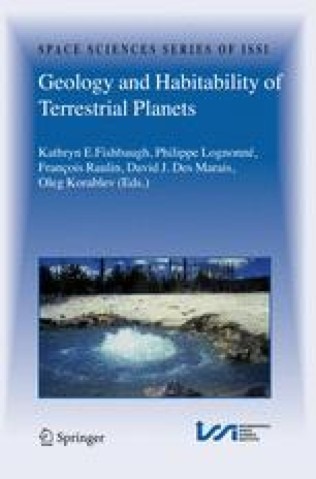
Geology and Habitability of Terrestrial Planets
This book has resulted from a workshop at the International Space Science Institute (ISSI) in Bern, Switzerland (5-9 September 2005) that brought together planetary geologists, geophysicists, atmospheric scientists, and biologists to discuss the multi-faceted problem of how the habitability of a planet co-evolves with the geology of the surface and interior, the atmosphere, and the magnetosphere.

Geological atlas of Africa : With notes on stratigraphy, tectonics, economic geology, geohazards, geosites and geoscientific education of each country
T is atlas is intended primarily for anybody who is in-some background for the arrangement of how the terested in basic geology of Africa. Its originality lies atlas was done. T e second chapter is devoted to the in the fact that the regional geology of each African history of geological mapping in Africa, necessary nation or territory is reviewed country-wise by maps for a fuller appreciation of why this work in Africa is and text, a view normally not presented in textbooks worth doing. Chapter 3 provides an executive s- of regional geology. It is my belief, that there has long mary on the stratigraphy and tectonics of Africa as a been a need in universities and geological surveys, whole, i. e. in the context of no political boundaries.

Geological Approaches to Coral Reef Ecology
By reconstructing the ecological history of coral reefs, the authors are able to evaluate whether or not recent, dramatic changes to reef ecosystems are novel events or part of a long-term trend or cycle. The contributions examine the interacting causes of change, which include hurricane damage, regional outbreaks of coral-consuming predators, disease epidemics, sea-level rise, nutrient loading, global warming and acidification of the oceans. Crucial predictions about the future of coral reefs lead to practical strategies for the successful restoration and management of reef ecosystems.

Geographies of the University
Raises awareness of the histories, geographies, and practices of universities and analyzes their role as key actors in today’s global knowledge economy. Universities are centers of research, teaching, and expertise with significant economic, social, and cultural impacts at different geographical scales. Scholars from a variety of disciplines and countries offer original analyses and discussions along five main themes: historical perspectives on the university as a site of knowledge production, cultural encounter, and political interest; institutional perspectives on university governance and the creation of innovative environments; relationships between universities and the city; the impact of universities on national and regional economies and cultures; and the processes of internationalization through student mobility, the creation of education hubs, and global regionalism in higher education.
Geographic Information Science ; 4th International Conference, GIScience 2006, Münster, Germany, September 20-23, 2006, Proceedings
The GIScience conference series (www. giscience. org) was created as a forum for all researchers who are interested in advancing research in the fundam- tal aspects of geographic information science.The conferences focus on emerging topics and basic research ?ndings across all s- tors of geographic information science. After three highly successful conferences in the United States, this year’s GIScience conference was held in Europe for the ?rst time. The GIScience conferences have been a meeting point for researchers coming from various disciplines, including cognitive science, computer science, engine- ing, geography,information science, mathematics, philosophy, psychology,social science, and statistics. The advancement of geographic information science - quiressuchinterdisciplinarybreadth,andthisisalsowhatmakestheconferences so exciting. In order to account for the di?erent needs of the involved scienti?c disciplines with regard to publishing their research results.

Geographic Hypermedia : Concepts and Systems
This book introduces a new paradigm, Geographic Hypermedia, which emerges from the convergence of Geographic Information Science and - permedia technology. Both GI Science and hypermedia have been rapidly evolving fields. The initial idea of Geographic Hypermedia was born in 2004 when the editors had been invited to organize a workshop in conju- tion with the ‘Hypertext’ conference organized annually by the Special - terest Group of the Association for Computing Machinery. The purpose of the workshop was to examine how hypermedia concepts and tools may be applied in geographical domains. The workshop was eventually held in conjunction with the Maps and the Internet Commission of the International Cartographic Association at the annual meeting of the Association of American Geographers in Denver, Colorado, in April 2005. The Denver workshop was a successful event, bringing together mul- disciplinary researchers and professionals in the area of Geographic - permedia.

Geodetic Deformation Monitoring : From Geophysical to Engineering Roles ; IAG Symposium Jaén, Spain, March 7-19,2005
Geodesy is the science dealing with the determination of the position of points in space, the shape and gravity field of the Earth and with their time variations. A consequence is that geodesists feel as a permanent subject of research, the detection, analysis and interpretation of spatial deformation as well as gravity field variation. This book collects 36 selected papers from the International Symposium on Geodetic Deformation Monitoring held in Jaén (Spain) from 17th to 19th March 2005. The main topics covered in the symposium were: mathematical and statistical models for crustal deformation analysis, deformation monitoring from GPS and InSAR data: analysis and geophysical interpretation, geodetic monitoring of movements in civil engineering, integration of spatial and terrestrial techniques in deformation studies, geodynamical applications of gravimetric observations and present-day geodetic instrumentation for deformation monitoring. This volume is a good overview of theoretical matters, models and results.

Genomic intelligence : Metagenomics and artificial intelligence
The field of metagenomics has revolutionized our comprehension of microbial diversity and function across various habitats, from the human body to terrestrial and aquatic environments. Simultaneously, advancements in AI have empowered researchers to analyze vast troves of genomic data with unprecedented speed and precision, facilitating new insights into the complex interplay between microorganisms and their surroundings. Provides an overview of metagenomics and discusses the combination of metagenomics and AI and its significant consequences for advancements in science. The chapters examine the approaches, difficulties, and revolutionary uses of AI in metagenomics and provide insight into the convergence of genomics, metagenomics, and AI’s potential to revolutionize diverse fields from healthcare to environmental.

Genetics of Adaptation
What is the genetic basis of adaptive evolution? In this volume, a new generation of biologists have taken up this challenge. Using advances in both molecular genetic and statistical techniques, evolutionary geneticists have made considerable progress in this emerging field. In this volume, a diversity of examples from plant and animal studies provides valuable information for those interested in the genetics and evolution of complex traits.

Genes on the Menu : Facts for Knowledge-Based Decisions
Only little more than a decade ago the term "genetic engineering" was hardly known outside research laboratories. Today it regularly makes headlines in the news. Supporters and opponents as well tell us that it could change our lives more than any other technological advance. This book delivers the state-of-the-art facts in order to empower the public to make knowledge-based decisions about plant biotechnology and GM crops and GM food, in particular. It discusses the hot topics of the present debate in a neutral manner and will function as a personal reference book for the interested public, for decision maker, and managers of consumer organisations.
Generative programming and component engineering ; 4th International conference, GPCE 2005, Tallinn, Estonia, September 29 - October 1, 2005, Proceedings
Generative Programming and Component Engineering (GPCE) is a leading - searchconferenceonautomaticprogrammingandcomponentengineering.These approaches to software engineering have the potential to revolutionize software development as automation and components revolutionized manufacturing. The conference brings together researchers and practitioners interested in adva- ing automation for software development. It is also a premier forum for cro- fertilization between the programming language and software engineering - search communities. GPCEaroseasajointconference, mergingthepriorconferenceonGenerative and Component-Based Software Engineering (GCSE) and the Workshop on - mantics, Applications, andImplementationofProgramGeneration(SAIG). The proceedingsofthepreviousGPCEconferenceswerepublishedintheLNCSseries of Springer as volumes2487,2830, and 3286.In 2005 GPCE wasco-locatedwith the International Conference on Functional Programming (ICFP) and the s- posium on Trends in Functional Programming (TFP), re?ecting the vigorous interaction between the functional programming and generative programming research communities. GPCE and ICFP are both sponsored by the Association for Computing Machinery. The quality and breadth of the papers submitted to GPCE 2005 was impr- sive. All 86 papers, including 5 papers for tool demonstrations, were rigorously reviewed by 17 highly quali?ed Program Committee members. The members of the Program Committee ?rst provided in-depth individual reviews of the s- mitted papers, and then debated the merits of the papers through an extended electronicProgramCommitteemeeting.After much(friendly) argument,25r- ular papers and 2 tool demonstration papers were selected for publication. The ProgramCommittee provided extensive technical feedback to the authors of the submittedpapers.Theconferenceprogramwascomplementedwiththreeinvited talks, three extended tutorials, and three all-day workshops.

Generalized Bounds for Convex Multistage Stochastic Programs
The auther was involved in several industry projects in the field of power management, on the occasion of which I was repeatedly c- fronted with complex decision problems under uncertainty. Although usually hard to solve, I quickly learned to appreciate the benefit of stochastic progr- ming models and developed a strong interest in their theoretical properties. Motivated both by practical questions and theoretical concerns, I became p- ticularly interested in the art of finding tight bounds on the optimal value of a given model. The present work attempts to make a contribution to this important branch of stochastic optimization theory. In particular, it aims at extending some classical bounding methods to broader problem classes of practical relevance.

Gene Therapy for Cancer
The possibility of treating cancer, a disease defined by genetic defects, by introducing genes targeting these very alterations has led to an immense interest in gene therapy for cancer. Although incremental successes have been realized, enthusiasm for gene therapy has declined due to an increasing number of obstacles. These obstacles include vector systems that do not reach systemic metastases, therapeutic genes with redundant mec- nisms allowing for cellular resistance, and toxicities in clinical trials leading to premature closure of these studies. Different tactics to overcome or circumvent these obstacles have catalyzed the development of a wide range of gene therapy approaches. Thus far, almost two-thirds of gene therapy trials have focused on cancer. This reflects the concept that gene therapy approaches for the treatment of cancer do not necessarily require long-term expression of the gene as is necessary for the treatment of primary genetic defects like hemophilia or juvenile diabetes.

GDPR and biobanking : Individual rights, Public interest and research regulation across Europe
This book focuses on the discrepancies in biobank research regulations that are among the most significant hurdles to effective research collaboration.

Gathering Hopewell : Society, Ritual and Ritual Interaction
In this book, twenty-one researchers in interwoven efforts immerse themselves and the reader in this vibrant archaeological record in order to richly reconstruct the faces, actions, and motivations Hopewellian people in their social and ritual life. Using a personalized and locally contextualized approach, the authors explore Hopewellian leadership, systems of social ranking and prestige, animal-totemic clan organization, kinship structures, sodalities, gender, community organizations, strategies of intercommunity alliance, and interregional travels for power questing, pilgrimage, healing, tutelage, and acquiring rituals.

Gas Adsorption Equilibria : Experimental Methods and Adsorptive Isotherms
This book is intended to present for the first time experimental methods to measure equilibria states of pure and mixed gases being adsorbed on the surface of solid materials. It has been written for engineers and scientists from industry and academia who are interested in adsorption-based gas separation processes and/or in using gas adsorption for characterization of the porosity of solid materials.Special emphasis is given to uncertainties of data and pros and cons of all measurement methods are offered.

Game Theory : Decisions, Interaction and Evolution
This introduction to game theory is written from a mathematical perspective. Its primary purpose is to be a first course for undergraduate students of mathematics, but it also contains material which will be of interest to advanced students or researchers in biology and economics.An understanding of basic calculus and probability is assumed but no prior knowledge of game theory is required. Detailed solutions are provided for the numerous exercises.

Game Theory : A Multi-Leveled Approach
This book presents the basics of game theory both on an undergraduate level and on a more advanced mathematical level. It covers most topics of interest in game theory, including cooperative game theory. Part I presents introductions to all these topics on a basic yet formally precise level. It includes chapters on repeated games, social choice theory, and selected topics such as bargaining theory, exchange economies, and matching. Part II goes deeper into noncooperative theory and treats the theory of zerosum games, refinements of Nash equilibrium in strategic as well as extensive form games, and evolutionary games. Part III covers basic concepts in the theory of transferable utility games, such as core and balancedness, Shapley value and variations, and nucleolus. Some mathematical tools on duality and convexity are collected in Part IV. Every chapter in the book concludes with a problem section. Hints, answers and solutions are included.
