



الصفحة 25
الصفحة 25

Geological Storage of Highly Radioactive Waste : Current Concepts and Plans for Radioactive Waste Disposal
The book describes and assesses current concepts for long-term disposal of highly radioactive waste. Different types of rock are discussed and assessed with respect to practical difficulties in construction of a repository, and the efficiency in isolating radioactive waste. Safety matters are most important and are treated in the respective chapters and in a final, conclusive chapter. Cost issues and related quality matters are discussed for the case of constructing a virgin repository and repositories in the form of converted abandoned mines.

Geographic information metadata for spatial data infrastructures : Resources, interoperability and information retrieval
Metadata play a fundamental role in both DLs and SDIs. Commonly defined as "structured data about data" or "data which describe attributes of a resource" or, more simply, "information about data", it is an essential requirement for locating and evaluating available data. Therefore, this book focuses on the study of different metadata aspects, which contribute to a more efficient use of DLs and SDIs. The three main issues addressed are: the management of nested collections of resources, the interoperability between metadata schemas, and the integration of information retrieval techniques to the discovery services of geographic data catalogs (contributing in this way to avoid metadata content heterogeneity).

Genome editing in drug discovery
In Genome Editing in Drug Discovery, a team of distinguished biologists delivers a comprehensive exploration of genome editing in the drug discovery process, with coverage of the technology’s history, current issues and techniques, and future perspectives and research directions. The book discusses techniques for disease modeling, target identification with CRISPR, safety studies, therapeutic editing, and intellectual property issues.

Genetic rogramming ; Vol. 3447 : 8th European conference, EuroGP 2005, Lausanne, Switzerland, March 30-April 1, 2005, Proceedings
In this volume we present the contributions for the 18th European Conference on Genetic Programming (EuroGP 2005). The conference took place from 30 March to 1 April in Lausanne, Switzerland. EuroGP is a well-established conf- ence and the only one exclusively devoted to genetic programming. All previous proceedings were published by Springer in the LNCS series. From the outset, EuroGP has been co-located with the EvoWorkshops focusing on applications of evolutionary computation. Since 2004, EvoCOP, the conference on evolutionary combinatorial optimization, has also been co-located with EuroGP, making this year’s combined events one of the largest dedicated to evolutionary computation in Europe. Genetic programming (GP) is evolutionary computation that solves complex problems or tasks by evolving and adapting a population of computer programs, using Darwinian evolution and Mendelian genetics as its sources of inspiration. Some of the 34 papers included in these proceedings address foundational and theoretical issues and there is also a wide variety of papers dealing with di?erent application areas, such as computer science, engineering, language processing, biology and computational design, demonstrating that GP is a powerful and practical problem-solving paradigm.

Genetic Programming Theory and Practice III
Genetic Programming Theory and Practice III explores the emerging interaction between theory and practice in the cutting-edge, machine learning method of Genetic Programming (GP). This contributed volume was developed from the third workshop at the University of Michigan’s Center for the Study of Complex Systems to facilitate the exchange of ideas and information related to this rapidly advancing field. The text provides a cohesive view of the issues facing both practitioners and theoreticians and examines the synergy between GP theory and application.

Genetic Programming ; Vol. 3905 ; 9th European Conference, EuroGP 2006, Budapest, Hungary, April 10-12, 2006. Proceedings
This book constitutes the refereed proceedings of the 9th European Conference on Genetic Programming, EuroGP 2006, held in Budapest, Hungary, in April 2006, colocated with EvoCOP 2006. The 21 revised plenary papers and 11 revised poster papers were carefully reviewed and selected from 59 submissions. The papers address fundamental and theoretical issues, along with a wide variety of papers dealing with different application areas, such as computer science, engineering, machine learning, Kolmogorov complexity, biology and computational design.

Genetic Engineering of Mesenchymal Stem Cells
MSC (mesenchymal stem cells) have been reported to initiate revascularization after injury, to facilitate engraftment of blood-forming stem cells, and to reduce the incidence of graft-vs. host disease through their immune-suppressive qualities. Finally, bone marrow-derived MSC have been reported to home to areas of solid tumor revascularization, and thus may be used as delivery vehicles to target ablative agents into dividing tumor cells. Recently the characteristics of human MSC from adipose (fat) tissue have also been identified. The possibility of repairing tissues, speeding stem cell engraftment, and targeting solid tumors for specific killing, using MSC easily harvested from bone marrow, or better yet, from unwanted fat tissue, holds broad appeal, and is an intriguing possibility that could have dramatic effect on health care. This book has information on how to isolate, grow, and characterize MSC from marrow and fat, and gives important insight into how these cells may be used for gene delivery and cellular therapies in the future. Updates on emerging clinical trials are given.

Genetic Democracy : Philosophical Perspectives
GENETIC DEMOCRACY involves an in-depth analysis of the ethical, social and philosophical issues related to modern genetic research and gene technology. The aim of the book is to introduce systematic research on the social and ethical impacts of the use and development of genetically modified organisms (GMOs) as well as the acquisition, use and storage of human genetic information (HGI). The book contributes into enhancing public discussion and reaching fair and democratic decision-making practices in GMO and HGI use and development both on local and global level.

Gene Expression and Regulation
This book offers a comprehensive look into the science of gene expression and regulation. Focusing on topics such as actions of nuclear receptors, RNA processing, and DNA methylation and imprinting, Gene Expression and Regulation is edited by a leading biologist and includes contributions by experts in the field. Presented in the following five sections, this book covers a full spectrum of topics: The History; The Machinery; The Regulators; The Genome; and Special Topics. The Machinery section covers the transcriptional apparatus and general transcription factors. The Regulators section examines selected gene-specific transcription factors important to regulating gene expression. The Genome section covers issues relevant to the behavior of the genome in relation to gene regulation. The Special Topics section discusses several selected topics ranging from bacterial and plant gene expression to DNA topology and interference RNA. The book’s focus is on scientific concepts and issues, rather than specific organisms or experimental approaches.

Genders in the Life Course : Demographic Issues
Treats the topic of gender and demographic behaviour during the life course in a comprehensive fashion. It covers a lot of ground, from the age at first intercourse over union formation and dissolution, fertility, migration, ageing, to excess male mortality, comparing genders behaviour and its determinants. It reports new findings of empirical research, mostly based on data from a number of European countries, making a good use of the Family and Fertility surveys and other international data base.

Gender, Health and Ageing : European Perspectives on Life Course, Health Issues and Social Challenges
The objective of this book is to provide an overview of gender, health and ageing. Important theoretical concepts, such as life course and "Lebenslagen" in old age, or differences in men's health, are introduced. It is increasingly important to build a European basis of knowledge, to conduct discussions on European research findings, and to develop European research frameworks. In this volume, central theoretical debates on gender impacts on life course and old-age health, and vital issues of health research in the context of gender and old age are introduced. Specific aspects, such as the impact of gender and age on cardiovascular health, elder abuse and mental health, or care between gender relations, gender roles and gender constructs, are pointed out.

Gender and the judiciary in Africa: from obscurity to parity
Addresses the important issue of the increasing numbers and varied roles of women judges and justices, as judiciaries evolve across the continent.Scholars of law, gender politics and African politics provide overviews of recent developments in gender and the judiciary in nine African countries that represent north.

Gap Junctions in Development and Disease
Starting with a comprehensive review of the various mouse and human genes encoding the channel-forming protein connexin, further chapters describe the most important connexin mutations that lead to diseases such as hereditary deafness and female infertility in humans. Erroneous signaling mediated via connexin-protein interactions, thought to be responsible for disfunction of organs such as heart, muscle, brain, skin, lens, placenta, and endocrine tissue in mice and men, is also addressed.

Fuzzy systems and knowledge discovery ; Vol. 3614 ; 2nd International Conference, FSKD 2005, Changsha, China, August 27-29, 2005, Proceedings, Part II
This book and its sister volume, LNAI 3613 and 3614, constitute the proce- ings of the Second International Conference on Fuzzy Systems and Knowledge Discovery (FSKD 2005), jointly held with the First International Conference on Natural Computation (ICNC 2005, LNCS 3610, 3611, and 3612) from - gust 27–29, 2005 in Changsha, Hunan, China. FSKD 2005 successfully attracted 1249 submissions from 32 countries/regions (the joint ICNC-FSKD 2005 received 3136 submissions). After rigorous reviews, 333 high-quality papers, i. e. , 206 long papers and 127 short papers, were included in the FSKD 2005 proceedings, r- resenting an acceptance rate of 26. 7%. The ICNC-FSKD 2005 conference featured the most up-to-date research - sults in computational algorithms inspired from nature, including biological, e- logical, and physical systems. It is an exciting and emerging interdisciplinary area in which a wide range of techniques and methods are being studied for dealing with large, complex, and dynamic problems. The joint conferences also promoted cross-fertilization over these exciting and yet closely-related areas, which had a signi?cant impact on the advancement of these important technologies. Speci?c areas included computation with words, fuzzy computation, granular com- tation, neural computation, quantum computation, evolutionary computation, DNA computation, chemical computation, information processing in cells and tissues, molecular computation, arti?cial life, swarm intelligence, ants colony, arti?cial immune systems, etc. , with innovative applications to knowledge d- covery, ?nance, operations research, and more.
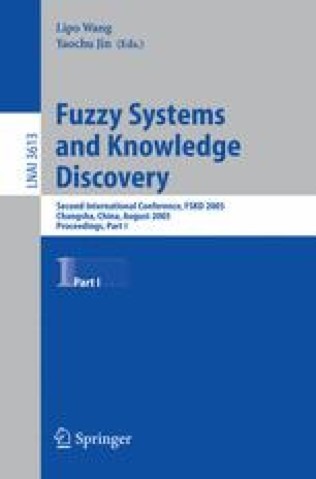
Fuzzy systems and knowledge discovery ; Vol. 3613 ; 2nd International Conference, FSKD 2005, Changsha, China, August 27-29, 2005, Proceedings, Part I
This book and its sister volume, LNAI 3613 and 3614, constitute the proce- ings of the Second International Conference on Fuzzy Systems and Knowledge Discovery (FSKD 2005), jointly held with the First International Conference on Natural Computation (ICNC 2005, LNCS 3610, 3611, and 3612) from - gust 27–29, 2005 in Changsha, Hunan, China. FSKD 2005 successfully attracted 1249 submissions from 32 countries/regions (the joint ICNC-FSKD 2005 received 3136 submissions). After rigorous reviews, 333 high-quality papers, i. e. , 206 long papers and 127 short papers, were included in the FSKD 2005 proceedings, r- resenting an acceptance rate of 26. 7%. The ICNC-FSKD 2005 conference featured the most up-to-date research - sults in computational algorithms inspired from nature, including biological, e- logical, and physical systems. It is an exciting and emerging interdisciplinary area in which a wide range of techniques and methods are being studied for dealing with large, complex, and dynamic problems. The joint conferences also promoted cross-fertilization over these exciting and yet closely-related areas, which had a signi?cant impact on the advancement of these important technologies. Speci?c areas included computation with words, fuzzy computation, granular com- tation, neural computation, quantum computation, evolutionary computation, DNA computation, chemical computation, information processing in cells and tissues, molecular computation, arti?cial life, swarm intelligence, ants colony, arti?cial immune systems, etc. , with innovative applications to knowledge d- covery, ?nance, operations research, and more.

Fuzzy sets and their extensions : Representation, aggregation and models : Intelligent systems from decision making to data mining, web intelligence and computer vision
This book presents an up-to-date state of current research in the use of fuzzy sets and their extensions, paying attention to foundation issues and to their application to four important areas where fuzzy sets are seen to be an important tool for modelling and solving problems.

Fuzzy portfolio optimization : Theory and methods
This is the first monograph on fuzzy portfolio optimization. By using fuzzy mathematical approaches, quantitative analysis, qualitative analysis, the experts' knowledge and the investors' subjective opinions can be better integrated into portfolio selection models. The contents of this book mainly comprise of the authors' research results for fuzzy portfolio selection problems in recent years. In addition, in the book, the authors introduce some other important progress in the field of fuzzy portfolio optimization. Some fundamental issues and problems of portfolio selection have been studied systematically and extensively by the authors to apply fuzzy systems theory and optimization methods. A new framework for investment analysis is presented in this book. A series of portfolio selection models are given and some of them are more efficient for practical applications. Some application examples are given to illustrate those models.

Fuzzy Modeling with Spatial Information for Geographic Problems
This book focuses on research advances in approaches for incorporating explicit handling of uncertainty, especially by fuzzy sets, to address geographic problems. It has two aims: to stimulate research in the theory and application of fuzzy sets to spatial information management and geographic problem solving; and to highlight advances that have matured so much that geoscientists, computer scientists, geographers, et al. use fuzzy modeling. The book includes examples of the use of fuzzy sets in representational issues such as terrain features, landscape morphology, spatial extents and approaches for spatial interpolation, plus applications using fuzzy sets covering data mining, spatial decision making, ecological simulation, and reliability in GIS.

Fuzzy Logic and Applications ; Vol. 3849 ; 6th International Workshop, WILF 2005, Crema, Italy, September 15-17, 2005, Revised Selected Papers
This volume contains the proceedings of the 6th International Workshop on Soft Computing and Applications (WILF 2005), which took place in Crema, Italy, on September 15–17, 2005, continuing an established tradition of biannual meetings among researchers and developers from both academia and industry to report on the latest scienti?c and theoretical advances, to discuss and debate major issues, and to demonstrate state-of-the-art systems. This edition of the workshop included two special sessions, sort of subwo- shops, focusing on the application of soft computing techniques (or compu- tional intelligence) to image processing (SCIP) and bioinformatics (CIBB).

Fuzzy Logic and Applications ; Vol. 2955 ; 5th International Workshop, WILF 2003, Naples, Italy, October 9-11, 2003, Revised Selected Papers
This volume constitutes the thoroughly refereed post-workshop proceedings of the 5th International Workshop on Fuzzy Logic and Applications held in Naples, Italy, in October 2003. The 40 revised full papers presented have gone through two rounds of reviewing and revision. All current issues of theoretical, experimental and applied fuzzy logic and related techniques are addressed with special attention to rough set theory, neural networks, genetic algorithms and soft computing.
