



الصفحة 25
الصفحة 25

Dynamic Programming : A Computational Tool
This book provides a practical introduction to computationally solving discrete optimization problems using dynamic programming. From the unusually numerous and varied examples presented, readers should more easily be able to formulate dynamic programming solutions to their own problems of interest. We also provide and describe the design, implementation, and use of a software tool, named DP2PN2Solver, that has been used to numerically solve all of the problems presented earlier in the book. This computational tool can be used by students to solve academic problems if this book is used in coursework, and by practitioners to solve many real-world problems if the state space is not too large.

Dynamic General Equilibrium Modelling : Computational Methods and Applications
Modern business cycle theory and growth theory uses stochastic dynamic general equilibrium models. Many mathematical tools are needed to solve these models. The book presents various methods for computing the dynamics of general equilibrium models. In part I, the representative-agent stochastic growth model is solved with the help of value function iteration, linear and linear quadratic approximation methods, parameterised expectations and projection methods. In order to apply these methods, fundamentals from numerical analysis are reviewed in detail. Part II discusses methods for solving heterogeneous-agent economies. In such economies, the distribution of the individual state variables is endogenous. This part of the book also serves as an introduction to the modern theory of distribution economics. Applications include the dynamics of the income distribution over the business cycle or the overlapping-generations model.

Dumbing Down : The Crisis of Quality and Equity in a Once-Great School System—and How to Reverse the Trend
This book examines the challenges and issues caused by a move to a marketized education system in Sweden. Observing the introduction of the school voucher system and a postmodern social constructivist view of knowledge, the move away from objective knowledge is identified as the core reason for Sweden’s current education crisis. The impact of declining education standards on the labor market is also discussed.

Dual Source CT Imaging
This book provides an introduction to DSCT technology and to the basics of contrast media administration followed by 25 in-depth clinical scan and contrast media injection protocols. All were developed in consensus by selected physicians on the Dual Source CT Expert Panel.

Drugs, the brain, and behavior : The pharmacology of therapeutics and drug use disorders
Provides a comprehensive overview of the brain and explores the clinical and pharmacological issues surrounding drug abuse and dependence. Dr Brick provides definitions, historic discoveries about the nervous system, and original, eye-catching illustrations to discuss the brain/behavior relationship, basic neuroanatomy, neurophysiology, and the mechanistic actions of mood-altering drugs. Topics include: how psychoactive drugs affect cognition, behavior, and emotion; the brain/behavior relationship; the specific effects of major addictive and psychoactive drug groups; new definitions and thinking about abuse and dependence; and the medical uses of drugs, such as cannabinoids. A new chapter on biobehavioral markers explores how markers can guide the clinician in the diagnosis of some disorders. This book offers a quick reference guide which uses a balance of instruction, illustrations, tables, and formulas, that will give you a broad, lasting introduction to this intriguing subject.

Drug utilization research : Methods and applications
Drug Utilization Research (DUR) is a discipline which combines aspects of pharmacotherapy, epidemiology, and health services research into an interdisciplinary set of methods for analyzing and assessing the prescribing, dispensing and consumption of medicines. It combines both qualitative and quantitative approaches to facilitate the safe and effective use of pharmaceuticals. Drug Utilization Research: Methods and Applications provides a comprehensive introduction to this discipline, prepared by an international team of authors with broad experience in numerous fields. Now reorganized and updated to reflect the latest research and global challenges, it is an indispensable resource for understanding the use of pharmaceuticals.

Drug safety evaluation : Methods and protocols
Focuses on the most recent advances in the field of drug safety evaluation. Divided into seven parts, chapters detail specific aspects related to the experimental design of preclinical studies conducted to support the safety of pediatric and combination drugs, necropsy and histopathology evaluation, mass spectrometry imaging, genetic toxicology protocols including the Pig-a mutation assay, safety pharmacology methods such as automatization of patch-clamp procedures, target safety assessment for investigative toxicology, screening assays for developmental toxicology, and methods to characterize novel translational safety biomarkers like microRNAs. Written in the highly successful Methods in Molecular Biology series format, chapters include introductions to their respective topics, lists of the necessary materials and reagents, step-by-step, readily reproducible laboratory protocols, and tips on troubleshooting to avoid known pitfalls.

Drug Delivery Systems for Metabolic Disorders
Covers recent developments in advanced drug delivery systems in various metabolic disorders, including disturbances in protein, lipid, carbohydrate and hormone metabolism and lysosomal and mitochondrial disorders. It provides a brief introduction to metabolic disorders, along with a focus on the current landscape and trends in understanding disease pathology using different in vitro and in vivo models required for clinical applications and developments of new therapeutics.

Drug Delivery Systems
Expands on the previous editions with a discussion of new and updated methods used to study drug delivery. Chapters cover topics such as drug delivery in cancer and intrathecal delivery of analgesics in humans. The increasing role of nanobiotechnology is reflected in eight of the sixteen chapters that include synthesis of gold nanoparticles; targeted siRNA delivery; and lipid nanocarriers. Written in the highly successful Methods in Molecular Biology series format, chapters include introductions to their respective topics, lists of the necessary materials and reagents, step-by-step, readily reproducible laboratory protocols, and tips on troubleshooting and avoiding known pitfalls.

Drug delivery : An integrated clinical and engineering approach
Offers a much needed comprehensive overview and patient-oriented approach for enhanced drug delivery optimization and advancement. Starting with an introduction to the subject and pharmacokinetics, it explores advances for such topics as oral, gastroretentive, intravitreal, and intrathecal drug delivery, as well as insulin delivery, gene delivery, and biomaterials-based delivery systems. It also describes drug delivery in cancer, cardiac, infectious diseases, airway diseases, and obstetrics and gynecology applications.

Drawing for Interior Design ; 2nd ed.
Covers all stages of visual presentation as part of the interior design process, from the most basic initial sketches to fully developed computer-generated visualizations. Following a brief introduction four chapters take the reader through the design process, from the basics to conception, presentation and production. This second edition includes more practical advice on techniques, more case studies, step-by-step sequences and updated examples. With a varied and comprehensive range of images, this book is an invaluable, inspirational and practical resource for interior design students.

Double-stranded RNA : Methods and protocols
Examines classical and cutting-edge methods involving double-stranded RNA (dsRNA), specifically regarding isolation, visualization, characterization, production, and application. Many protocols, such as co-immunoprecipitation-based isolation of double-stranded RNA-associated protein complexes, identification of mycoviruses by dsRNA extraction, application of dsRNA for fungi disease management (Sclerotinia sclerotiorum and Botrytis cin), and production of double-stranded RNA in plants by plant viral vectors for gene silencing, can also be easily adapted for identification of viruses from other organisms, control of other pathogens, and fundamental research. Written for the highly successful Methods in Molecular Biology series, chapters include introductions to their respective topics, lists of the necessary materials and reagents, step-by-step and readily reproducible laboratory protocols, as well as tips for troubleshooting and avoiding known pitfalls.

Domain-driven design with Java, a practitioner's guide : create simple, elegant, and valuable software solutions for complex business problems
Helps you as a developer and architect to put your knowledge to work in order to create elegant software designs that are enjoyable to work with and easy to reason about. You'll begin with an introduction to the concepts of domain-driven design and discover various ways to apply them in real-world scenarios. You'll also appreciate how DDD is extremely relevant when creating cloud native solutions that employ modern techniques such as event-driven microservices and fine-grained architectures. As you advance through the chapters, you'll get acquainted with core DDD's strategic design concepts such as the ubiquitous language, context maps, bounded contexts, and tactical design elements like aggregates and domain models and events. You'll understand how to apply modern, lightweight modeling techniques such as business value canvas, Wardley mapping, domain storytelling, and event storming, while also learning how to test-drive the system to create solutions that exhibit high degrees of internal quality.

Domain Decomposition Methods for the Numerical Solution of Partial Differential Equations
Domain decomposition methods are divide and conquer methods for the parallel and computational solution of partial differential equations of elliptic or parabolic type. They include iterative algorithms for solving the discretized equations, techniques for non-matching grid discretizations and techniques for heterogeneous approximations. This book serves as an introduction to this subject, with emphasis on matrix formulations. The topics studied include Schwarz, substructuring, Lagrange multiplier and least squares-control hybrid formulations, multilevel methods, non-self adjoint problems, parabolic equations, saddle point problems (Stokes, porous media and optimal control), non-matching grid discretizations, heterogeneous models, fictitious domain methods, variational inequalities, maximum norm theory, eigenvalue problems, optimization problems and the Helmholtz scattering problem. Selected convergence theory is included.

DNA vaccines : Methods and protocols
Details practical procedures on the latest DNA vaccine technology. Chapters guide readers through methods and protocols on DNA vaccine design, the adjuvant influence, production and purification methodologies, delivery systems, and approaches of the influence of DNA vaccines in the immunological response performance and in the cancer immunotherapy. Written in the highly successful Methods in Molecular Biology series format, chapters include introductions to their respective topics, lists of the necessary materials and reagents, step-by-step, readily reproducible laboratory protocols, and tips on troubleshooting and avoiding known pitfalls.

DNA damage detection : Methods and protocols
Explores techniques in DNA damage analysis, important not only for understanding cellular health after exposure to genotoxic agents but also for assessing cellular ability of genome maintenance. The book explores traditional DNA damage measurement methods, as well as modern fluorescence-based analysis and high throughput automatic analysis methods. Written for the highly successful Methods in Molecular Biology series, chapters include introductions to their respective topics, lists of the necessary materials and reagents, step-by-step and readily reproducible laboratory protocols, and tips on troubleshooting and avoiding known pitfalls.

DNA and RNA origami : methods and protocols
Detials diverse methodological approaches on the assembly and applications of DNA origami assemblies. Chapters guide readers through different synthetic and computational methods, isolation and structural characterization of 2D and 3D DNA origami nanoarchitectures, nanophotonics, drug delivery, biophysics, and synthetic biology.Written in the successful Methods in Molecular Biology series format, chapters include introductions to their respective topics, lists of the necessary materials and reagents, step-by-step, readily reproducible protocols, and notes on troubleshooting and avoiding known pitfalls.

Distributed network systems : From concepts to implementations
This textbook covers both theoretical and practical aspects of distributed computing. It describes the client-server model for developing distributed network systems, the communication paradigms used in a distributed network system, and the principles of reliability and security in the design of distributed network systems. Based on theoretical introductions, the book presents various implementation strategies and techniques for building distributed network systems, including examples in TCP/IP communications, the use of remote procedure call and remote method invocation techniques, and the development of web-based applications, distributed databases, and mobile computing systems.

Dissipative Systems Analysis and Control : Theory and Applications
Dissipative Systems Analysis and Control (second edition) presents a fully revised and expanded treatment of dissipative systems theory, constituting a self-contained, advanced introduction for graduate students, researchers and practising engineers. It examines linear and nonlinear systems with examples of both in each chapter; some infinite-dimensional examples are also included. Throughout, emphasis is placed on the use of the dissipative properties of a system for the design of stable feedback control laws. The theory is substantiated by experimental results and by reference to its application in illustrative physical cases (Lagrangian and Hamiltonian systems and passivity-based and adaptive controllers are covered thoroughly).
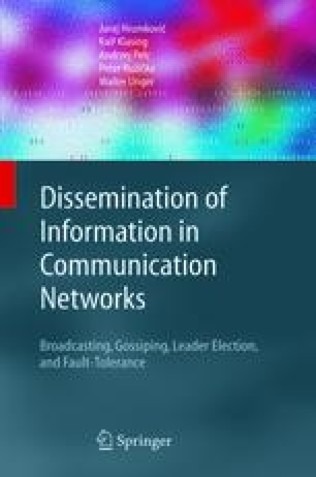
Dissemination of information in communication networks : Broadcasting, gossiping, leader election, and fault-tolerance
Preface Due to the development of hardware technologies (such as VLSI) in the early 1980s, the interest in parallel and distributive computing has been rapidly growingandinthelate1980sthestudyofparallelalgorithmsandarchitectures became one of the main topics in computer science. To bring the topic to educatorsandstudents,severalbooksonparallelcomputingwerewritten. The involvedtextbook“IntroductiontoParallelAlgorithmsandArchitectures”by F. Thomson Leighton in 1992 was one of the milestones in the development of parallel architectures and parallel algorithms. But in the last decade or so the main interest in parallel and distributive computing moved from the design of parallel algorithms and expensive parallel computers to the new distributive reality – the world of interconnected computers that cooperate (often asynchronously) in order to solve di?erent tasks.
