



الصفحة 25
الصفحة 25

Financial management for technology start-ups : How to power growth, track performance and drive innovation
Develops the financial intelligence you need to communicate effectively with investors, implement business strategies and pinpoint emerging pathways for profit / Outlines how to analyze your performance and undertake risk-return assessments to tactically grow your start-up / Offers proven methods for tracking your start-up's progress to ensure that growth is maintained and continuous / Analysis of financial statements directly from start-ups, new case studies on companies that have scaled up, focus on new digital technologies and market opportunities for start-ups, information on new players and potential future tech start-ups

Financial cryptography and data security ; FC 2020 International Workshops, AsiaUSEC, CoDeFi, VOTING, and WTSC, Kota Kinabalu, Malaysia, February 14, 2020, Revised Selected Papers
This book constitutes the refereed proceedings of two workshops held at the 24th International Conference on Financial Cryptography and Data Security, FC 2020, in Kota Kinabalu, Malaysia, in February 2020. The 39 full papers and 3 short papers presented in this book were carefully reviewed and selected from 73 submissions. The papers feature four Workshops: The 1st Asian Workshop on Usable Security, AsiaUSEC 2020, the 1st Workshop on Coordination of Decentralized Finance, CoDeFi 2020, the 5th Workshop on Advances in Secure Electronic Voting, VOTING 2020, and the 4th Workshop on Trusted Smart Contracts, WTSC 2020.

Fifth World Conference on Information Security Education ; Proceedings of the IFIP TC 11 WG 11.8, WISE 5, 19 to 21 June 2007, United States Military Academy, West Point, NY, USA
The scope of This book includes: foundations of computer science; software theory and practice; education; computer applications in technology; communication systems; systems modeling and optimization; information systems; computers and society; computer systems technology; security and protection in information processing systems; artificial intelligence; and human-computer interaction. Proceedings and post-proceedings of referred international conferences in computer science and interdisciplinary fields are featured. These results often precede journal publication and represent the most current research.
Fifth IFIP International Conference On Theoretical Computer Science - Tcs 2008 ; IFIP 20th World Computer Congress, TC 1, Foundations of Computer Science, September 7-10, 2008, Milano, Italy
Includes: foundations of computer science; software theory and practice; education; computer applications in technology; communication systems; systems modeling and optimization; information systems; computers and society; computer systems technology; security and protection in information processing systems; artificial intelligence; and human-computer interaction. Proceedings and post-proceedings of refereed international conferences in computer science and interdisciplinary fields are featured. These results often precede journal publication and represent the most current research. The principal aim of the IFIP series is to encourage education and the dissemination and exchange of information about all aspects of computing.

Field and service robotics : Results of the 6th international conference
This book presents the results of the sixth edition of Field and Service Robotics, FSR07, held in Chamonix, France, on 9th - 12th July 2007. The conference provided a forum for researchers, professionals and robot manufacturers to exchange up-to-date technical knowledge and experience. This book offers a collection of a broad range of topics including: Underwater Robots and Systems, Autonomous Navigation for Unmanned Aerial Vehicles, Simultaneous Localization and Mapping, Climbing Robotics, Sensor Fusion.

Federated AI for Real-World Business Scenarios
Real-world AI applications frequently have training data distributed in many different locations, with data at different sites having different properties and different formats. In many cases, data movement is not permitted due to security concerns, bandwidth, cost or regulatory restriction. Under these conditions, techniques of federated learning can enable creation of practical applications. Creating practical applications requires implementation of the cycle of learning from data, inferring from data, and acting based on the inference.

Feasibility and Infeasibility in Optimization : Algorithms and Computational Methods
Feasibility and Infeasibility in Optimization is a timely expository book that summarizes the state of the art in both classical and recent algorithms related to feasibility and infeasibility in optimization, with a focus on practical methods. All model forms are covered, including linear, nonlinear, and mixed-integer programs. Connections to related work in constraint programming are shown. Part I of the book addresses algorithms for seeking feasibility quickly, including new methods for the difficult cases of nonlinear and mixed-integer programs. Part II provides algorithms for analyzing infeasibility by isolating minimal infeasible (or maximum feasible) subsets of constraints, or by finding the best repair for the infeasibility. Infeasibility analysis algorithms have arisen primarily over the last two decades, and the book covers these in depth and detail. Part III describes applications in numerous areas outside of direct infeasibility analysis such as finding decision trees for data classification, analyzing protein folding, radiation treatment planning, automated test assembly, etc.

Explainable artificial intelligence in troke from the clinical, rehabilitation and nursing perspectives
As we know, strokes are one of the world's leading causes of death, and the cruel aspect of a stroke is that it leaves people with severe functional disability and/or cognitive impairment. Strokes have a significant impact on economies worldwide, as it is estimated that about 10% of the male population and 8% of the female population are affected by them. Such people need personal help in their everyday life and must be materially supported by social services. With the advancement of medicine, artificial intelligence, and new technologies have been developing rapidly and are gradually applied in diseases of the nervous system, increasingly helping diagnosis, treatment, rehabilitation, and prognosis of disease.
Explainable Artificial Intelligence : An Introduction to Interpretable Machine Learning
Offers a curriculum for introducing interpretability to machine learning at every stage. The authors provide compelling examples that a core teaching practice like leading interpretive discussions can be taught and learned by teachers and sustained effort. And what better way to strengthen the quality of AI and Machine learning outcomes. I hope that this book will become a primer for teachers, data Science educators, and ML developers, and together we practice the art of interpretive machine learning.
Explainable AI with Python
This book provides a full presentation of the current concepts and available techniques to make “machine learning” systems more explainable. The approaches presented can be applied to almost all the current “machine learning” models: linear and logistic regression, deep learning neural networks, natural language processing and image recognition, among the others.

Expert Clouds and Applications ; Proceedings of ICOECA 2021
Features original papers from International Conference on Expert Clouds and Applications (ICOECA 2021), organized by GITAM School of Technology, Bangalore, India during February 18–19, 2021. It covers new research insights on artificial intelligence, big data, cloud computing, sustainability, and knowledge-based expert systems. The book discusses innovative research from all aspects including theoretical, practical, and experimental domains that pertain to the expert systems, sustainable clouds, and artificial intelligence technologies.

Experimental vibration analysis for civil structures : Testing, sensing, monitoring, and control
Covers a wide range of topics in the areas of vibration testing, instrumentation, and analysis of civil engineering and critical infrastructure. It explains how recent research, development, and applications in experimental vibration analysis of civil engineering structures have progressed significantly due to advancements in the fields of sensor and testing technologies, instrumentation, data acquisition systems, computer technology, computational modeling and simulation of large and complex civil infrastructure systems. The book also examines how cutting-edge artificial intelligence and data analytics can be applied to infrastructure systems.

Experimental Robotics : The 10th International Symposium on Experimental Robotics
The goal of ISER is to provide a forum for research in robotics that focuses on novelty of theoretical contributions validated by experimental results. The meetings are conceived to bring together, in a small group setting, researchers from around the world who are in the forefront of experimental robotics research.

Evolving Connectionist Systems : The Knowledge Engineering Approach
Evolving Connectionist Systems is aimed at all those interested in developing and using intelligent computational models and systems to solve challenging real world problems in computer science, engineering, bioinformatics and neuroinformatics. The book challenges scientists and practitioners with open questions about future creation of new information models inspired by Nature. This edition includes new methods for adaptive, knowledge-based learning, such as online incremental feature selection, spiking neural networks, transductive neuro-fuzzy inference, adaptive data and model integration, cellular automata and artificial life systems, particle swarm optimisation, ensembles of evolving systems, and quantum inspired neural networks. New applications to gene and protein interaction modelling, brain data analysis and brain model creation, computational neuro-genetic modelling, adaptive speech, image and multimodal recognition, language modelling, adaptive robotics, modelling dynamic financial and socio-economic systems, and ecological modelling, are covered. An important new feature of the book is the attempt to connect different structural and functional levels of a complex, intelligent system, looking for inspiration from functional relationships in natural systems, such as the genetic and the brain activity.

Evolvable systems : From biology to hardware ; 8th International Conference, ICES 2008, Prague, Czech Republic, September 21-24, 2008. Proceedings
This book constitutes the refereed proceedings of the 8th International Conference on Evolvable Systems, ICES 2008, held in Prague, Czech Republic, in September 2008.The 28 revised full papers and 14 revised poster papers presented were carefully reviewed and selected from 52 submissions. The papers are organized in topical sections on evolution of analog circuits, evolution of digital circuits, hardware-software codesign and platforms for adaptive systems, evolutionary robotics, development, real-world applications, evolutionary networking, evolvable artificial neural networks, and transistor-level circuit evolution.

Evolvable systems : From biology to hardware ; 6th International Conference, ICES 2005, Sitges, Spain, September 12-14, 2005, Proceedings
The flying machines proposed by Leonardo da Vinci in the fifteenth century, the se- reproducing automata theory proposed by John von Neumann in the middle of the twentieth century and the current possibility of designing electronic and mechanical systems using evolutionary principles are all examples of the efforts made by humans to explore the mechanisms present in biological systems that permit them to tackle complex tasks. These initiatives have recently given rise to the emergent field of b- inspired systems and evolvable hardware. The inaugural workshop, Towards Evolvable Hardware, took place in Lausanne in October 1995, followed by the successive events of the International Conference on Evolvable Systems: From Biology to Hardware, held in Tsukuba (Japan) in October 1996, in Lausanne (Switzerland) in September 1998, in Edinburgh (UK) in April 2000, in Tokyo (Japan) in October 2001, and in Trondheim (Norway) in March 2003. Following the success of these past events the sixth international conference was aimed at presenting the latest developments in the field, bringing together researchers who use biologically inspired concepts to implement real systems in artificial intelligence, artificial life, robotics, VLSI design, and related domains. The sixth conference consolidated this biennial event as a reference meeting for the community involved in bio-inspired systems research. All the papers received were reviewed by at least three independent reviewers, thus guaranteeing a high-quality bundle for ICES 2005.
Evolutionary Swarm Robotics : Evolving Self-Organising Behaviours in Groups of Autonomous Robots
In this book the use of ER techniques for the design of self-organising group behaviours, for both simulated and real robots is introduced. This research has a twofold value. From an engineering perspective, an automatic methodology for synthesising complex behaviours in a robotic system is described.

Evolutionary Scheduling
Evolutionary scheduling is a vital research domain at the interface of two important sciences - artificial intelligence and operational research. Scheduling problems are generally complex, large scale, constrained, and multi-objective in nature, and classical operational research techniques are often inadequate at solving them effectively. With the advent of computation intelligence, there is renewed interest in solving scheduling problems using evolutionary computational techniques. These techniques, which include genetic algorithms, genetic programming, evolutionary strategies, memetic algorithms, particle swarm optimization, ant colony systems, etc, are derived from biologically inspired concepts and are well-suited to solve scheduling problems since they are highly scalable and flexible in terms of handling constraints and multiple objectives. This edited book gives an overview of many of the current developments in the large and growing field of evolutionary scheduling, and demonstrates the applicability of evolutionary computational techniques to solve scheduling problems, not only to small-scale test problems, but also fully-fledged real-world problems.

Evolutionary Intelligence : An introduction to theory and applications with Matlab
This book gives a good introduction to evolutionary computation for those who are first entering the field and are looking for insight into the underlying mechanisms behind them. Emphasizing the scientific and machine learning applications of genetic algorithms instead of applications to optimization and engineering, the book could serve well in an actual course on adaptive algorithms.
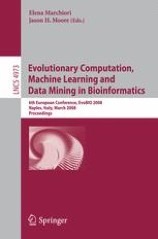
Evolutionary computation, machine learning and data mining in bioinformatics ; 6th European Conference, EvoBIO 2008, Naples, Italy, March 26-28, 2008. Proceedings
The feld of bioinformatics has two main objectives: the creation and main- nance of biological databases, and the discovery of knowledge from life sciences data in order to unravel the mysteries of biological function, leading to new drugs and therapies for human disease. Life sciences data come in the form of biological sequences, structures, pathways, or literature. One major aspect of discovering biological knowledge is to search, predict, or model specifc infortioninagivendatasetinorderto generate new in teresting knowledge.Computer science methods such as evolutionary computation, machine learning, and data mining all have a great deal to ofer the feld of bioinformatics.
