



الصفحة 24
الصفحة 24

Geometric Methods in Algebra and Number Theory
The transparency and power of geometric constructions has been a source of inspiration to generations of mathematicians. The beauty and persuasion of pictures, communicated in words or drawings, continues to provide the intuition and arguments for working with complicated concepts and structures of modern mathematics. This volume contains a selection of articles exploring geometric approaches to problems in algebra, algebraic geometry and number theory.

Geometric mechanics on riemannian manifolds : Applications to partial differential equations
This work presents a purely geometric treatment of problems in physics involving quantum harmonic oscillators, quartic oscillators, minimal surfaces, and Schrödinger's, Einstein's and Newton's equations. Historically, problems in these areas were approached using the Fourier transform or path integrals, although in some cases (e.g., the case of quartic oscillators) these methods do not work. New geometric methods are introduced in the work that have the advantage of providing quantitative or at least qualitative descriptions of operators, many of which cannot be treated by other methods. And, conservation laws of the Euler–Lagrange equations are employed to solve the equations of motion qualitatively when quantitative analysis is not possible. It includes : Lagrangian formalism on Riemannian manifolds; energy momentum tensor and conservation laws; Hamiltonian formalism; Hamilton–Jacobi theory; harmonic functions, maps, and geodesics; fundamental solutions for heat operators with potential; and a variational approach to mechanical curves.

Geometric Integration Theory
This textbook introduces geometric measure theory through the notion of currents. Currents—continuous linear functionals on spaces of differential forms—are a natural language in which to formulate various types of extremal problems arising in geometry, and can be used to study generalized versions of the Plateau problem and related questions in geometric analysis. Key features of Geometric Integration Theory: * Includes topics on the deformation theorem, the area and coarea formulas, the compactness theorem, the slicing theorem and applications to minimal surfaces * Applies techniques to complex geometry, partial differential equations, harmonic analysis, differential geometry, and many other parts of mathematics

Geometric Group Theory ; Geneva and Barcelona Conferences
This volume assembles research papers in geometric and combinatorial group theory. This wide area may be defined as the study of those groups that are defined by their action on a combinatorial or geometric object, in the spirit of Klein’s programme.The contributions range over a wide spectrum: limit groups, groups associated with equations, with cellular automata, their structure as metric objects, their decomposition, etc. Their common denominator is the language of group theory, used to express and solve problems ranging from geometry to logic.

Geometric Function Theory : Explorations in Complex Analysis
Complex variables is a precise, elegant, and captivating subject. Presented from the point of view of modern work in the field, this new book addresses advanced topics in complex analysis that verge on current areas of research, including invariant geometry, the Bergman metric, the automorphism groups of domains, harmonic measure, boundary regularity of conformal maps, the Poisson kernel, the Hilbert transform, the boundary behavior of harmonic and holomorphic functions, the inhomogeneous Cauchy–Riemann equations, and the corona problem.
Geometric Data Analysis : From Correspondence Analysis to Structured Data Analysis
Geometric Data Analysis (GDA) is the name suggested by Stanford University to designate the approach to Multivariate Statistics initiated.as Correspondence Analysis, an approach that has become more and more used and appreciated over the years. This book presents the full formalization of GDA in terms of linear algebra - the most original and far-reaching consequential feature of the approach - and shows also how to integrate the standard statistical tools such as Analysis of Variance, including Bayesian methods. Chapter 9, Research Case Studies, is nearly a book in itself; it presents the methodology in action on three extensive applications, one for medicine, one from political science, and one from education (data borrowed from the Stanford computer-based Educational Program for Gifted Youth ). Thus the readership of the book concerns both mathematicians interested in the applications of mathematics, and researchers willing to master an exceptionally powerful approach of statistical data analysis.
Geometric Aspects of Functional Analysis : Israel Seminar 2004-2005
Most of the papers deal with different aspects of the Asymptotic Geometric Analysis, ranging from classical topics in the geometry of convex bodies, to inequalities involving volumes of such bodies or, more generally, log-concave measures, to the study of sections or projections of convex bodies. In many of the papers Probability Theory plays an important role; in some limit laws for measures associated with convex bodies, resembling Central Limit Theorems, are derive and in others probabilistic tools are used extensively. There are also papers on related subjects, including a survey on the behavior of the largest eigenvalue of random matrices and some topics in Number Theory.

Geometric and Topological Methods for Quantum Field Theory
This volume offers an introduction, in the form of four extensive lectures, to some recent developments in several active topics at the interface between geometry, topology and quantum field theory. The first lecture is by Christine Lescop on knot invariants and configuration spaces, in which a universal finite-type invariant for knots is constructed as a series of integrals over configuration spaces. This is followed by the contribution of Raimar Wulkenhaar on Euclidean quantum field theory from a statistical point of view. The author also discusses possible renormalization techniques on noncommutative spaces. The third lecture is by Anamaria Font and Stefan Theisen on string compactification with unbroken supersymmetry. The authors show that this requirement leads to internal spaces of special holonomy and describe Calabi-Yau manifolds in detail. The last lecture, by Thierry Fack, is devoted to a K-theory proof of the Atiyah-Singer index theorem and discusses some applications of K-theory to noncommutative geometry. These lectures notes, which are aimed in particular at graduate students in physics and mathematics, start with introductory material before presenting more advanced results. Each chapter is self-contained and can be read independently.
Geographic Information Science ; 4th International Conference, GIScience 2006, Münster, Germany, September 20-23, 2006, Proceedings
The GIScience conference series (www. giscience. org) was created as a forum for all researchers who are interested in advancing research in the fundam- tal aspects of geographic information science.The conferences focus on emerging topics and basic research ?ndings across all s- tors of geographic information science. After three highly successful conferences in the United States, this year’s GIScience conference was held in Europe for the ?rst time. The GIScience conferences have been a meeting point for researchers coming from various disciplines, including cognitive science, computer science, engine- ing, geography,information science, mathematics, philosophy, psychology,social science, and statistics. The advancement of geographic information science - quiressuchinterdisciplinarybreadth,andthisisalsowhatmakestheconferences so exciting. In order to account for the di?erent needs of the involved scienti?c disciplines with regard to publishing their research results.

geoENV VI - Geostatistics for Environmental Applications : Proceedings of the Sixth European Conference on Geostatistics for Environmental Applications
This volume contains how geostatistics is applied within the environmental sciences. A few selected theoretical contributions are also included.

Geodetic Deformation Monitoring : From Geophysical to Engineering Roles ; IAG Symposium Jaén, Spain, March 7-19,2005
Geodesy is the science dealing with the determination of the position of points in space, the shape and gravity field of the Earth and with their time variations. A consequence is that geodesists feel as a permanent subject of research, the detection, analysis and interpretation of spatial deformation as well as gravity field variation. This book collects 36 selected papers from the International Symposium on Geodetic Deformation Monitoring held in Jaén (Spain) from 17th to 19th March 2005. The main topics covered in the symposium were: mathematical and statistical models for crustal deformation analysis, deformation monitoring from GPS and InSAR data: analysis and geophysical interpretation, geodetic monitoring of movements in civil engineering, integration of spatial and terrestrial techniques in deformation studies, geodynamical applications of gravimetric observations and present-day geodetic instrumentation for deformation monitoring. This volume is a good overview of theoretical matters, models and results.

Génetique statistique = Statistical genetics
Presents the main statistical tools useful in genetics: significance tests, analysis methods based on the likelihood function, EM algorithm, modeling, analysis of variance, hierarchical classifications, multiple comparisons, etc. All of them shed light on a number of biological phenomena such as carcinogenesis, population genetics, Hardy-Weinberg equilibrium, natural selection, mutations, heredity, coalescence processes, and even evolution. This book is intended for mathematicians and biologists alike. Written with a great concern for clarity, it is also accessible to non-specialists who will be able, thanks to it, to strengthen their theoretical base and above all to develop their know-how through very concrete applications.

Genetics of Adaptation
What is the genetic basis of adaptive evolution? In this volume, a new generation of biologists have taken up this challenge. Using advances in both molecular genetic and statistical techniques, evolutionary geneticists have made considerable progress in this emerging field. In this volume, a diversity of examples from plant and animal studies provides valuable information for those interested in the genetics and evolution of complex traits.

Genetic programming : Theory and practice II
This volume explores the emerging interaction between theory and practice in the cutting-edge, machine learning method of Genetic Programming (GP). The contributions developed from a second workshop at the University of Michigan's Center for the Study of Complex Systems where leading international genetic programming theorists from major universities and active practitioners from leading industries and businesses met to examine how GP theory informs practice and how GP practice impacts GP theory. Chapters include such topics as financial trading rules, industrial statistical model building, population sizing, the roles of structure in problem solving by computer, stock picking, automated design of industrial-strength analog circuits, topological synthesis of robust systems, algorithmic chemistry, supply chain reordering policies, post docking filtering, an evolved antenna for a NASA mission and incident detection on highways.

Generalized Curvatures
The central object of this book is the measure of geometric quantities describing N a subset of the Euclidean space (E ,), endowed with its standard scalar product. Let us state precisely what we mean by a geometric quantity. Consider a subset N S of points of the N-dimensional Euclidean space E , endowed with its standard N scalar product. LetG be the group of rigid motions of E . We say that a 0 quantity Q(S) associated toS is geometric with respect toG if the corresponding 0 quantity Q[g(S)] associated to g(S) equals Q(S), for all g?G . For instance, the 0 diameter ofS and the area of the convex hull ofS are quantities geometric with respect toG . But the distance from the origin O to the closest point ofS is not, 0 since it is not invariant under translations ofS. It is important to point out that the property of being geometric depends on the chosen group. For instance, ifG is the 1 N group of projective transformations of E , then the property ofS being a circle is geometric forG but not forG , while the property of being a conic or a straight 0 1 line is geometric for bothG andG . This point of view may be generalized to any 0 1 subsetS of any vector space E endowed with a groupG acting on it.

Generalized Convexity, Generalized Monotonicity and Applications ; Proceedings of the 7th International Symposium on Generalized Convexity and Generalized Monotonicity
This volume contains a collection of refereed articles on generalized convexity and generalized monotonicity. The first part of the book contains invited papers with applications of (generalized) convexity to such diverse fields as algebraic dynamics of the Gamma function values, discrete optimization, Lipschitzian stability of parametric constraint systems, and monotonicity of functions. The second part contains contributions presenting the latest developments in generalized convexity and generalized monotonicity: its connections with discrete and with continuous optimization, multiobjective optimization, fractional programming, nonsmooth Aanalysis, variational inequalities, and its applications to concrete problems such as finding equilibrium prices in mathematical economics, or hydrothermal scheduling.

Generalized collocations methods : Solutions to nonlinear problems
This book examines various mathematical tools—based on generalized collocation methods—to solve nonlinear problems related to partial differential and integro-differential equations. Covered are specific problems and models related to vehicular traffic flow, population dynamics, wave phenomena, heat convection and diffusion, transport phenomena, and pollution. Based on a unified approach combining modeling, mathematical methods, and scientific computation, each chapter begins with several examples and problems solved by computational methods; full details of the solution techniques used are given. The last section of each chapter provides problems and exercises giving readers the opportunity to practice using the mathematical tools already presented.
General Theory of Information Transfer and Combinatorics
This book constitutes the thoroughly refereed research papers contributed to a research project on the `General Theory of Information Transfer and Combinatorics' that was hosted from 2001-2004 at the Center for Interdisciplinary Research (ZIF) of Bielefeld University and also papers of several incorporated meetings thereof. The 63 revised full papers presented were carefully reviewed and selected for inclusion in the book. The papers are organized in topical sections on probabilistic models, cryptology, pseudo random sequences, quantum models, statistics, probability theory, information measures, error concepts, performance criteria, search, sorting, ordering, planning, language evolution, pattern discovery, reconstructions, network coding, combinatorial models, and a problem section.

General Relativity
this book is a short and concise exposition of the central ideas of general relativity. Although the original audience was made up of mathematics students, the focus is on the chain of reasoning that leads to the relativistic theory from the analysis of distance and time measurements in the presence of gravity, rather than on the underlying mathematical structure. The geometric ideas - which are central to the understanding of the nature of gravity - are introduced in parallel with the development of the theory, the emphasis being on laying bare how one is led to pseudo-Riemannian geometry through a natural process of reconciliation of special relativity with the equivalence principle.
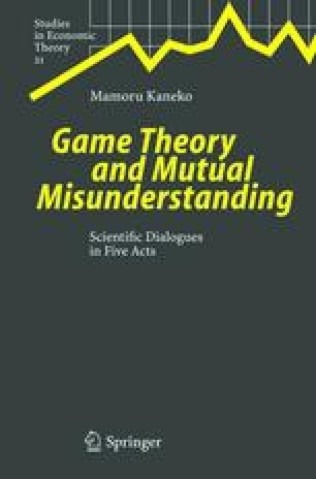
Game Theory and Mutual Misunderstanding : Scientific Dialogues in Five Acts
This book consists of five acts and two interludes, which are all written as dialogues between three main characters and other supporting characters. Each act discusses the epistemological, institutional and methodological foundations of game theory and economics, while using various stories and examples. A featured aspect of those discussions is that many forms of mutual misunderstanding are involved in social situations as well as in those fields themselves. One Japanese traditional comic story called the Konnyaku Mondo is representative and gives hints of how our thought is constrained by incorrect beliefs. Each dialogue critically examines extant theories and common misunderstanding in game theory and economics in order to find possible future developments of those fields.
