



الصفحة 24
الصفحة 24

Gaming, simulations and society : Research scope and perspective
The Japan Association of Simulation & Gaming (JASAG) and the Science Council of Japan (SCJ) hosted ISAGA 2003, the 34th annual conference of the International Simulation and Gaming Association (ISAGA), at Kazusa Akademia Park in Kisarazu, Japan,August 25–29, 2003. About 450 participants and guests attended,with 330 from Japan and 101 from 34 other countries. The number of submitted papers and reports exceeded 210, and in addition, many poster presentations and experiential sessions were held. This book is made up of 30 papers submitted to ISAGA 2003 and provides a good example of the diverse scope and standard of research achieved in simu- tion and gaming today.The theme of ISAGA 2003 was “Social Contributions and Responsibilities of Simulation and Gaming.”

Game-Theoretical Semantics : Essays on Semantics by Hintikka, Carlson, Peacocke, Rantala and Saarinen
This book is a collection of studies applying game-theoretical concepts and ideas to analysing the semantics of natural language and some formal languages. The bulk of the book consists of several papers by Hintikka, Carlson and Saarinen and discusses several of the central problems of the semantics of natural language.The topics covered are the semantics of natural language quantifiers, conditionals, pronouns and anaphora more generally. Hintikka’s famous essay presenting examples of "branching quantifier structures" in English, as well as one formulating his "any-every thesis", are included. The book also includes Hintikka’s closely argued philosophical discussion of the relationships between the new semantical games with the language games of Wittgenstein.

Games Without Frontiers? : Socio-historical Perspectives at the Gaming/Gambling Intersection
This book focuses on how and why digital games and gambling are increasingly intertwined and asks “does this matter?” Looking at how “loot boxes” became the poster child for the convergence of gambling and gaming, Wardle traces how we got here. She argues that the intersection between gambling and gaming cultures has a long lineage, one that can be traced back throughout the 20th century but also incorporates more recent trends like the poker boom of the 1990s, the development of social media gambling products and the development of skin betting markets.
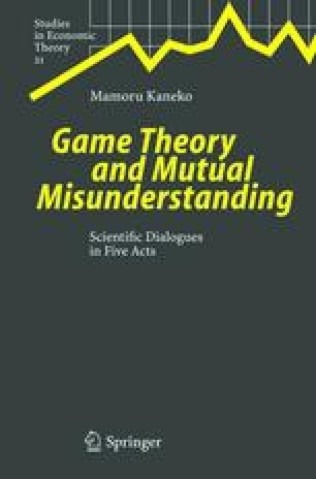
Game Theory and Mutual Misunderstanding : Scientific Dialogues in Five Acts
This book consists of five acts and two interludes, which are all written as dialogues between three main characters and other supporting characters. Each act discusses the epistemological, institutional and methodological foundations of game theory and economics, while using various stories and examples. A featured aspect of those discussions is that many forms of mutual misunderstanding are involved in social situations as well as in those fields themselves. One Japanese traditional comic story called the Konnyaku Mondo is representative and gives hints of how our thought is constrained by incorrect beliefs. Each dialogue critically examines extant theories and common misunderstanding in game theory and economics in order to find possible future developments of those fields.

Game Theory : A Multi-Leveled Approach
This book presents the basics of game theory both on an undergraduate level and on a more advanced mathematical level. It covers most topics of interest in game theory, including cooperative game theory. Part I presents introductions to all these topics on a basic yet formally precise level. It includes chapters on repeated games, social choice theory, and selected topics such as bargaining theory, exchange economies, and matching. Part II goes deeper into noncooperative theory and treats the theory of zerosum games, refinements of Nash equilibrium in strategic as well as extensive form games, and evolutionary games. Part III covers basic concepts in the theory of transferable utility games, such as core and balancedness, Shapley value and variations, and nucleolus. Some mathematical tools on duality and convexity are collected in Part IV. Every chapter in the book concludes with a problem section. Hints, answers and solutions are included.

Gambling Problems in Youth : Theoretical and Applied Perspectives
Howard J. Shaffer, Ph. D. More than 20 years ago, I first noted that young people in North America were growing up in a context of legalized gambling for their entire lifetime. By the 1980s, for young people, gambling had become an average and expectable part of the social landscape. Amid legal opportunities to gamble in all but two of the United States and with illicit opportunities to gamble in every state, gambling is now ubiquitous in America. With few social sa- tions to limit a young person’s interest in gambling—like their adult co- terparts—young people now gamble in larger numbers and for seemingly higher stakes

Galaxies in Turmoil : The Active and Starburst Galaxies and the Black Holes That Drive Them
Active galaxies involve some of the most extreme conditions and some of the most intriguing phenomena found anywhere in the universe. Research students - and even established research astronomers - will also find this book invaluable as a quick reference to the properties of, and phenomena within, those types of active galaxies that may be outside their specialisms.

Galaxies and How to Observe Them
Satisfies the need for a modern, comprehensive review in combining the three major aspects: the physical background on the nature and data of galaxies, the relevant instrumentation and viewing techniques, and finally the targets and their individual appearance in telescopes of various apertures. To illustrate the latter, a comprehensive sample of galaxies, including quasars, groups and clusters of galaxies is presented. This combination of theoretical knowledge and practical information guarantees successful observing sessions. The book could become a standard source on galaxy observing for all kinds of amateur observers, from the beginner to the experienced.

Gaithers Dictionary of Scientific Quotations
Finding words of wisdom about science is now easy with Gaither's Dictionary of Scientific Quotations. Organized thematically and indexed alphabetically by author, this work makes readily available an unprecedented collection of approximately 18,000 quotations related to a broad range of scientific topics, including astronomy, biology, chemistry, engineering, and physics. The thematic organization allows you to effortlessly find a pertinent quotation from a variety of sources and perspectives.

Fuzzy Logic : A Spectrum of Theoretical & Practical Issues
This book exclusively surveys the active on-going research of the current maturity of fuzzy logic over the last four decades. Many world leaders of fuzzy logic have enthusiastically contributed their best research results into five theoretical, philosophical and fundamental sub areas and nine distinctive applications, including two PhD dissertations from two world class universities dealing with cutting-edge research areas of bioinformatics and geological science. Beyond the scope of survey and collection of the book, one important spin off is the emerging and recognition of a major scientific paradigm shift from the conventional mathematics to the mathematics of uncertainty, which arguably holds the key to solving very difficult and complex problems in biological and social sciences alike. The book, loaded with historical perspective, creative thinking, critical reviewing, and uniquely constructed strategy for future growth of this dynamic research area, is an invaluable resource for active researchers at all levels, university administrators, foundation directors, funding agency program chiefs, research & development planners and technological assessors.

Future tech : How to capture value from disruptive industry trends
In Future Tech, the author reveals that true change only results from combining the forces of science and technology, policy and regulation, new business models (i.e. sharing economy) and social dynamics (whether or not people adopt it). Whether these four forces align explains why some technologies, such as AI, blockchain, robotics, synthetic biology and 3D printing, stick and why others fail.

Future Shaper : How Leaders Can Take Charge in an Uncertain World
What should leaders do? The answer is not to shy away from inevitable changes and more uncertainty, but to have the courage to face it. Leaders need to take charge by embracing new technologies, new ideas and converting these into opportunities for leadership innovation. The best ways for leaders to predict the future is to help create the future. Future Shaper is about giving back a sense of control. It's about empowering leaders to take charge and shape the future. Niamh O'Keeffe asks leaders to re-calibrate their leadership skills to include imagination and courage, to embrace innovation and drive growth and create a better future. Future Shaper helps readers to: · Embrace new digital technologies, understand AI and equip themselves for those not-yet-invented challenges ·

Future campus : Design quality in university buildings
Argues that investment in the higher education sector is a driver for intellectual, social and economic development, offering opportunities for positive impacts for the physical environment on the character and performance of higher education. The editor believes that good outcomes result from good design, which should address elements such as learning from best current practice, the importance of clear briefing, good environmental performance, the positive social impacts and, also, the importance of ensuring a beautiful outcome. It has chapters contributed from leading-edge practices, including case studies with highly illustrated project examples.

Funds, Flows and Time : An Alternative Approach to the Microeconomic Analysis of Productive Activities
The subject of this book is production, which is an important and extensive field in economic science. In fact, production, distribution and consump tion were long considered the three federated kingdoms which together formed the great empire of the economy. According to other slightly dif ferent traditions, production also held pride of place, specifically as a basic link in the long chain of social reproduction. Today, whatever the theoreti cal approach, production is a fundamental requirement for human survival. This was not, however, always the case. For much of the history of man kind hominids were hunter, scavenger and gatherers, with very little con trol over their environment, and extremely little in the way of artefacts with which to work. However, since the Neolithic revolution, productive processes have constituted an essential mechanism, providing human soci ety with goods and services to satisfy its needs and cravings.
Fundamentals of multimedia ; 3rd ed.
Addresses real issues commonly faced in the workplace. The essential concepts are explained in a practical way to enable students to apply their existing skills to address problems in multimedia. Fully revised and updated, this new edition now includes coverage of such topics as 3D TV, social networks, high-efficiency video compression and conferencing, wireless and mobile networks, and their attendant technologies.

Fundamentals of multimedia ; 2nd ed.
Addresses real issues commonly faced in the workplace. The essential concepts are explained in a practical way to enable students to apply their existing skills to address problems in multimedia. Fully revised and updated, this new edition now includes coverage of such topics as 3D TV, social networks, high-efficiency video compression and conferencing, wireless and mobile networks, and their attendant technologies.

Fundamental change : International handbook of educational change
This set of four volumes on brings together evidence and insights on educational change issues from leading writers and researchers in the field from across the world. Many of these writers, whose chapters have been specially written for these books, have been investigating, helping initiate and implementing educational change, for most or all of their lengthy careers. Others are working on the cutting edge of theory and practice in educational change, taking the field in new or even more challenging directions. And some are more skeptical about the literature of educational change and the assumptions on which it rests. They help us to approach projects of understanding or initiating educational change more deeply, reflectively and realistically.

Fun and Games ; 2nd International conference, Eindhoven, The Netherlands, October 20-21, 2008. Proceedings
This book constitutes the refereed proceedings of the Second International Conference on Fun and Games, held in Eindhoven, The Netherlands, in October 2008.The 17 revised full papers, presented together with 2 invited talks were carefully reviewed and selected from a total of 36 submissions. The papers encompass the study of computer games, game development and experiences by researchers from social sciences, computing, electrical engineering, design, etc. Main focus is given to topics such as tightly-coupled embodied control of movement-sensitive mobile devices, hypercomputation and cultural computing, emerging gaming paradigms.

Full of Life : UNESCO Biosphere Reserves - Model Regions for Sustainable Development
UNESCO biosphere reserves are full of life. Here, people put sustainable development into practice: economic, ecological, social and cultural objectives are pursued, conserving precious natural spaces in the process. People are opening up new opportunities for today and are taking responsibility for future generations. What could be more exciting than a look at new ways into the future? The 14 biosphere reserves in Germany are part of a world network of 440 areas in the UNESCO Man and the Biosphere Programme (MAB). Founded in the 1970s to research the relationship between man and the environment, biosphere reserves have been developed into model regions for sustainable development since the 1992 Rio Conference. This publication gives an overview of developments to date and the new direction for the MAB Programme in Germany. The generally valid guidelines for the conservation, care and development of these areas are explained. Various project examples from practice and research bear witness to the living implementation of the Programme in the German UNESCO biosphere reserves.

Frontline and Factory : Comparative Perspectives on the Chemical Industry at War, 1914-1924
This book represents a first considered attempt to study the factors that conditioned industrial chemistry for war in1914-18. Taking a comparative perspective, it reflects on the experience of France, Germany, Austria, Russia, Britain, Italy and Russia, and points to significant similarities and differences. It looks at changing patterns in the organisation of industry, and at the emerging symbiosis between science, industry and the military, which contributed to the first ‘academic-military-industrial’ complex of the 20th century. At the same time, it reflects on the world’s first, and ultimately unsuccessful attempt to monitor ‘dual-use’ chemical technologies, and so restrict the proliferation of an important category of weapons of mass destruction.
