



الصفحة 24
الصفحة 24

Morphometrics with R
The R language and environment offers a single platform to perform a multitude of analyses from the acquisition of data to the production of static and interactive graphs. This offers an ideal environment to analyze shape variation and shape change. This open-source language is accessible for novices and for experienced users. Adopting R gives the user and developer several advantages for performing morphometrics: evolvability, adaptability, interactivity, a single and comprehensive platform, possibility of interfacing with other languages and software, custom analyses, and graphs. The book explains how to use R for morphometrics and provides a series of examples of codes and displays covering approaches ranging from traditional morphometrics to modern statistical shape analysis such as the analysis of landmark data, Thin Plate Splines, and Fourier analysis of outlines.

More Joel on software : Further toughts on diverse and occasionally related matters that will prove of interest to software developers, designers, and managers, and to those who, whether by good fortune or III Luck, work with them in some capacity
Joel Spolsky started his weblog in March 2000 in order to offer his insights, based on years of experience, on how to improve the world of programming. This weblog has become infamous among the programming world, and is linked to more than 600 other web sites and translated into 30+ languages! Spolsky's extraordinary writing skills, technical knowledge, and caustic wit have made him a programming guru. With the success of Joel on Software, there has been a strong demand for additional gems and advice, and this book is the answer to those requests. Containing a collection of all–new articles from the original, More Joel on Software has even more of an edge than the original, and the tips for running a business or managing people have far broader application than the software industry.

Moran's Dictionary of Chemical Engineering Practice
Moran’s Dictionary of Chemical Engineering Practice is the most comprehensive guide to the jargon of the chemical engineering profession. It defines and where necessary disambiguates more than 10,000 terms and includes short discussions of the various meanings of the most contested terms.

Moral reasoning at work : Rethinking ethics in organizations ; 2nd ed.
Moral Reasoning at Work offers a fresh perspective on how to live with them using ethics and moral psychology research. It argues that decision-makers must go beyond compliance and traditional approaches to ethics to prepare for moral dilemmas. The book has been updated with a range of examples from the author’s more recent research, to reflect current issues affecting organizations in the digital age. With two new chapters on artificial intelligence and social media, this new edition provides an up-to-date overview of ethical challenges in organizations.

Moral Philosophy on the Threshold of Modernity
This volume investigates the paradigm changes which occurred in ethics during the early modern era (1350-1600). While many general claims have been made regarding the nature of moral philosophy in the period of transition from medieval to modern thought, the rich variety of extant texts has seldom been studied and discussed in detail. The present collection attempts to do this. It provides new research on ethics in the context of Late Scholasticism, Neo-Scholasticism, Renaissance Humanism and the Reformation. It traces the fate of Aristotelianism and of Stoicism, explores specific topics such as probabilism and casuistry, and highlights the connections between Protestant theology and early modern ethics. The book also examines how the origins of human rights, as well as different views of moral agency, the will and the emotions, came into focus on the eve of modernity.

Moral Education : Beyond the Teaching of Right and Wrong
This volume is unique in providing a comprehensive discussion of moral education in the light of a range of ethical theories. In a balanced, thoughtful and penetrating account, all of these are shown to have a contribution to make to our moral understanding, and hence to moral education, even if none provides a definitive criterion of moral conduct. Though divine command is rejected as a source of moral justification, the possible contribution of some religious traditions to moral education is sympathetically considered. Fashionable relativism and recent moves towards inculcatory authoritarianism are both firmly rejected. The argument is philosophically rigorous throughout. Contemporary issues addressed include the links between personal morality and citizenship, including world citizenship, family values and sexual morality.

Monte Carlo and Quasi-Monte Carlo Methods 2006
This book represents the refereed proceedings of the Seventh International Conference on Monte Carlo and Quasi-Monte Carlo Methods in Scientific Computing, held in Ulm (Germany) in August 2006. The proceedings include carefully selected papers on many aspects of Monte Carlo and quasi-Monte Carlo methods and their applications, as well as providing information on current research in these very active areas. Besides covering theory, the book is an excellent resource work for practitioners as well.

Monograph of the Urostyloidea (Ciliophora, Hypotricha)
This monograph is the second of a series treating the hypotrichs, a major part of the spirotrichous ciliates. The urostyloids are characterised by a zigzag-arrangement of the ventral cirri. Like the first part of the series, the Oxytrichidae, it summarises the morphological, morphogenetic, faunistic, and ecological data from the past 230 years, scattered in more than 1300 references from all over the world. Dichotomous keys lead to 36 genera and subgenera comprising 153 species illustrated by more than 2100 figures, including original ones. The treatise offers taxonomists, cell biologists, and ecologists a thorough and up-to-date revision because for each species a detailed list of synonyms, a discussion of the nomenclature and systematics, and an extensive description of the morphology and ecology, including almost all published faunistic records, are provided. With the monographs of the Urostyloidea and the Oxytrichidae the interested scientist can identify more than 320 species of hypotrichs, which are an important component of the eukaryotic microbial life in limnetic, marine, and terrestrial habitats.

Monograph of the Spathidiida (Ciliophora, Haptoria) ; Vol. I : Protospathidiidae, Arcuospathidiidae, Apertospathulidae
The present monograph carefully revises the taxonomy, nomenclature, and ecology of all nominal species and shows that spathidiid diversity has been greatly underestimated. Based on the reinvestigation of described species with modern methods (silver impregnation, scanning electron microscopy) and the first description of over 50 new species, the family Spathidiidae is split into four families and 20 genera. Each species is described and figured in detail, making it unnecessary to go back to the original literature often difficult to obtain. Two identification keys are provided, viz., one for taxonomists and another, simple key for users not specifically trained in ciliate taxonomy.

Mono-Cycle Photonics and Optical Scanning Tunneling Microscopy : Route to Femtosecond Ångstrom Technology
"Mono-Cycle Photonics and Optical Scanning Tunneling Microscopy" deals with both the ultrashort laser-pulse technology in the few- to mono-cycle region and the laser-surface-controlled scanning-tunneling microscopy (STM) extending into the spatiotemporal extreme technology. The former covers the theory of nonlinear pulse propagation beyond the slowly-varing-envelope approximation, the generation and active chirp compensation of ultrabroadband optical pulses, the amplitude and phase characterization of few- to mono-cycle pulses, and the feedback field control for the mono-cycle-like pulse generation. In addition, the wavelength-multiplex shaping of ultrabroadband pulse is described. The latter covers the CW-laser-excitation STM, the femtosecond-time-resolved STM and atomic-level surface phenomena controlled by femtosecond pulses.

Monitors of Organic Chemicals in the Environment : Semipermeable Membrane Devices
Modern, industrialized societies depend on a wide range of chemical substances such as fuels, plastics, biocides, pharmaceuticals and detergents for maintaining the high quality lifestyle to which we aspire. The challenge is to ensure that while we enjoy the benetsof thes esubstances,theirinevitablereleaseintoourbiosphere does not result in unwanted human and ecosystem exposures, and the risk of - verse effects. One response to this challenge has been the extensive effort to detect and analyze or monitor a multitude of chemicals in a variety of environmental media, especially toxic organic compounds in air, water, soils and biota. An extensive literature on these traditional techniques has evolved over the years.

Monitoring State Compliance with the UN Convention on the Rights of the Child : An Analysis of Attributes
This book presents a discussion on human rights-based attributes for each article pertinent to the substantive rights of children, as defined in the United Nations Convention on the Rights of the Child (UNCRC). It provides the reader with a unique and clear overview of the scope and core content of the articles, together with an analysis of the latest jurisprudence of the UN Committee on the Rights of the Child. For each article of the UNCRC, the authors explore the nature and scope of corresponding State obligations, and identify the main features that need to be taken into consideration when assessing a State’s progressive implementation of the UNCRC. This analysis considers which aspects of a given right are most important to track, in order to monitor States' implementation of any given right, and whether there is any resultant change in the lives of children.

Monitoring of Cerebral and Spinal Haemodynamics During Neurosurgery
Monitoring of Cerebral and Spinal Haemodynamics During Neurosurgery is a comprehensive description of subdural monitoring of intracranial pressure (ICP) during neurosurgery.

Money and debt : The public role of banks
This book from the Netherlands Scientific Council for Government Policy explains how money creation and banking works, describes the main problems of the current monetary and financial system and discusses several reform options. This book systematically evaluates proposals for fundamental monetary reform, including ideas to separate money and credit by breaking up banks, introducing a central bank digital currency, and introducing public payment banks. By drawing on these plans, the authors suggest several concrete reforms to the current banking system with the aim to ensure that the monetary system remains stable, contributes to the Dutch economy, fairly distributes benefits, costs and risks, and enjoys public legitimacy. This systematic approach, and the accessible way in which the book is written, allows specialized and non-specialised readers to understand the intricacies of money, banking, monetary reform and financial innovation, far beyond the Dutch context.
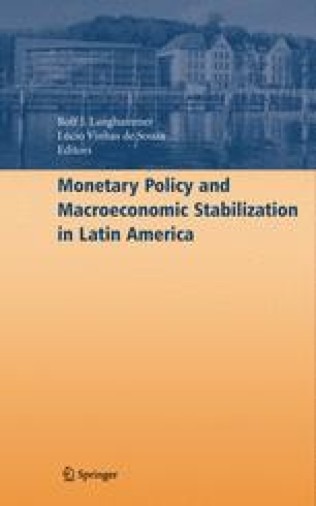
Monetary Policy and Macroeconomic Stabilization in Latin America
Latin America is a very important region of the globe, which has been buffeted by successive waves of economic instability within the last decades. These waves have caused several episodes of hyperinflation or near hyperinflation, and several currency and financial crises, which, in certain moments, have even spilled over and affected other emerging markets. This has resulted in huge costs in terms of lost potential growth, and, as is inevitable, the markets most affected by this have been the least capable of defending themselves. In a region plagued by still considerable rates of social exclusion, with some of the highest rates of income concentration in the whole globe, the human costs of these crises have been very substantial. Starting in the early 1990s, the slow implementation of reforms, plus the resumption of more sustained growth—to a substantial degree linked to the increase in commodity prices, especially since the early 2000s—seems to have resulted in a more stable situation. Initially, in early reformers like Chile, later in the larger economies of the region, like Brazil and Mexico, a consensus— embraced by both sides of the political spectrum—towards integration in global markets, both in their trade and financial components, floating exchange rates, independent monetary authorities, and sustainable fiscal policies has emerged.

Molluscs : From Chemo-ecological Study to Biotechnological Application
Marine molluscs are very promising candidates for a wide range of biotechnological applications. For example, they possess analgesic drugs more potent than morphine and very effective anticancer agents. The present book gives an up-to-date overview of the main classes of bioactive compounds from molluscs, moving from ecological observations, to chemical characterization, to biosynthesis, to large-scale synthesis, and to pharmacological applications. A truly outstanding international panel of experts from all continents provides complete coverage of the most stimulating topics related to molluscs. This knowledge of their history and current studies provides an open door to the future.

Molecules in Superfluid Helium Nanodroplets : Spectroscopy, Structure, and Dynamics
This book covers recent advances in experiments using the ultra-cold, very weakly perturbing superfluid environment provided by helium nanodroplets for high resolution spectroscopic, structural and dynamic studies of molecules and synthetic clusters. The recent infra-red, UV-Vis studies of radicals, molecules, clusters, ions and biomolecules, as well as laser dynamical and laser orientational studies, are reviewed. The Coulomb explosion studies of the uniquely quantum structures of small helium clusters, X-ray imaging of large droplets and electron diffraction of embedded molecules are also described. Particular emphasis is given to the synthesis and detection of new species by mass spectrometry and deposition electron microscopy.

Molecular Wires : From Design to Properties
In the emerging field of nanoscience the desire to construct objects which in the molecular scale can resemble and act as macroscopic devices is a constant trend. Amongst the simplest but also most attractive functional component molecular wires are surely the most investigated. The reason for such interest is quite obvious since wires, in today world, are used all around us and are the most indispensable unit to assemble any type of electronic devices.In this issue the synthesis and characterization of molecular wires based on organic or metal complexes components, their properties and some theoretical background will be illustrated.

Molecular Techniques in the Microbial Ecology of Fermented Foods
Molecular Methods and Microbial Ecology of Fermented Foods presents the latest findings in microbial ecology as determined by the application of molecular methods, reports the most recent advances in the field, and offers details on primers and protocols most suitable for studying specific food ecosystems. It provides analytical details and suggestions useful in research, as well as evaluation of the criticism of using novel approaches in food fermentation microbiology. This book also discusses new insights drawn from the use of bio-molecular techniques in the microbial ecology of fermented foods.

Molecular Targeting in Oncology
In Molecular Targeting in Oncology, authors present an overview of the development of targeted therapies for the treatment of cancer with an emphasis on clinical application. The volume covers the complexity of the rapidly developing area of targeted therapies for the treatment of patients with cancer and is structured in a way so readers may begin with chapters that most interest them and work through the rest of the chapters in the order of their choice. The volume is divided into five sections that cover the most important elements of drug development. The first section focuses on approaches using targeted therapies to inhibit cell growth. The second section describes how clinicians are evaluating targeted therapies in specific organ systems. The third section illustrates how various classes of pharmacologic and immunologic agents are developed for individual molecular targets. The fourth section details new drugs that have novel mechanisms of action. The final section looks to the future of targeted therapeutics and includes chapters on appropriate patient selection, use of combination therapy, dealing with tumor cell resistance, and more. Comprehensive and cutting-edge, Molecular Targeting in Oncology is an essential reference for those working in the field.
