



الصفحة 23
الصفحة 23

Computational Processing of the Portuguese Language ; 7th International Workshop, PROPOR 2006, Itatiaia, Brazil, May 13-17, 2006, Proceedings
Since 1993, PROPOR Workshops have become an important forum for - searchers involved in the Computational Processing of Portuguese,both written and spoken. The workshop and this book were structured around the following main t- ics, seven for full papers: (i) automatic summarization; (ii) resources; (iii) au- matic translation; (iv) named entity recognition; (v) tools and frameworks; (vi) systems and models; and another ?ve topics for short papers; (vii) information extraction; (viii) speech processing; (ix) lexicon; (x) morpho-syntactic studies; (xi) web, corpus and evaluation.

Computational methods in systems biology ; Vol. 3082 ; International Conference CMSB 2004, Paris, France, May 26-28, 2004, Revised Selected Papers
present CMBSlib, a library of Computational Models of Biological Systems. It is aimed at providing a list of test problems for formalisms, modeling issues and implementation issues in systems biology. The main motivation for CMBSlib is to stimulate research on the formal modeling of biological systems, by facilitating the exchange of formal models between researchers, and by providing a forum of comparison and validation of not only models, but also modeling formalisms and implementations. Unlike a standardization effort, CMBSlib welcomes the most exotic formalisms and models provided they attack the modeling of well documented biological systems. Models of biological systems written in any referenced formalism can be submitted to CMBSlib. No special format or standard is required. We discuss the advantages of and problems encountered in building such a library, give an example of typical entry in the library, and most of all we invite the community to become active contributors to CMBSlib.

Computational linguistics and intelligent text processing ; Vol. 3878 ; 7th International Conference, CICLing 2006, Mexico City, Mexico, February 19-25, 2006, Proceedings
CICLing 2006 (www.CICLing.org) was the 7th Annual Conference on Intelligent Text Processing and Computational Linguistics. The CICLing conferences are intended to provide a wide-scope forum for discussion of the internal art and craft of natural language processing research and the best practices in its applications.
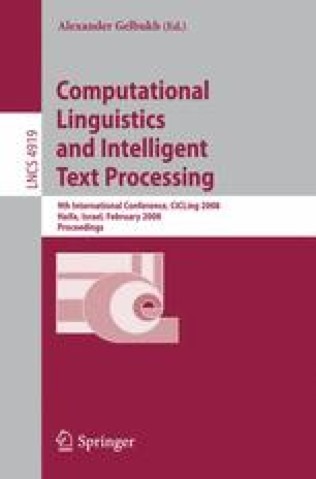
Computational linguistics and intelligent text processing ; 9th International Conference, CICLing 2008, Haifa, Israel, February 17-23, 2008. Proceedings
The CICLing conferences are intended to provide a wide-scope forum for the discussion of both the art and craft of natural language processing research and the best practices in its applications. This volume contains the papers accepted for oral presentation at the c- ference, as well as several of the best papers accepted for poster presentation.
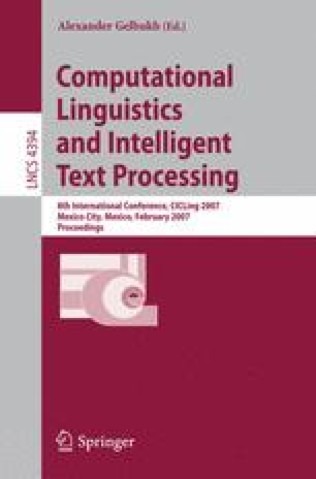
Computational linguistics and intelligent text processing ; 8th International Conference, CICLing 2007, Mexico City, Mexico, February 18-24, 2007, Proceedings
This book cover all current issues in computational linguistics research and present intelligent text processing applications. The papers are organized in topical sections on: lexical resources, corpus-based knowledge acquisition, morphology and part-of-speech tagging, named entity recognition, temporal expression treatment, word segmentation, sentence splitting, chunking, grammar formalisms and syntax, word sense disambiguation and discrimination and semantics.

Computational linguistics and intelligent text processing ; Vol. 3406 ; 6th International Conference, CICLing 2005, Mexico City, Mexico, February 13-19, 2005, Proceedings
This book constitutes the refereed proceedings of the 6th International Conference on Computational Linguistics and Intelligent Text Processing, CICLing 2005, held in Mexico City, Mexico in February 2005. An approach that involves natural language analysis techniques for the treatment of software system functional requirements is described in this book. This approach is used as the basis for a process developed to generate sequence diagrams automatically from the textual specification of use cases. This facility has been integrated in the Requirements Engineering Phase of OO-Method, an automatic production environment of software. For this purpose, a translator that is based on natural language parser is used. The translator provides grammatical information to each use case sentence and it identifies the corresponding interaction. The automatic transformation is conceived and specified following an orientation that is based on models and patterns. The results of the validation of the transformation patterns are presented.

Computational intelligence : Methods and techniques
This book focuses on various techniques of computational intelligence, both single ones and those which form hybrid methods. Those techniques are today commonly applied issues of artificial intelligence, e.g. to process speech and natural language, build expert systems and robots.

Computational Forensic ; 2nd International Workshop, IWCF 2008, Washington, DC, USA, August 7-8, 2008. Proceedings
This book constitutes the refereed proceedings of the Second International Workshop, IWCF 2008, held in Washington, DC, USA, August 2008. The papers are organized in topical sections on trends and challenges; scanner, printer, and prints; human identification; shoeprints; linguistics;decision making and search; speech analysis; signatures and handwriting.

Computational Collective Intelligence ; 12th International Conference, ICCCI 2020, Da Nang, Vietnam, November 30 – December 3, 2020, Proceedings
This volume constitutes the refereed proceedings of the 12th International Conference on Computational Collective Intelligence, ICCCI 2020, held in Da Nang, Vietnam, in November 2020.* The 70 full papers presented were carefully reviewed and selected from 314 submissions. The papers are grouped in topical sections on: knowledge engineering and semantic web; social networks and recommender systems; collective decision-making; applications of collective intelligence; data mining methods and applications; machine learning methods; deep learning and applications for industry 4.0; computer vision techniques; biosensors and biometric techniques; innovations in intelligent systems; natural language processing; low resource languages processing; computational collective intelligence and natural language processing; computational intelligence for multimedia understanding; and intelligent processing of multimedia in web systems.
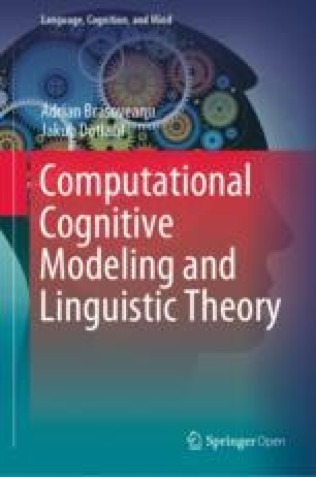
Computational Cognitive Modeling and Linguistic Theory
This book introduces a general framework that allows natural language researchers to enhance existing competence theories with fully specified performance and processing components. Gradually developing increasingly complex and cognitively realistic competence-performance models, it provides running code for these models and shows how to fit them to real-time experimental data. This computational cognitive modeling approach opens up exciting new directions for research in formal semantics, and linguistics more generally, and offers new ways of (re)connecting semantics and the broader field of cognitive science.

Combinatorial pattern matching ; Vol. 3537 ; 16th Annual Symposium, CPM 2005, Jeju Island, Korea, June 19-22, 2005, Proceedings
This volume presents the proceedings of The 16th Annual Symposium on Combinatorial Pattern Matching was heldon Jeju Island, Korea on June 19–22, 2005. the Program Committee accepted 37 of the submissionsto be presented at the conference. This collection of papers offers original research contributionsin combinatorial pattern matching and its applications.In addition to the selected papers
Combinatorial pattern matching ; 19th Annual Symposium, CPM 2008, Pisa, Italy, June 18-20, 2008 Proceedings
This book constitutes the refereed proceedings of the 19th Annual Symposium on Combinatorial Pattern Matching, CPM 2008, held in Pisa, Italy, in June 2008.

Combinatorial Chemistry on Solid Supports
In this volume, state-of-the-art solid-phase synthesis is presented from different angles. Ranging from methodology development to application in the synthesis of complex native and designed structures, a complete overview is presented. We are confident that addressing the fascinating interface between chemistry and biology is only possible by innovative methods in both disciplines. Combinatorial chemistry is surely one of these.This book, written by an international group of renowned experts in their respective field, covers recent advances in important topics regarding combinatorial chemistry on solid supports

Coloring the Cosmetic World : Using Pigments in Decorative Cosmetic Formulations
A comprehensive resource on the regulations, applications, properties and processing of pigments used in color cosmetics. It is a highly practical guide to colorant selection for product formulations in the modern cosmetics and toiletries industry. Providing the essential knowledge required to successfully incorporate pigments into cosmetic formulations, this unique resource covers all essential aspects of color selection—including regulations, economics, color esthetics, and stability—as well as processing, color measurement, pigment testing, natural colorants, and more. This new edition contains carefully revised content and includes updated coverage of economic and regulatory criteria.

Collaboration Technologies and Social Computing ; 26th International Conference, CollabTech 2020, Tartu, Estonia, September 8–11, 2020, Proceedings
This book constitutes the proceedings of the 26th International Conference on Collaboration Technologies and Social Computing, CollabTech 2020. The conference was scheduled to take place in Tartu, Estonia, in September 2020. It was held virtually due to the COVID-19 pandemic. The 10 full and 5 work-in-progress papers presented in this volume were carefully reviewed and selected from 25 submissions.

Cohesion, coherence and temporal reference from an experimental corpus pragmatics perspective
Provides new methodological and theoretical insights into temporal reference and its linguistic expression, from a cross-linguistic experimental corpus pragmatics approach. Verbal tenses, in general, and more specifically the categories of tense, grammatical and lexical aspect are treated as cohesion ties contributing to the temporal coherence of a discourse, as well as to the cognitive temporal coherence of the mental representations built in the language comprehension process. As such, it investigates the phenomenon of temporal reference at the interface between corpus linguistics, theoretical linguistics and pragmatics, experimental pragmatics, psycholinguistics, natural language processing and machine translation.
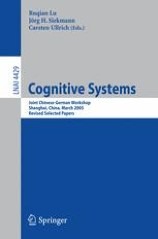
Cognitive Systems ; Joint Chinese-German Workshop, Shanghai, China, March 7-11, 2005, Revised Selected Papers
This book organized in topical sections on multimodal human-computer interfaces, neuropsychology and neurocomputing, Chinese-German natural language processing and psycholinguistics, as well as information processing and retrieval from the semantic Web for intelligent applications.

Cognitive Development in Chimpanzees
From an evolutionary perspective, understanding chimpanzees offers a way of understanding the basis of human nature. This book on cognitive development in chimpanzees is the first of its kind to focus on infants reared by their own mothers within a natural setting, illustrating various aspects of chimpanzee cognition and the developmental changes that accompany them. The subjects of this book are chimpanzees of three generations inhabiting an enriched environment as well as a wild community in West Africa; and phenomena such as face recognition, concept formation, object manipulation, tool manufacture and use, decision making, learning, communication, self-awareness, intentionality, understanding others’ minds, cooperation, deception, altruism, and reciprocity observed within these groups are reported herein. Unique approaches both in the field and in the laboratory go hand in hand to illustrate the cognitive world of our closest living evolutionary relatives.

Codes : An Introduction to Information Communication and Cryptography
Information is an important feature of the modern world. Mathematical techniques underlie the devices that we use to handle it, for example, mobile phones, digital cameras, and personal computers. This book is an integrated introduction to the mathematics of coding, that is, replacing information expressed in symbols, such as a natural language or a sequence of bits, by another message using (possibly) different symbols. There are three main reasons for doing this: economy, reliability, and security, and each is covered in detail. Only a modest mathematical background is assumed, the mathematical theory being introduced at a level that enables the basic problems to be stated carefully, but without unnecessary abstraction.

Coded Leadership : Developing Scalable Management in an AI-induced Quantum World
Introduces the necessary background to understand the challenges in today’s organizational leadership and how artificial intelligence enables learning to be viewed from a probabilistic framework. Introduction to Quantum Natural Language Processing. Overview of Leadership and AI. The Age of Quantum Superiority. Challenges to Today’s Leadership. AI-induced Strategic Implementation and Organizational Performance.
