



الصفحة 220
الصفحة 220

Aligner systems in invisible orthodontics: basic concepts and clinical management
Describes the processes, techniques and biomechanics involved in providing aligner treatment for different types of malocclusions. It opens with an overview of the material characteristics and the basic concepts of aligner therapy including topics like biocompatibility and intraoral deterioration. The main part of the book is dedicated to the various types of aligners, the methods used in their application and the practical aspects of delivery. It is structured based on the type of malocclusion being managed giving the reader a systematic pattern and a practical way of progressing through the book. The book closes with a discussion of the scientific data available.
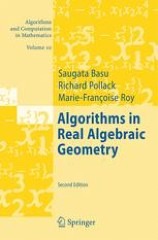
Algorithms in Real Algebraic Geometry
The algorithmic problems of real algebraic geometry such as real root counting, deciding the existence of solutions of systems of polynomial equations and inequalities, finding global maxima or deciding whether two points belong in the same connected component of a semi-algebraic set appear frequently in many areas of science and engineering. In this first-ever graduate textbook on the algorithmic aspects of real algebraic geometry, the main ideas and techniques presented form a coherent and rich body of knowledge, linked to many areas of mathematics and computing.
Algorithms in Bioinformatics ; Vol. 3692 ; 5th international workshop, WABI 2005, Mallorca, Spain, October 3-6, 2005, Proceedings
this book present the proceedings of the 5th Workshop on Algorithmsin Bioinformatics (WABI 2005) which took place in Spain, 2005. The Workshop on Algorithms in Bioinformatics highlights research workspecifically developed to address algorithmic problems in biosequence analysis. The emphasis is therefore on statistical and probabilistic algorithms that addressimportant problems in the field of molecular and structural biology. the workshop aims to present recent research results, includingsignificant work in progress, and to identify and explore directions of futureresearch.Original research papers (including significant work in progress) or state-of-the-art surveys were solicited on all aspects of algorithms in bioinformatics,including, but not limited to: exact and approximate algorithms for genomics,genetics, sequence analysis, gene and signal recognition, alignment, molecularevolution, phylogenetics, structure determination or prediction, gene expressionand gene networks, proteomics, functional genomics, and drug design.
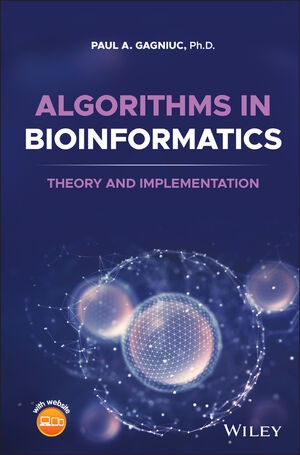
Algorithms in Bioinformatics : Theory and Implementation
Explores a comprehensive and insightful treatment of the practical application of bioinformatic algorithms in a variety of fields. Delivers a fulsome treatment of some of the main algorithms used to explain biological functions and relationships. It introduces readers to the art of algorithms in a practical manner which is linked with biological theory and interpretation. The book covers many key areas of bioinformatics, including global and local sequence alignment, forced alignment, detection of motifs, Sequence logos, Markov chains or information entropy. Other novel approaches are also described, such as Self-Sequence alignment, Objective Digital Stains (ODSs) or Spectral Forecast and the Discrete Probability Detector (DPD) algorithm. Readers will also benefit from the inclusion of: A detailed presentation of new methods, such as Self-sequence alignment, Objective Digital Stains and Spectral Forecast ; A treatment of sequence alignment, including local sequence alignment, global sequence alignment and forced sequence alignment with full implementations ; Discussions of position-specific weight matrices, including the count, weight, relative frequencies, and log-likelihoods matrices ; A detailed presentation of the methods related to Markov Chains as well as a description of their implementation in Bioinformatics and adjacent fields ; An examination of information and entropy, including sequence logos and explanations related to their meaning ; A chapter on philosophical transactions that allows the reader a broader view of the prediction process ; Extensive worked examples with detailed case studies that point out the meaning of different results

Algorithms – ESA 2005 ; 13th Annual European Symposium, Palma de Mallorca, Spain, October 3-6, 2005, Proceedings
This volume contains the 75 contributed papers and the abstracts of the threeinvited lectures presented at the 13th Annual European Symposium on Algo-rithms (ESA 2005), held in Spain, 2005. respectively.Papers were solicited in all areas of algorithmic research, including but notlimited to algorithmic aspects of networks, approximation and on-line algo-rithms, computational biology, computational geometry, computational financeand algorithmic game theory, data structures, database and information re-trieval, external memory algorithms, graph algorithms, graph drawing, machinelearning, mobile computing, pattern matching and data compression, quantumcomputing, and randomized algorithms. The algorithms could be sequential,distributed, or parallel. Submissions were especially encouraged in the area ofmathematical programming and operations research, including combinatorialoptimization, integer programming, polyhedral combinatorics, and semidefiniteprogramming.Each extended abstract was submitted to one of the two tracks.

Algorithmic Aspects of Wireless Sensor Networks ; 4th International Workshop, ALGOSENSORS 2008, Reykjavik, Iceland, July 2008. Revised Selected Papers
This book constitutes the reviewed proceedings of the Fourth International Workshop on Algorithmic Aspects of Wireless Sensor Networks, ALGOSENSORS 2008, held in Reykjavik, Iceland, Wroclaw, Poland, July 12, 2008.

Algorithmic Aspects of Wireless Sensor Networks ; 3rd International Workshop, ALGOSENSORS 2007, Wroclaw, Poland, July 14, 2007, Revised Selected Papers
This book contains the proceedings of the Third International Workshop on Algorithmic Aspects of Wireless Sensor Networks. Coverage includes abstract models, complexity-theoretic results, and the design and analysis of algorithms for wireless sensor networks.

Algorithmic Aspects of Wireless Sensor Networks ; 2nd International Workshop, ALGOSENSORS 2006, Venice, Italy, July 15, 2006, Revised Selected Papers
This volume contains the contributed papers and invited talks presented at the 1stInternational Workshop on Algorithmic Aspect sof Wireless Sensor Networks (ALGOSENSORS 2004), which was held July 16, 2004, in Turku, Finland, - located with the 31st International Colloquium on Automata, Languages, and Programming (ICALP 2004). Wireless ad hoc sensor networks have become a very important research subject due to their potential to provide diverse services in numerous appli- tions. The realization of sensor networks requires intensive technical research and development e?orts, especially in power-aware scalable wireless ad hoc c- munications protocols, due to their unusual application requirements and severe constraints. On the other hand, a solid theoretical background seems necessary for sensor networks to achieve their full potential. It is an algorithmic challenge to achieve e?cient and robust realizations of such large, highly dynamic, complex, n- conventional networking environments
Algorithmic Aspects of Bioinformatics
Advances in bioinformatics and systems biology require improved computational methods for analyzing data, while progress in molecular biology is in turn influencing the development of computer science methods. This book introduces some key problems in bioinformatics, discusses the models used to formally describe these problems, and analyzes the algorithmic approaches used to solve them. After introducing the basics of molecular biology and algorithmics, Part I explains string algorithms and alignments; Part II details the field of physical mapping and DNA sequencing; and Part III examines the application of algorithmics to the analysis of biological data. Exciting application examples include predicting the spatial structure of proteins, and computing haplotypes from genotype data. This book describes topics in detail and presents formal models in a mathematically precise, yet intuitive manner, with many figures and chapter summaries, detailed derivations, and examples. It is well suited as an introduction into the field of bioinformatics, and will benefit students and lecturers in bioinformatics and algorithmics, while also offering practitioners an update on current research topics.

Algorithmic Aspects in Information and Management ; Second International Conference, AAIM 2006, Hong Kong, China, June 20-22, 2006, Proceedings
This book constitutes the refereed proceedings of the Second International Conference on Algorithmic Aspects in Information and Management, AAIM 2006, held in Hong Kong, June 2006. The book presents 34 revised full papers together with abstracts of 2 invited talks. The papers cover topics from areas such as online scheduling, game and finance, data structures and algorithms, computational geometry, optimization, graph, and string, and more.

Algorithmic Aspects in Information and Management ; 4th International Conference, AAIM 2008, Shanghai, China, June 23-25, 2008. Proceedings
This book constitutes the refereed proceedings of the 4th International Conference on Algorithmic Aspects in Information and Management, AAIM 2008, held in Shanghai, China, in June 2008.

Algorithmic Aspects in Information and Management ; 3rd International Conference, AAIM 2007, Portland, OR, USA, June 6-8, 2007, Proceedings
This Book is intended for or- inal algorithmic research on immediate applications and/or fundamental pr- lems pertinent to information management and management science, broadly construed.

Algorithmic Aspects in Information and Management ; 14th International Conference, AAIM 2020, Jinhua, China, August 10–12, 2020, Proceedings
This volume constitutes the proceedings of the 14th International Conference on Algorithmic Aspects in Information and Management, AAIM 2020, held in Jinhua, China in August 2020. The 39 full papers and 17 short papers presented were carefully reviewed and selected from 76 submissions. The papers deal with emerging important algorithmic problems with a focus on the fundamental background, theoretical technology development, and real-world applications associated with information and management analysis, modeling and data mining. Special considerations are given to algorithmic research that was motivated by real-world applications.

Alginates in drug delivery
Alginates in Drug Delivery explores the vital precepts, basic and fundamental aspects of alginates in pharmaceutical sciences, biopharmacology, and in the biotechnology industry. The use of natural polymers in healthcare applications over synthetic polymers is becoming more prevalent due to natural polymers’ biocompatibility, biodegradability, economic extraction and ready availability. To fully utilize and harness the potential of alginates, this book presents a thorough understanding of the synthesis, purification, and characterization of alginates and their derivative. This book collects, in a single volume, all relevant information on alginates in health care, including recent advances in the field.

Algebras, Rings and Modules ; Vol.2
This book provides both the classical aspects of the theory of groups and their representations as well as a general introduction to the modern theory of representations including the representations of quivers and finite partially ordered sets and their applications to finite dimensional algebras.
Algebraic Multiplicity of Eigenvalues of Linear Operators
This book brings together all the most important known results of research into the theory of algebraic multiplicities, from well-known classics like the Jordan Theorem to recent developments such as the uniqueness theorem and the construction of multiplicity for non-analytic families.
Algebraic Methods for Nonlinear Control Systems
A self-contained introduction to algebraic control for nonlinear systems suitable for researchers and graduate students.The most popular treatment of control for nonlinear systems is from the viewpoint of differential geometry yet this approach proves not to be the most natural when considering problems like dynamic feedback and realization. Professors Conte, Moog and Perdon develop an alternative linear-algebraic strategy based on the use of vector spaces over suitable fields of nonlinear functions. This algebraic perspective is complementary to, and parallel in concept with, its more celebrated differential-geometric counterpart.Algebraic Methods for Nonlinear Control Systems describes a wide range of results, some of which can be derived using differential geometry but many of which cannot.

Algebraic Biology ; 2nd International Conference, AB 2007, Castle of Hagenberg, Austria, July 2-4, 2007, Proceedings
This volume constitutes the refereed proceedings of the Second International Conference on Algebraic Biology. The conference served as an interdisciplinary forum for the presentation of research on all aspects of the application of symbolic computation in biology, including computer algebra, computational logic, and related methods.

Algebraic Aspects of the Advanced Encryption Standard
The Belgian block cipher Rijndael was chosen in 2000 by the U.S. government’s National Institute of Standards and Technology (NIST) to be the successor to the Data Encryption Standard. Rijndael was subsequently standardized as the Advanced Encryption Standard (AES), which is potentially the world’s most important block cipher. In 2002, some new analytical techniques were suggested that may have a dramatic effect on the security of the AES. Existing analytical techniques for block ciphers depend heavily on a statistical approach, whereas these new techniques are algebraic in nature.

Algebraic and Proof-theoretic Aspects of Non-classical Logics : Papers in Honor of Daniele Mundici on the Occasion of His 60th Birthday
It profound connections between logic and such diverse fields of research as functional analysis, probability and measure theory, the geometry of toric varieties, piecewise linear geometry, and error-correcting codes. Several prominent logicians, mathematicians, and computer scientists
