



الصفحة 22
الصفحة 22

Human motion : Understanding, modeling, capture and animation ; 2nd Workshop, HumanMotion 2007, Rio de Janeiro, Brazil, October 20, 2007, Proceedings
This LNCS volume contains the papers presented at the second Workshop on Human Motion Understanding, Modeling, Capture and Animation. The accepted papers re?ect the state of the art in the ?eld and cover various topicsrelatedto humanmotiontrackingandanalysis.Thepapersinthisvolume have been classi?ed into three categories based on the topics they cover: human motion capture and pose estimation, body and limb tracking and segmentation, and activity recognition.
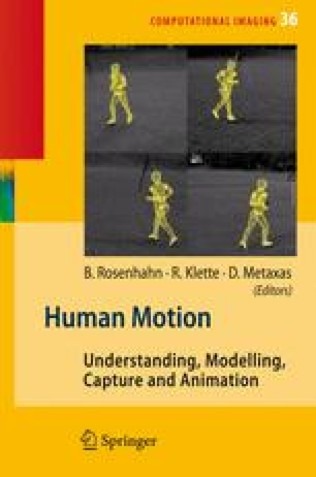
Human motion : Understanding, modeling, capture and animation
Edward Muybridge (1830–1904) is known as the pioneer in motion capt- ing with his famous experiments in 1887 called “Animal Locomotion”. Since then, the feld of animal or human motion analysis has grown in many dir- tions. However, research and results that involve human-like animation and the recovery of motion is still far from being satisfactory. Progress in human motion analysis depends on empirically anchored and grounded research in computer vision, computer graphics, and biomechanics. This book is based on a June 2006 workshop held in Dagstuhl, Germany. This workshop brought together for the frst time researchers from the afo- mentioned disciplines.

How to engineer software : A model-based approach
The book promotes development scalability through domain partitioning and subdomain partitioning. It also explores software documentation that specifically and intentionally adds value for development and maintenance. Contains many illustrative examples of model-based software engineering, from semantic model all the way to executable code Explains how to derive verification (acceptance) test cases from a semantic model Describes project estimation, along with alternative software development and maintenance processes Shows how to develop and maintain cost-effective software that solves real-world problems

Honeypots for Windows
Installing a honeypot inside your network as an early warning system can significantly improve your security. Currently, almost every book and resource about honeypots comes from a Unix background, which leaves Windows administrators still grasping for help. But Honeypots for Windows is a forensic journeyhelping you set up the physical layer, design your honeypot, and perform malware code analysis. You'll discover which Windows ports need to be open on your honeypot to fool those malicious hackers, and you'll learn about numerous open source tools imported from the Unix world. Install a honeypot on your DMZ or at home and watch the exploits roll in! Your honeypot will capture waves of automated exploits, and youll learn how to defend the computer assets under your control.

Homology modeling : Methods and protocols
It Provides state-of-the-art methodologies and reviews of important topics in the field of homology modeling. From homology modeling in the twilight zone and improving accuracy through sequence space analysis to approaches to construct multi-protein complex models, the book explores a wide variety of uses and applications of this valuable technique.

Homogenization of Partial Differential Equations
Homogenization is a method for modeling processes in microinhomogeneous media, which are encountered in radiophysics, filtration theory, rheology, elasticity theory, and other domains of mechanics, physics, and technology. These processes are described by PDEs with rapidly oscillating coefficients or boundary value problems in domains with complex microstructure. From the technical point of view, given the complexity of these processes, the best techniques to solve a wide variety of problems involve constructing appropriate macroscopic (homogenized) models. The present monograph is a comprehensive study of homogenized problems, based on the asymptotic analysis of boundary value problems as the characteristic scales of the microstructure decrease to zero. The work focuses on the construction of nonstandard models: non-local models, multicomponent models, and models with memory.

Home-oriented informatics and telematics ; Proceedings of the IFIP WG 9.3 HOIT2005 Conference
The IFIP series publishes state-of-the-art results in the sciences and technologies of information and communication. The scope of the series includes: foundations of computer science; software theory and practice; education; computer applications in technology; communication systems; systems modeling and optimization; information systems; computers and society; computer systems technology; security and protection in information processing systems; artificial intelligence; and human-computer interaction. Proceedings and post-proceedings of referred international conferences in computer science and interdisciplinary fields are featured. These results often precede journal publication and represent the most current research. The principal aim of the IFIP series is to encourage education and the dissemination and exchange of information about all aspects of computing.

Home Networking ; 1st IFIP WG 6.2 Home Networking Conference (IHN’2007), Paris, France, December 10–12, 2007
The IFIP series publishes state-of-the-art results in the sciences and technologies of information and communication. The scope of the series includes: foundations of computer science; software theory and practice; education; computer applications in technology; communication systems; systems modeling and optimization; information systems; computers and society; computer systems technology; security and protection in information processing systems; artificial intelligence; and human-computer interaction. Proceedings and post-proceedings of referred international conferences in computer science and interdisciplinary fields are featured.

Holonic Execution: A BDI Approach
Holonic manufacturing has been an active area of research for the past decade. However, this work has been predominately in the areas of planning and scheduling on the one hand and control on the other. In this book we propose these two areas can be integrated through adopting a focus on execution.

History of Nordic computing ; IFIP WG9.7 ; 1st Working conference on the history of Nordic computing (HiNC1), June 16-18, 2003, Trondheim, Norway
The IFIP series publishes state-of-the-art results in the sciences and technologies of information and communication. The scope of the series includes: foundations of computer science; software theory and practice; education; computer applications in technology; communication systems; systems modeling and optimization; information systems; computers and society; computer systems technology; security and protection in information processing systems; artificial intelligence; and human-computer interaction. Proceedings and post-proceedings of referred international conferences in computer science and interdisciplinary fields are featured. These results often precede journal publication and represent the most current research. The principal aim of the IFIP series is to encourage education and the dissemination and exchange of information about all aspects of computing.

History of Computing and Education 3 (Hce3) ; IFIP 20th World Computer Congress, Proceedings of the Third IFIP Conference on the History of Computing and Education WG 9.7/TC9, History of Computing, September 7–10, 2008, Milano, Italy
The IFIP series publishes state-of-the-art results in the sciences and technologies of information and communication. The scope of the series includes: foundations of computer science; software theory and practice; education; computer applications in technology; communication systems; systems modeling and optimization; information systems; computers and society; computer systems technology; security and protection in information processing systems; artificial intelligence; and human-computer interaction. Proceedings and post-proceedings of refereed international conferences in computer science and interdisciplinary fields are featured. These results often precede journal publication and represent the most current research.

History of computing and education 2 (HCE2) ; IFIP 19th World Computer Congress, WG 9.7, TC 9: History of computing, Proceedings of the 2nd Conference on the history of computing and education, August 21-24, Santiago, Chile
International Federation for Information Processing The IFIP series publishes state-of-the-art results in the sciences and technologies of information and communication. The scope of the series includes: foundations of computer science; software theory and practice; education; computer applications in technology; communication systems; systems modeling and optimization; information systems; computers and society; computer systems technology; security and protection in information processing systems; artificial intelligence; and human-computer interaction. Proceedings and post-proceedings of referred international conferences in computer science and interdisciplinary fields are featured. These results often precede journal publication and represent the most current research. The principal aim of the IFIP series is to encourage education and the dissemination and exchange of information about all aspects of computing.

High-Performance Computing ; 6th International Symposium, ISHPC 2005, Nara, Japan, September 7-9, 2005, First International Workshop on Advanced Low Power Systems, ALPS 2006, Revised Selected Papers
This is the joint post-proceedings of the 6th International Symposium on High Performance Computing (ISHPC-VI) and the First International Workshop on Advanced Low Power Systems 2006 (ALPS2006). The post-proceedings also contain the papers presented at the Second HPF International Workshop: - periences and Progress (HiWEP2005) and the Workshop on Applications for PetaFLOPS Computing (APC2005), which are workshops of ISHPC-VI. ISHPC-VI, HiWEP2005 and APC2005 were held in Nara, Japan during September 7–9, 2005. Fifty-eight papers from 11 countries were submitted to ISHPC-VI. After the reviews of the submitted papers, the ISHPC-VI Program Committee selected 15 regular (12-page) papers for oral presentation. In ad- tion, several other papers with favorable reviews were recommended for poster presentation, and 14 short (8-page) papers were also selected.

High-Level Modeling and Synthesis of Analog Integrated Systems
In High-Level Modeling and Synthesis of Analog Integrated Systems, two novel generic behavioral models are described. The first one adopts a time-domain approach and is suited for classes like Delta-Sigma modulators and sampled-data systems. For the second model, a new frequency-domain framework has been developed (the Phase- Frequency Transfer model) which allows the representation of classes of RF systems like front-ends of wireless receivers. To complete the high-level design strategy, the synthesis strategy has been concretized with a new top-down heterogeneous optimization algorithm.

High-Frequency Oscillator Design for Integrated Transceivers
High-Frequency Oscillator Design for Integrated Transceivers covers the analysis and design of all high-frequency oscillators required to realize integrated transceivers for wireless and wired applications.

High-dimensional chaotic and attractor systems : A comprehensive introduction
If we try to describe real world in mathematical terms, we will see that real life is very often a high–dimensional chaos. Sometimes, by ‘pushing hard’, we manage to make order out of it; yet sometimes, we need simply to accept our life as it is. To be able to still live successfully, we need tounderstand, predict, and ultimately control this high–dimensional chaotic dynamics of life. This is the main theme of the present book.

High resolution numerical modelling of the atmosphere and ocean
This book includes 15 individual papers that highlight the emerging research in atmospheric and oceanic science that has been made possible by exploiting newly available computational resources. Results from regional atmospheric, global atmospheric, global ocean, and global coupled ocean-atmosphere models are discussed in the various contributions.

High resolution morphodynamics and sedimentary evolution of estuaries
This book focuses on the use of high-resolution geophysical techniques, field observations and modeling to investigate the morphodynamics of estuaries on both glaciated and non-glaciated coasts and on different time scales. Papers in this book offer a new approach to nearshore and estuary studies, with an emphasis on multidisciplinary techniques and data integration. Results of these studies have important implications for estuary resource management and shoreline stability. This book will be of interest to sedimentologists, coastal and Quaternary geologists, environmental scientists, and coastal managers.

High Resolution Infrared Spectroscopy in Astronomy ; Proceedings of an ESO Workshop Held at Garching, Germany, 18-21 November 2003
Two specialized new instruments for ESO's VLT, VISIR and CRIRES, spawned the idea for this workshop. CRIRES is a dedicated very high resolution infrared spectrograph; VISIR features a high resolution spectroscopic mode. Together, the instruments combine the sensitivity of an 8m-telescope with the now well-established reliability of VLT-facility instruments. High resolution here means that lines in cool stellar atmospheres and HII-regions can be resolved. The astrophysical topics discussed in this rather specialized workshop range from the inner solar system to active galactic nuclei. There are many possibilities for new discoveries with these instruments, but the unique capability, which becomes available through high-resolution infrared spectroscopy, is the observation of molecular rotational-vibrational transitions in many astrophysical environments. Particularly interesting and surprising in this context, many papers on modeling and laboratory spectroscopy at the workshop appear to indicate that astronomical observations are lagging a bit behind in this field. The papers are an interesting mix of reports from existing high resolution facilities, reports on modeling efforts of synthetic spectra and reports on laboratory spectra. In this sense, a fruitful exchange between molecular physics and astronomy was again accomplished and is documented in this volume.

High performance computing on vector systems 2007 ; Conference proceedings
The following book presents contributions from the 6th TERAFLOP Workshop which was hosted by Tohoku University in Sendai, Japan in Autumn 2006 and the 7th Workshop in Stuttgart which was held in spring 2007 in Stuttgart. Focus is layed on current applications and future requirements, as well as developments of next generation hardware architectures and installations. The papers presented in this book lay out the wide range of fields in which sustained performance can be achieved if engineering knowledge, numerical mathematics and computer science skills are brought together. With the advent of hybrid systems, the Teraflop workbench project will continue the support of leading edge computations for future applications.
