



الصفحة 21
الصفحة 21

Languages, Methodologies and Development Tools for Multi-Agent Systems ; 1st International Workshop, LADS 2007, Durham, UK, September 4-6, 2007. Revised Selected Papers
Constitutes the thoroughly refereed post-workshop proceedings of the First International Workshop on Languages, Methodologies and Development Tools for Multi-Agent Systems, LADS 2007, held in Durham, UK, in September 2007. The workshop was part of MALLOW 2007, a federation of workshops on Multi-Agent Logics, Languages, and Organizations.

Lake Victoria : Ecology, Resources, Environment
Recently, there has been, and continues to be, a tremendous interest on Lake Victoria and its environs, both locally and internationally. A casual browsing on the Internet indicates that the entries on the Lake have been rising phenomenally. At the same time, the issues discussed are as diverse as they are varied in their treatment of the subject, both in terms of depth and comprehensiveness. The information on Lake Victoria and its environ is scattered, isolated, and sometimes confusing even though documentation on the subject are available. Despite this situation, the fact remains that various people (e. g. , secondary and universitystudents,researchers,practitioners,etc. ,)wouldliketoaccess and know more about the Lake and its environs. Aware of the existing information gap about this world’s second largest fresh water Lake, this book is intended to provide readers with up-to-date information pertaining the Lake. The book gives an in-depth coverage of environmental issues, - source endowment, poverty amidst plenty, development opportunities, challenges and other related issues facing the Lake and its environs. It aims at providing information on the above variables, which hopefully will address the needs of various users.

Knowledge-Based Intelligent Information and Engineering Systems ; 12th International Conference, KES 2008, Zagreb, Croatia, September 3-5, 2008, Proceedings, Part III
Constitutes the refereed proceedings of the 12th International Conference on Knowledge-Based Intelligent Information and Engineering Systems, KES 2008, held in Zagreb, Croatia, in September 2008.The 316 revised papers presented were carefully reviewed and selected. The papers present a wealth of original research results from the field of intelligent information processing in the broadest sense; topics covered in the third volume are intelligent data processing in process systems and plants; neural information processing for data mining; soft computing approach to management engineering; advanced groupware; agent and multi-agent systems.

Knowledge-Based Intelligent Information and Engineering Systems ; 12th International Conference, KES 2008, Zagreb, Croatia, September 3-5, 2008, Proceedings, Part II
The papers present a wealth of original research results from the field of intelligent information processing in the broadest sense; topics covered in the second volume are artificial intelligence driven engineering design optimization; biomedical informatics: intelligent information management from nanomedicine to public health; communicative intelligence; computational intelligence for image processing and pattern recognition; computational intelligence in human cancer research; computational intelligence techniques for Web personalization; computational intelligent techniques for bioprocess modelling, monitoring and control; intelligent computing for Grid.

Knowledge-Based Intelligent Information and Engineering Systems ; 12th International Conference, KES 2008, Zagreb, Croatia, September 3-5, 2008, Proceedings, Part I
The 316 revised papers presented were carefully reviewed and selected. The papers present a wealth of original research results from the field of intelligent information processing in the broadest sense; topics covered in the first volume are artificial neural networks and connectionists systems; fuzzy and neuro-fuzzy systems; evolutionary computation; machine learning and classical AI; agent systems; knowledge based and expert systems; intelligent vision and image processing; knowledge management, ontologies, and data mining; Web intelligence, text and multimedia mining and retrieval; and intelligent robotics and control.

Knowledge science, engineering and management; 13th International Conference, KSEM 2020, Hangzhou, China, August 28–30, 2020, Proceedings, Part I
Constitutes the refereed proceedings of the 13th International Conference on Knowledge Science, Engineering and Management, KSEM 2020, held in Hangzhou, China, in August 2020.* The 58 revised full papers and 27 short papers were carefully reviewed and selected from 291 submissions. The papers of the first volume are organized in the following topical sections: knowledge graph; knowledge representation; knowledge management for education; knowledge-based systems; and data processing and mining. The papers of the second volume are organized in the following topical sections: machine learning; recommendation algorithms and systems; social knowledge analysis and management; text mining and document analysis; and deep learning.

Knowledge science, engineering and management ; 13th International Conference, KSEM 2020, Hangzhou, China, August 28–30, 2020, Proceedings, Part II
Constitutes the refereed proceedings of the 13th International Conference on Knowledge Science, Engineering and Management, KSEM 2020, held in Hangzhou, China, in August 2020.* The 58 revised full papers and 27 short papers were carefully reviewed and selected from 291 submissions. The papers of the first volume are organized in the following topical sections: knowledge graph; knowledge representation; knowledge management for education; knowledge-based systems; and data processing and mining. The papers of the second volume are organized in the following topical sections: machine learning; recommendation algorithms and systems; social knowledge analysis and management; text mining and document analysis; and deep learning.
Knowledge Processing with Interval and Soft Computing
In particular, these chapters cover computing techniques for interval linear systems of equations, interval matrix singular-value decomposition, interval function approximation, and decision making with statistical and graph-based data processing. To enable these applications, the book presents a standards-based object-oriented interval computing environment in C++.
Knowledge graphs and big data processing
This book is part of the LAMBDA Project (Learning, Applying, Multiplying Big Data Analytics), funded by the European Union, GA No. 809965. Data Analytics involves applying algorithmic processes to derive insights.

Knowledge Engineering : Practice and Patterns ; 16th International Conference, EKAW 2008, Acitrezza, Italy, September 29 - October 2, 2008. Proceedings
Constitutes the refereed proceedings of the 16th International Conference on Knowledge Engineering and Knowledge Management, EKAW 2008, held in Acitrezza, Sicily, Italy, in September/October 2008.The 17 revised full papers and 15 revised short papers presented together with 3 invited talks were carefully reviewed and selected from 102 submissions. The papers are organized in topical sections on knowledge patterns and knowledge representation, matching ontologies and data integration, natural language, knowledge acquisition and annotations, search, query and interaction, as well as ontologies.
Knowledge Cartography : Software Tools and Mapping Techniques
The authors see mapping software as a set of visual tools for reading and writing in a networked age. In an information ocean, the primary challenge is to find meaningful patterns around which we can weave plausible narratives. Maps of concepts, discussions and arguments make the connections between ideas tangible and disputable.With 17 chapters from the leading researchers and practitioners, the reader will find the current state–of-the-art in the field. Part 1 focuses on educational applications in schools and universities, before Part 2 turns to applications in professional communities.

Key Aspects of German Business Law : A Practical Manual
This book presents a clear and precise overview of the key aspects of German business law. It was written by attorneys involved in the daily practice of business law in Germany and is aimed at people who wish to orient themselves quickly with the German legal system and the manner in which it impacts business purchases, establishment, operations and liquidations. The first section of the book is devoted to an explanation of the major issues to be considered in acquiring or establishing a business in Germany. The second section focuses on areas of commercial law that are important for an operating business. The following sections deal with labor law as an independent part of German business law and with computer law. Furthermore, procedural law and European law are addressed. Finally, the last two sections of the book are devoted to an overview over the German tax law, which has an enormous impact on business decisions, and IP law.
Journal on Data Semantics XI
The LNCS Journal on Data Semantics is devoted to the presentation of notable work that, in one way or another, addresses research and development on issues related to data semantics. The scope of the journal ranges from theories supporting the formal definition of semantic content to innovative domain-specific applications of semantic knowledge. The journal addresses researchers and advanced practitioners working on the semantic web, interoperability, mobile information services, data warehousing, knowledge representation and reasoning, conceptual database modeling, ontologies, and artificial intelligence.
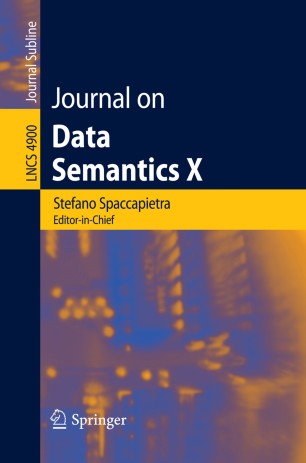
Journal on Data Semantics X
Web semantics and semi-structured data , Semantic caching , Data warehousing and semantic data mining , Spatial, temporal, multimedia and multimodal semantics , Semantics in data visualization , Semantic services for mobile users , Supporting tools , Applications of semantic-driven approaches These topics are to be understood as specifically related to semantic issues. Contributions submitted to the journal and dealing with semantics of data will be considered even if they are not from the topics in the list. While the physical appearance of the journal issues is like the books from the we- known Springer LNCS series, the mode of operation is that of a journal. Contributions can be freely submitted by authors and are reviewed by the Editorial Board.

Java : how to program. Late objects : Introducing Jshell
Introduction to Computers, the Internet and Java / Introduction to Java Applications; Input/Output and Operators / Control Statements: Part 1; Assignment, ++ and Operators / Control Statements: Part 2; Logical Operators / Methods / Arrays and ArrayLists / Introduction to Classes and Objects / Classes and Objects: A Deeper Look / Object-Oriented Programming: Inheritance / Object-Oriented Programming: Polymorphism and Interfaces / Exception Handling: A Deeper Look / JavaFX Graphical User Interfaces / JavaFX GUI / Strings, Characters and Regular Expressions / Files, Input/Output Streams, NIO and XML Serialization / Generic Collections / Lambdas and Streams / Recursion / Searching, Sorting and Big O / Generic Classes and Methods: A Deeper Look / Custom Generic Data Structures / JavaFX Graphics and Multimedia / Concurrency / Accessing Databases with JDBC / Introduction to JShell: Java 9's REPL for Interactive Java

Computable Models of the Law : Languages, Dialogues, Games, Ontologies
This book originate from a workshop held at the European University Institute of Florence, Italy, in December 2006. The workshop was devoted to the discussion of the different ways of understanding and explaining contemporary law, for the purpose of building computable models of it -- especially models enabling the development of computer applications for the legal domain.
Complex Engineered Systems : Science Meets Technology
This volume examines the difficulties that arise in creating highly complex engineered systems and new approaches that are being adopted. Topics addressed range from the formal representation and classification of distributed networked systems to revolutionary engineering practices inspired by biological evolution. By bringing together the latest research in Complex Engineered Systems, this book sheds light on the current state and future course of this emerging field.
Complex Dynamics in Communication Networks
Computer and communication networks are among society's most important infrastructures. The internet, in particular, is a giant global network of networks without central control or administration. It is a paradigm of a complex system, where complexity may arise from different sources: topological structure, network evolution, connection and node diversity, or dynamical evolution. The present volume is the first book entirely devoted to the new and emerging field of nonlinear dynamics of TCP/IP networks. It addresses both scientists and engineers working in the general field of communication networks.

Communities and Technologies 2005 ; Proceedings of the Second Communities and Technologies Conference, Milano 2005
This book includes 23 papers dealing with the impact of modern information and communication technologies that support a wide variety of communities: local communities, virtual communities, and communities of practice, such as knowledge communities and scientific communities. The volume is the result of the second multidisciplinary "Communities and Technologies Conference", a major event in this emerging research field. The various chapters discuss how communities are affected by technologies, and how understanding of the way that communities function can be used in improving information systems design. This state of the art overview will be of interest to computer and information scientists, social scientists and practitioners alike.
Communicative figurations : Transforming communications in times of deep mediatization
This open access volume is about how to research the influence of our changing media environment. Today, there is not one single medium that is the driving force of change. With the spreading of various technical communication media such as mobile phone and internet platforms, we are confronted with a media manifold of deep mediatization. But how can we investigate its transformative capability? This book answers this question by taking a non-media-centric perspective, researching the various figurations of collectivities and organizations humans are involved in. The first part of the book outlines a fundamental understanding of the changing media environment of deep mediatization and its transformative capacity. The second part focuses on collectivities and movements: communities in the city, critical social movements, maker, online gaming groups and networked groups of young people. The third part moves institutions and organizations into the foreground, discussing the transformation of journalism, religion, politics, and education, whilst the fourth and final part is dedicated to methodologies and perspectives.
