



الصفحة 204
الصفحة 204

Fault Diagnosis and Tolerance in Cryptography ; 3rd International Workshop, FDTC 2006, Yokohama, Japan, October 10, 2006, Proceedings
The sophistication of the underlying cryptographic algorithms, the high complexity of the implementations, and the easy access and low cost of cryptographic devices resulted in increased concerns regarding the reliability and security of crypto-devices. The effectiveness of side channel attacks on cryptographic devices, like timing and power-based attacks, has been known for some time. Several recent investigations have demonstrated the need to develop methodologies and techniques for designing robust cryptographic systems (both hardware and software) to protect them against both accidental faults and maliciously injected faults with the purpose of extracting the secret key. This trend has been particularly motivated by the fact that the equipment needed to carry out a successful side channel attack based on fault injection is easily accessible at a relatively low cost (for example, laser beam technology), and that the skills needed to use it are quite common.

Fatigue Science for Human Health
Fatigue is quite a familiar sensation, one that everyone is likely to have experienced. Its molecular and neural mechanisms have not yet been elucidated, however, probably because of the complicated nature of its causes. To provide a broad forum for discussion, the International Conference on Fatigue Science was organized, the first being held in 2002 in Sandhamn, Sweden, and the second in 2005 in Karuizawa, Japan. Subsequently it was decided that the papers presented at the two conferences should be collected and incorporated in this pioneering work, Fatigue Science for Human Health. The book summarizes fatigue researchers' achievements, explains the status of the research on fatigue, and presents perspectives on remedies for chronic fatigue and chronic fatigue syndrome. The result is an authoritative guide to recent progress in the molecular and neural mechanisms of fatigue and in the development of the ways to prevent and overcome fatigue and chronic fatigue.

FastSLAM : A Scalable Method for the Simultaneous Localization and Mapping Problem in Robotics
This monograph describes a new family of algorithms for the simultaneous localization and mapping problem in robotics (SLAM). SLAM addresses the problem of acquiring an environment map with a roving robot, while simultaneously localizing the robot relative to this map. This problem has received enormous attention in the robotics community in the past few years, reaching a peak of popularity on the occasion of the DARPA Grand Challenge in October 2005, which was won by the team headed by the authors. The FastSLAM family of algorithms applies particle filters to the SLAM Problem, which provides new insights into the data association problem that is paramount in SLAM. The FastSLAM-type algorithms have enabled robots to acquire maps of unprecedented size and accuracy, in a number of robot application domains and have been successfully applied in different dynamic environments, including the solution to the problem of people tracking.

Fast, Efficient and Predictable Memory Accesses : Optimization Algorithms for Memory Architecture Aware Compilation
Fast, Efficient and Predictable Memory Accesses presents techniques for designing fast, energy-efficient and timing predictable memory systems. By using a careful combination of compiler optimizations and architectural improvements, we can achieve more than what would be feasible at one of the levels in isolation. The described optimization algorithms achieve the goals of high performance and low energy consumption. In addition to these benefits, the use of scratchpad memories significantly improves the timing predictability of the entire system, leading to tighter worst case execution time bounds (WCET). The WCET is a relevant design parameter for all timing critical systems. In addition, the book covers algorithms to exploit the power down modes of main memories in SDRAM technology, as well as the execute-in-place feature of Flash memories. The final chapter considers the impact of the register file, which is also part of the memory hierarchy.

Fast Track to MDX
Fast Track to MDX gives you all the necessary background to let you to write useful, powerful MDX expressions and introduces the most frequently used MDX functions and constructs. No prior knowledge is assumed and examples are used throughout the book to rapidly develop your MDX skills to the point where you can solve real business problems.
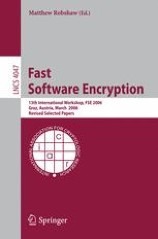
Fast software encryption ; Vol. 4047 ; 13th international workshop, FSE 2006, Graz, Austria, March 15-17, 2006, Revised Selected Papers
Fast Software Encryption (FSE) 2006 is the 13th in a series of workshops on symmetric cryptography. It has been sponsored for the last ?ve years by the International Association for Cryptologic Research (IACR), and previous FSE workshops have been held around the world: 1993 Cambridge, UK 1994 Leuven, Belgium 1996 Cambridge, UK 1997 Haifa, Israel 1998 Paris, France 1999 Rome, Italy 2000 New York, USA 2001 Yokohama, Japan 2002 Leuven, Belgium 2003 Lund, Sweden 2004 New Delhi, India 2005 Paris, France The FSE workshop is devoted to research on fast and secure primitives for symmetric cryptography, including the design and analysis of block ciphers, stream ciphers, encryption schemes, analysis and evaluation tools, hash fu- tions, and message authentication codes.

Fast software encryption ; Vol. 3557 ; 12th International Workshop, FSE 2005, Paris, France, February 21-23, 2005, Revised Selected Papers
The Fast Software Encryption 2005 Workshop was the twelfth in a series of annual workshops on symmetric cryptography, sponsored for the fourth year by the International Association for Cryptologic Research (IACR). The workshop concentratedonallaspectsoffastprimitivesforsymmetriccryptology, including thedesign, cryptanalysisandimplementationofblockandstreamciphersaswell as hash functions and message authentication codes. The ?rst FSE workshop was held in Cambridge in 1993, followed by Leuven in 1994, Cambridge in 1996, Haifain1997, Parisin1998, Romein1999, NewYorkin2000, Yokohamain2001, Leuven in 2002, Lund in 2003, and New Delhi in 2004. This year, a total of 96 submissions were received. After an extensive review by the Program Committee, 30 submissions were accepted.

Fast software encryption ; 15th International Workshop, FSE 2008, Lausanne, Switzerland, February 10-13, 2008, Revised Selected Papers
Constitutes the thoroughly refereed proceedings of the 15th International Workshop on Fast Software Encryption, FSE 2008, held in Lausanne, Switzerland in February 2008.The 26 revised full papers presented together with 4 short papers were carefully reviewed and selected from 72 submissions. The papers address all current aspects of fast and secure primitives for symmetric cryptology and are organized in topical sections on SHA collisions, new hash function designs, block cipher cryptanalysis, implementation aspects, hash function cryptanalysis, stream cipher cryptanalysis, security bounds, and entropy.

Fast Software Encryption ; 14th International Workshop, FSE 2007, Luxembourg, Luxembourg, March 26-28, 2007, Revised Selected Papers
It addresses all current aspects of fast and secure primitives for symmetric cryptology, covering hash function cryptanalysis and design, stream ciphers cryptanalysis, theory, block cipher cryptanalysis, block cipher design, theory of stream ciphers, side channel attacks, and macs and small block ciphers.

Fast Simulation of Electro-Thermal MEMS : Efficient Dynamic Compact Models
Fast Simulation of Electro-Thermal MEMS provides the reader with a complete methodology and software environment for creating efficient dynamic compact models for electro-thermal MEMS devices. It supplies the basic knowledge and understanding for using model order reduction at the engineering level. Emphasis is placed on the application of the Arnoldi method for effective order reduction of thermal systems. This tutorial is written for MEMS engineers and is enriched with many case studies which equip readers with the know-how to facilitate the simulation of a specific problem.

Fast Reactions in Energetic Materials : High-Temperature Decomposition of Rocket Propellants and Explosives
Modern energetic materials include explosives, blasting powders, pyrotechnic m- tures and rocket propellants [1, 2]. The study of high-temperature decomposition of condensed phases of propellants and their components (liquid, solid and hybrid) is currently of special importance for the development of space-system engineering [3, 4]. To better understand the burning mechanisms (stationary, nonstationary, - steady) of composite solid propellants and their components, information about the macrokinetics of their high-temperature decomposition is required [5]. To be able to evaluate the ignition parameters and conditions of safe handling of heat-affected explosives, one needs to know the kinetic constants of their high-temperature - composition. The development of new composite solid propellants characterized by high performance characteristics (high burning rates, high thermal stability, stability to intrachamber perturbations, and other aspects) is not possible without quanti- tive data on the high-temperature decomposition of composite solid propellants and their components [6].

Fast Motions in Biomechanics and Robotics : Optimization and Feedback Control
In the past decades, much progress has been made in the field of walking robots. The current state of technology makes it possible to create humanoid robots that nearly walk like a human being, climb stairs, or avoid small - stacles. However, the dream of a robot running as fast and as elegantly as a human is still far from becoming reality. Control of such fast motions is still a big technological issue in robotics, and the maximum running speed of contemporary robots is still much smaller than that of human track runners. The conventional control approach that most of these robots are based on does not seem to be suitable to increase the running speeds up to a biological level.

Fashionable Technology
The interplay of electronic textiles and wearable technology, wearables for short, and fashion, design and science is a highly promising and topical subject. Offered here is a compact survey of the theory involved and an explanation of the role technology plays in a fabric or article of clothing. The practical application is explained in detail and numerous illustrations serve as clarification. Over 50 well-known designers, research institutes, companies and artists, among them Philips, Burton, MIT Media Lab, XS Labs, New York University, Hussein Chalayan, Cute Circuit or International Fashion Machines are introduced by means of their latest, often still unpublished, project, and a survey of their work to date. Given for the first time is a list of all the relevant information on research institutes, materials, publications etc. A must for all those wishing to know everything about fashionable technology.

Fashion recommender systems
The impact of social networks and the influence that fashion influencers have on the choices people make for shopping is undeniable. For instance, many people use Instagram to learn about fashion trends from top influencers, which helps them to buy similar or even exact outfits from the tagged brands in the post. When traced, customers’ social behavior can be a very useful guide for online shopping websites, providing insights on the styles the customers are really interested in, and hence aiding the online shops in offering better recommendations and facilitating customers quest for outfits.

Fashion Figures : How Missy the Mathlete Made the Cut
Gain an inside perspective on what it’s like when you love math and science and happen to be a girl. Fashion Figures highlights the societal and internal pressures preteen and early-teen girls often face when they excel in these subjects, and it shows strategies for overcoming barriers to being themselves and doing what they love while still fitting in socially.

Fas Signaling
Fas Signaling is focused on the signaling mechanisms and biology of the prototypic death receptor Fas, also called CD95 or APO-1. The chapters of this book cover, besides the well recognized apoptosis-related functions of Fas, its emerging role as a proinflammatory cytokine and as an inducer of alternative forms of cell death. Fas Signaling aims to provide the reader with an up-to-date survey of the various aspects of Fas biology and the open questions of the field are addressed. This title is intended for Ph.D and post-doctoral students starting to work in the field, but is also useful for everyone with an interest in the biology of this exciting molecule.

Farming for Health : Green-Care Farming Across Europe and the United States of America
Farming for Health describes the utilization of agricultural farms, farm animals, plants and landscapes as a base for promoting human mental and physical health and social well-being. This book gives an overview of the development of ‘Farming for Health’ initiatives across Europe. This development is a logical result of the changing paradigms in the health-care sector and the demand for new social and financial impulses in agriculture and rural areas.

Farmacognosia applicata : Controllo di qualità delle droghe vegetali
Il processo di identificazione è per una droga vegetale di enorme importanza ai fini dell'efficacia e sicurezza della stessa. Infatti la risposta terapeutica e gli effetti indesiderati sono fortemente condizionati dall'identificazione della droga e dalla presenza di contaminanti botanici. Il testo si compone di due parti; la prima sintetizza gli aspetti diagnostici che indirizzano verso il riconoscimento della droga vegetale, mentre la seconda descrive gli aspetti macro- e microscopici della droga ed i saggi chimici e farmacologici che consentono con certezza l’identificazione della stessa. Infine, l’ultima parte riporta alcuni esempi di cromatogrammi e di tracciati di organi isolati.

Farewell to the Party Model? : Independent Local Lists in East and West European Countries
Local independent lists are a general phenomenon on the local level in many European countries – in established Western countries as well as in new democracies in Middle and Eastern Europe. The research is linked to the much-discussed phenomenon of the growing disenchantment with political parties and the sceptical evaluation of political parties on the local level. The edited book aims first at developing a theoretical and conceptual framework for these non-partisan lists. Second, the contributions describe and analyse for the first time comparatively presence, success, organisational structure, behaviour and performance of these local actors in twelve West and East European countries.

Farewell to the Internal Clock : A contribution in the field of chronobiology
Nearly everything making up what we call the “environment” of a plant has an infuence on the way it grows. Sunlight, te- perature, moisture contents of soil and atmosphere and vib- tions are all obvious examples of environmental components, and transient variations in their amount or intensity lead the plant to manifest more or less immediate responses. Small changes in carbon dioxide level in the atmosphere can even have effects, but these take a longer time to be registered – at least those that are visible, albeit at the microscopic level. Plants meet the challenges of the environment by means of acclimation. In this respect, plants are notable for the pl- ticity of their development. However, where morphological or physiological plasticity is no longer an option, the responses would be by means of adaptations as a result of genetic - lection or genetic “assimilation” (Waddington 1957).
