



الصفحة 20
الصفحة 20

Electromagnetic Aquametry : Electromagnetic wave interaction with water and moist substances
This book covers all aspects of Electromagnetic Aquametry. It summarizes the wide area of metrology and its applications in electromagnetic sensing of moist materials. The physical properties of water in various degrees of binding interacting with electromagnetic fields is presented by model systems. The book describes measurement methods and sensors in the frequency domain, TDR-techniques for environmental problems, methods and sensors for quality assessment of biological substances, and nuclear magnetic resonance techniques

EKC2008 Proceedings of the EU-Korea Conference on Science and Technology
Current research fields in science and technology were presented and discussed at the EKC2008, informing about the interests and directions of the scientists and engineers in EU countries and Korea. The Conference has emerged from the idea of bringing together EU and Korea to get to know each other better, especially in fields of science and technology.

Efficient Numerical Methods and Information-Processing Techniques for Modeling Hydro- and Environmental Systems
The book gives a brief overview of various information-processing techniques and demonstrates the interactions of the numerical methods with the information-processing techniques in order to achieve efficient numerical simulations for a wide range of applications in environment water.

Efficient Methods for WCDMA Radio Network Planning and Optimization
The book introduces innovative models and algorithms for the evaluation of WCDMA/UMTS network performance. The author established an advanced snapshot analysis method which allows the efficient and accurate analysis of large radio networks.

Effects of Space Weather on Technology Infrastructure ; Proceedings of the NATO ARW on Effects of Space Weather on Technology Infrastructure, Rhodes, Greece, from 25 to 29 March 2003
The 17 chapters of this book grew out of the tutorial lectures given by leading world-class experts at the NATO Advanced Research Workshop “Effects of Space Weather on Technology Infrastructure” - ESPRIT, which was held in Rhodes on March 25-29, 2004. All manuscripts were refereed and subsequently meticulously edited by the editor to ensure the highest quality for this monograph. I owe particular thanks to the lecturers of the ESPRIT Advanced Research Workshop for producing these excellent tutorial reviews, which convey the essential knowledge and the latest advances in our field. Due to the breadth, extensive literature citations and quality of the reviews we expect this publication to serve extremely well as a reference book. Multimedia material referring to individual chapters of the book is accessible on the accompanying CD. The aim of ESPRIT was to assess existing knowledge and identify future actions regarding monitoring, forecasting and mitigation of space weather induced malfunction and damage of vital technological systems operating in space and on the ground.

Effective Functional Verification : Principles and Processes
Effective Functional Verification is organized into 4 parts. The first part contains 3 chapters designed appeal to newcomers and experienced people to the field. There is a survey of various verification methodologies and a discussion of them. The second part with 3 chapters is targeted towards people in management and higher up on the experience ladders. New verification engineers reading these chapters learn what is expected and how things work in verification. Some case studies are also presented with analysis of proposed improvements. The last two parts are the result of experience of several years. It goes into how to optimize a verification plan and an environment and how to get results effectively.

ECOOP’ 87 European Conference on Object-Oriented Programming ; Paris, France, June 15-17, 1987. Proceedings
In October 1983 an informal meeting was organized in Le Cap d'Agde with the help of the BIGRE bulletin. Sixty people turned out to hear more than ten presentations on object-oriented programming. More important was their unanimous demand for other, more structured encounters. So, about one year later, the Object group was created by AFCET.

Econophysics of Wealth Distributions: Econophys-Kolkata I
Understanding the distribution of income and wealth in an economy has been a classic problem in economics for the last hundred years. Apart from the rapidly decaying number density of people with their income crossing over to a robust power law for the very rich, known as the Pareto power-law, after Vilfredo Pareto. With the availability of accurate data from finance/income-tax departments of various countries, several robust features of the income distribution have been established. This field had been dormant for more than a decade, although accurate data had been accumulated over this period. The recent enthusiasm comes mainly from the physicists modelling of markets in analogy with physical systems like gases etc. This is the first book reporting exhaustively on these developments over the last decade by leaders in the field

Eco-design of buildings and infrastructure : developments in the period 2016–2020
Reviews the second five-year sequence of the Chair, first presenting methodological advances in eco-design: life cycle assessment and quantification of uncertainties; local environmental impacts of transport and biodiversity. The interdisciplinary partnership, also associating the human sciences, shows its interest in taking into account the human factor in the modelling of urban systems. This modelling is based on several numerical simulation tools, presented in the third part.

Earthquakes, Tsunamis and Nuclear Risks : Prediction and Assessment Beyond the Fukushima Accident
This book covers seismic probabilistic risk assessment (S-PRA) and related studies which have become more important to increase the safety of nuclear facilities against earthquakes and tsunamis in the face of the many uncertainties after the Fukushima accident. The topics are (1) Active faults and active tectonics important for seismic hazard assessment of nuclear facilities,(2) Seismic source modeling and simulation and modeling techniques indispensable for strong ground motion prediction, and (3) PRA with external hazard and risk communication.

Earthquakes : Simulations, Sources and Tsunamis
This book includes a variety of studies that focus on the modeling of tsunamis and earthquakes, both large-scale simulation and visualization programs, as well as detailed models of small-scale features. Particular attention is paid to computational techniques, languages, and hardware that can be used to facilitate data analysis, visualization, and modeling. Also included are studies of several earthquake forecasting techniques and associated comparisons of their results with historic earthquake data. Finally, the volume ends with theoretical analyses of statistical properties of seismicity by internationally recognized experts in the field. This volume will be of particular interest to researchers interested in the multiscale simulation and visualization of large earthquakes and tsunamis.

Earthquake Source Asymmetry, Structural Media and Rotation Effects
This is the first book on rotational effects in earthquakes, a revolutionary concept in seismology. Existing models do no yet explain the significant rotational and twisting motions that occur during an earthquake and cause the failure of structures. This breakthrough monograph thoroughly investigates rotational waves, basing considerations on modern observations of strong rotational ground motions and detection of seismic rotational waves. To describe the propagation of such waves the authors consider structured elastic media that allow for rotational motions and rotational deformations of the ground, sometimes stronger than translational deformations. The rotation and twist effects are investigated and described and their consequences for designing tall buildings and other important structures are presented. The book will change the way the world views earthquakes and will interest scientists and researchers in the fields of Geophysics, Geology and Civil Engineering.

Earthquake disaster simulation of civil infrastructures : From tall buildings to urban areas
Covers a range of numerical modeling approaches, higher performance computation methods, and high fidelity visualization techniques for earthquake disaster simulation of tall buildings and urban areas. It also demonstrates successful engineering applications of the proposed methodologies to typical landmark projects (e.g., Shanghai Tower and CITIC Tower, two of the world's tallest buildings; Beijing CBD and San Francisco Bay Area).

Dynamics of Freezing-Thawing Soil around Subway Shield Tunnels
Addresses development laws for axial strain and excess pore water pressure in silty clay around subway shield tunnels before and after freezing-thawing when subjected to subway loading, as well as the effect of freezing-thawing on the dynamic parameters of silty clay, including the dynamic modulus and damping ratio, introducing readers to the design and construction of bypasses in subway tunnels with the artificial freezing method. On this basis, it then studies the microstructures of silty clay before and after freezing-thawing cyclic loading by means of scanning electron microscope tests and mercury intrusion porosimetry tests. Lastly, the book presents a numerical simulation of the dynamics of silty clay around subway tunnels before and after thawing.

Dynamic Fleet Management : Concepts, Systems, Algorithms & Case Studies
Dynamic Fleet Management will focus on real time management of a distribution system. The book will integrate the latest results in system design, algorithm development and system implementation, to capture the state-of-the art research and application trends.

Dynamic Asset Allocation with Forwards and Futures
DYNAMIC ASSET ALLOCATION WITH FORWARD AND FUTURES is an advanced text on the theory of forward and futures markets which aims at providing readers with a comprehensive knowledge of how prices are established and evolve over time, what optimal strategies one can expect from the participants, what characterizes such markets, and what major theoretical and practical differences distinguish futures from forward contracts. The book proposes an approach of these markets from the perspective of dynamic asset allocation and asset pricing theory within an inter-temporal framework. The main ingredients that are used are the assumed absence of frictions and arbitrage opportunities in financial and real markets, the uniqueness of the economic general equilibrium, when such an equilibrium is required and the tools of continuous time finance, namely martingale theory and stochastic dynamic programming. The scope of DYNAMIC ASSET ALLOCATION WITH FORWARD AND FUTURES is essentially theoretical, with emphasis on economic meaning and financial interpretation. Regarding investment and/or hedging, focus is on optimal strategies rather than on actual practice. Simulations, however, are performed when important insights can be delivered as to the practical relevance of some theoretical results. Also, optimal strategies using futures are shown to differ markedly from those using forwards. The following issues are examined: pure hedging, investment and hedging in complete or incomplete markets, currency risk, optimal spreading, presence of stochastic dividend or convenience yields, pricing of non-redundant futures or forwards by means of general equilibrium analysis, and revisiting of existing Capital Asset Pricing Models.

Drug target selection and validation
Focuses on the computational aspects of early drug discovery, drug target identification, and validation. It revises current classical paradigms in target and phenotypic-based drug design with still ingrained approximations and concepts and discusses the research in the new network approach concept that include kinetic selectivity and metabolic analysis. Many often-overlooked approximations and concepts in drug discovery are fully covered. Drug Target Selection and Validation includes both introductory sections and research-based sections to be of use to both students and research scientists in drug discovery, design, kinetics and metabolic analysis. Pharmaceutical scientists, pharmaceutics, drug developers, pharmacologists, biomedical researchers in computer science, medicinal chemists, and precision medicine developers benefit from the information provided. The book concludes with a chapter on chemical and structural databases.

Drug design : A conceptual overview
The newer research areas in pharmaceutical sciences, particularly molecular modeling and simulations, prompted a more efficient drug discovery process. Informatics integrated with pharmaceutical sciences (cheminformatics and bioinformatics) became an essential component of drug research. Drug informatics such as genomics and proteomics assists in the Rational Drug Design (RDD). This emerging discipline is known as “Computer-Aided Drug Design" (CADD), which has profound application in RDD. The advanced and adequate practice in drug design informatics is essential for pharmacy graduates. Hence, a companion for acquiring knowledge on these concepts is vital. The students of B. Pharmacy, M. Pharmacy (Pharmaceutical Chemistry, Pharmacology, and Pharmaceutics), biotechnology, biomedical engineering and other interdisciplinary fields may find this book as a reference guide.

Domain Decomposition Methods in Science and Engineering XVII
This volume contains a selection of papers presented at the 17th International Conference on Domain Decomposition Methods in Science and Engineering held at St. Wolfgang / Strobl, Austria, July 3 - 7, 2006. Domain decomposition is an active, interdisciplinary research area concerned with the development, analysis, and implementation of coupling and decoupling strategies in mathematical and computational models. Domain decomposition techniques provide efficient tools for treating problems in all Computational Sciences. The reader will become familiar with the newest domain decomposition technologies and their use for modeling and simulating of complex problems from different fields of applications.
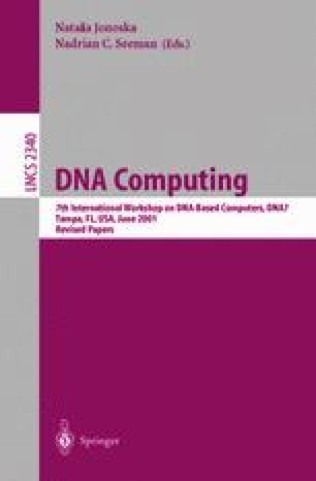
DNA Computing ; 7th International Workshop on DNA-Based Computers, DNA7, Tampa, FL, USA, June 10-13, 2001, Revised Papers
Constitutes the post-proceedings of the 7th International Workshop on DNA-Based Computers, held in Florida in 2001. The 26 papers cover experimental tools, theoretical tools, probabilistic computational models, computer simulation and sequence design, algorithms, experimental solutions and more.
