



الصفحة 20
الصفحة 20

Condorcets Paradox
It begins with a historical overview of the discovery of Condorcet's Paradox in the 18th Century, reviews numerous studies conducted to find actual occurrences of the paradox, and compiles research that has been done to develop mathematical representations for the probability that the paradox will be observed.

Conditionals, Information, and Inference
Conditionals are fascinating and versatile objects of knowledge representation. On the one hand, they may express rules in a very general sense, representing, for example, plausible relationships, physical laws, and social norms. On the other hand, as default rules or general implications, they constitute a basic tool for reasoning, even in the presence of uncertainty. In this sense, conditionals are intimately connected both to information and inference. Due to their non-Boolean nature, however, conditionals are not easily dealt with. They are not simply true or false — rather, a conditional “if A then B” provides a context, A, for B to be plausible (or true) and must not be confused with “A entails B” or with the material implication “not A or B.” This ill- trates how conditionals represent information, understood in its strict sense as reduction of uncertainty. To learn that, in the context A, the proposition B is plausible, may reduce uncertainty about B and hence is information. The ab- ity to predict such conditioned propositions is knowledge and as such (earlier) acquired information. The ?rst work on conditional objects dates back to Boole in the 19th c- tury, and the interest in conditionals was revived in the second half of the 20th century, when the emerging Arti?cial Intelligence made claims for appropriate formaltoolstohandle“generalizedrules.”Sincethen,conditionalshavebeenthe topic of countless publications, each emphasizing their relevance for knowledge representation, plausible reasoning, nonmonotonic inference, and belief revision.
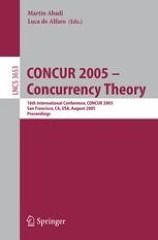
CONCUR 2005 - Concurrency Theory
This volume contains the papers presented at CONCUR 2005, the 16th - ternational Conference on Concurrency Theory. The purpose of the CONCUR series of conferences is to bring together researchers,developers, and students in order to advance the theory of concurrency and to promote its applications. The Program Committee selected 38 papers for presentation. Because of the format of the conference and the high number of submissions, many good papers could not be included. Although submissions werereadand evaluated, the papers that appear in this volume may di?er in form and contents from the corresponding submissions.

Conceptual Structures: Knowledge Architectures for Smart Applications ; 15th International Conference on Conceptual Structures, ICCS 2007, Sheffield, UK, July 22-27, 2007, Proceedings
Conceptual structures focus on the representation and analysis of concepts, events, actions and objects with applications in - search,softwareengineering,manufacturing and business.The book covers computer science, information technology,artificial int- ligence, philosophy and a variety of applied disciplines to explore novel ways that information technologies can be leveraged to assist human reasoning and interaction for tangible business or social benefits. Conceptual structures can be used to augment human intelligence by facilitating knowledge integration, desion making, the creation of intelligent software systems and the exploration of implicit structures.

Conceptual Structures : Knowledge Visualization and Reasoning; 16th International Conference on Conceptual Structures, ICCS 2008 Toulouse, France, July 7-11, 2008 Proceedings
This book constitutes the refereed proceedings of the 16th International Conference on Conceptual Structures, ICCS 2008, held in Toulouse, France, in July 2008.

Conceptual Modeling of Information Systems
When designing an information system, conceptual modeling is the activity that elicits and describes the general knowledge the system needs to know. This description, called the conceptual schema, is necessary in order to develop an information system.textbook explains in detail the principles of conceptual modeling independently from particular methods and languages and shows how to apply them in real-world projects. It covers all aspects of the engineering process from structural modeling over behavioral modeling to meta-modeling, and completes the presentation with an extensive case study based on the osCommerce system, an online store-management software program freely available under the GNU General Public License. His presentation is based on well-known industry standards like UML and OCL as a particular conceptual modeling language, yet also delivers the basics of the formal logical language background.

Conceptual Modeling for Traditional and Spatio-Temporal Applications : The MADS Approach
This book shows that a conceptual design approach for spatio-temporal databases is both feasible and easy to apprehend. While providing a firm basis through extensive discussion of traditional data modeling concepts, the major focus of the book is on modeling spatial and temporal information. Parent, Spaccapietra and Zimányi provide a detailed and comprehensive description of an approach that fills the gap between application conceptual requirements and system capabilities, covering both data modeling and data manipulation features.

Conceptual Landscapes : Fundamentals in the Beginning Design Process
Explores the dilemma faced in the early moments of design thinking through a gradient of work in landscape and environmental design media by both emerging and well-established designers and educators of landscape architecture. It questions where and, more importantly, how the process of design starts. Deconstructs the steps of conceptualizing design in order to reignite pedagogical discussions about timing and design fundamentals, and to reveal how the spark of an idea happens – from a range of unique perspectives. Through a careful arrangement of visual essays that integrate analog, digital, and mixed-media works and processes, the book highlights differences between diverse techniques and triggers debate between design, representation, technology, and creative culture in the field.

Concepts, Frames and Cascades in Semantics, Cognition and Ontology
This book presents novel theoretical, empirical and experimental work exploring the nature of mental representations that support natural language production and understanding, and other manifestations of cognition. One fundamental question raised in the text is whether requisite knowledge structures can be adequately modeled by means of a uniform representational format, and if so, what exactly is its nature. Frames are a key topic covered which have had a strong impact on the exploration of knowledge representations in artificial intelligence, psychology and linguistics; cascades are a novel development in frame theory. Other key subject areas explored are: concepts and categorization, the experimental investigation of mental representation, as well as cognitive analysis in semantics. This book is of interest to students, researchers, and professionals working on cognition in the fields of linguistics, philosophy, and psychology.

Concepts in action : Representation, learning, and application
This book is a timely contribution in presenting recent issues, approaches, and results that are not only central to the highly interdisciplinary field of concept research but also particularly important to newly emergent paradigms and challenges. The contributors present a unique, holistic picture for the understanding and use of concepts from a wide range of fields including cognitive science, linguistics, philosophy, psychology, artificial intelligence, and computer science. The chapters focus on three distinct points of view that lie at the core of concept research: representation, learning, and application. The contributions present a combination of theoretical, experimental, computational, and applied methods that appeal to students and researchers working in these fields.

Concepts and Semantics of Programming Languages 2 : Modular and Object-oriented Constructs with OCaml, Python, C++, Ada and Java
Explores the syntactical constructs of the most common programming languages, and sheds a mathematical light on their semantics, providing also an accurate presentation of the material aspects that interfere with coding. Presents an original semantic model, collectively taking into account all of the constructs and operations of modules and classes: visibility, import, export, delayed definitions, parameterization by types and values, extensions, etc. The model serves for the study of Ada and OCaml modules, as well as C header files. It can be deployed to model object and class features, and is thus used to describe Java, C++, OCaml and Python classes.

Concepts and Semantics of Programming Languages 1 : A Semantical Approach with OCaml and Python
Explores the syntactical constructs of the most common programming languages, and sheds a mathematical light on their semantics, while also providing an accurate presentation of the material aspects that interfere with coding. It is dedicated to functional and imperative features. Included is the formal study of the semantics of typing and execution; their acquisition is facilitated by implementation into OCaml and Python, as well as by worked examples. Data representation is considered in detail: endianness, pointers, memory management, union types and pattern-matching, etc., with examples in OCaml, C and C++. The second volume introduces a specific model for studying modular and object features and uses this model to present Ada and OCaml modules, and subsequently Java, C++, OCaml and Python classes and objects.
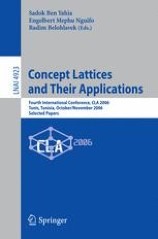
Concept Lattices and Their Applications ; Fourth International Conference, CLA 2006 Tunis, Tunisia, October 30-November 1, 2006 Selected Papers
This book constitutes the refereed proceedings of the Fourth International Conference on Concept Lattices and their Applications, CLA 2006, held in Tunis, Tunisia, October 30-November 1, 2006.

Computing Meaning : Vol.3
This book provides an in-depth view of the current issues, problems and approaches in the computation of meaning as expressed in language. Aimed at linguists, computer scientists, and logicians with an interest in the computation of meaning, this book focuses on two main topics in recent research in computational semantics. The first topic is the definition and use of underspecified semantic representations, i.e. formal structures that represent part of the meaning of a linguistic object while leaving other parts unspecified. The second topic discussed is semantic annotation. Annotated corpora have become an indispensable resource both for linguists and for developers of language and speech technology, especially when used in combination with machine learning methods. The annotation in corpora has only marginally addressed semantic information, however, since semantic annotation methodologies are still in their infancy. This book discusses the development and application of such methodologies.

Computer Vision, Graphics and Image Processing ; 5th Indian Conference, ICVGIP 2006, Madurai, India, December 13-16, 2006, Proceedings
The Indian Conference on Computer Vision, Graphics and Image Processing (ICVGIP) is a forum bringing together researchers and practitioners in these related areas, coming from national and international academic institutes, from government research and development laboratories, and from industry. The proceedings of ICVGIP 2006, published in Springer's series Lecture Notes in Computer Science, comprise 85 papers that were selected for presentation from 284 papers, which were submitted from all over the world.

Computer Vision Systems ; 2nd International Workshop, ICVS 2001 Vancouver, Canada, July 7-8, 2001 Proceedings
Computer Vision has reached a level of maturity that allows us not only to p- form research on individual methods and system components but also to build fully integrated computer vision systems of signi cant complexity. This opens a number of new problems related to system architecture, methods for system synthesis and veri cation, active vision systems, control of perception and - tion, knowledge and system representation, context modeling, cue integration, etc. By focusing on methods and concepts for the construction of fully integrated vision systems, ICVS aims to bring together researchers interested in computer vision systems. Similar to the previous event in Las Palmas, ICVS 2001 was organized as a single-track workshop consisting of high-quality.
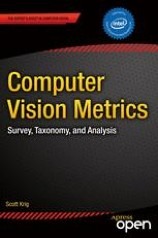
Computer Vision Metrics : Survey, Taxonomy, and Analysis
Computer Vision Metrics provides an extensive survey and analysis of over 100 current and historical feature description and machine vision methods, with a detailed taxonomy for local, regional and global features. This book provides necessary background to develop intuition about why interest point detectors and feature descriptors actually work, how they are designed, with observations about tuning the methods for achieving robustness and invariance targets for specific applications. The survey is broader than it is deep, with over 540 references provided to dig deeper. The taxonomy includes search methods, spectra components, descriptor representation, shape, distance functions, accuracy, efficiency, robustness and invariance attributes, and more.

Computer vision approaches to medical image analysis ; 2nd International ECCV Workshop, CVAMIA 2006, Graz, Austria, May 12, 2006, Revised Papers
This was the second time that a satellite workshop,solely devoted to medical image analysis issues, was held in conjunction with the European Conference on Computer Vision (ECCV). We received 38 full-length paper submissions to the second Computer Vision Approaches to Medical Image Analysis (CVAMIA) Workshop, out of which 10 were accepted for oral and 11 for poster presentation after a rigorous peer-review process. In addition, the workshop included three invited talks.
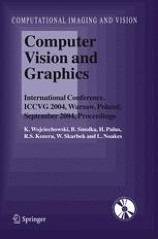
Computer vision and graphics ; International Conference, ICCVG 2004, Warsaw, Poland, September 2004, Proceedings
The objectives of the ICCVG are: presentation of current research topics and d- cussions leading to the integration of the community engaged in machine vision and computer graphics, carrying out and supporting research in the ?eld and ?nally pro- tion of new applications. The ICCVG is a continuation of the former International Conference on Computer Graphics and Image Processing called GKPO, held in Poland every second year in May since 1990, organized by the Institute of Computer Science of the Polish Academy of Sciences, Warsaw.

Computer vision : A modern approach
Provides the most complete treatment of modern computer vision methods by two of the leading authorities in the field. This accessible presentation gives both a general view of the entire computer vision enterprise and also offers sufficient detail for students to be able to build useful applications. Students will learn techniques that have proven to be useful by first-hand experience and a wide range of mathematical methods.
