



الصفحة 20
الصفحة 20

Modeling of metal forming and machining processes : By finite element and soft computing methods
The physics of metal forming and metal removing is normally expressed using non-linear partial differential equations which can be solved using the finite element method (FEM). However, when the process parameters are uncertain and/or the physics of the process is not well understood, soft computing techniques can be used with FEM or alone to model the process.

Modeling of Creep for Structural Analysis
"Creep Modeling for Structural Analysis" develops methods to simulate and analyze the time-dependent changes of stress and strain states in engineering structures up to the critical stage of creep rupture. The principal subjects of creep mechanics are the formulation of constitutive equations for creep in structural materials under multi-axial stress states; the application of structural mechanics models of beams, plates, shells and three-dimensional solids and the utilization of procedures for the solution of non-linear initial-boundary value problems. The objective of this book is to review some of the classical and recently proposed approaches to the modeling of creep for structural analysis applications as well as to extend the collection of available solutions of creep problems by new, more sophisticated examples.

Modeling of Biological Materials
This interdisciplinary collection of surveys highlights the central role played by the mathematical modeling of mechanical properties having an effect on the biology, chemistry, and physics of living matter. One of the main goals of the book is to present—in a single, self-contained resource—topics that are widely scattered across the literature in a variety of journals having mutually nonintersecting communities of readers, such as applied mathematicians, engineers, biologists, and physicians. Readers coming from diverse backgrounds are provided with basic modeling ideas and tools to address important problems in the medical and health sciences. Presented are appropriate models as well as their implementation through numerical and computer simulations, which may lead to potential technological innovations useful in medicine.

Modeling in membranes and membrane-based processes
This book explores almost every major aspect of modeling and the techniques applied in membrane separation studies and applications. This includes first principle-based models, thermodynamics models, computational fluid dynamics simulations, molecular dynamics simulations, and artificial intelligence-based modeling for membrane separation processes. These models have been discussed in light of various applications ranging from desalination to gas separation.
Modeling Foundations of Economic Property Rights Theory : An Axiomatic Analysis of Economic Agreements
The idea is to construct a kind of mathematical application in which any fundamental formal entity and/or operation has an empirical economic interpretation. This approach is seen as a way to cope with an extreme c- plexity of economic phenomena under consideration and requests for precise formulationofmodelswheremeaningfulanswersandsolutionsofproblemsare only those which are obtained rigorously. The proposed extensions in ma- ematical economics and property rights theory are to provide rich enough foundations to follow complexity of economic property rights in the exact way, and to identify where there is an appropriate method providing a- quate solution, and also to ?nd problems where in general there is no such methodology.
Modeling Decisions for Artificial Intelligence ; Vol.3885 ; 3rd International Conference, MDAI 2006, Tarragona, Spain, April 3-5, 2006, Proceedings
This book constitutes the refereed proceedings of the Third International Conference on Modeling Decisions for Artificial Intelligence, MDAI 2006, held in Tarragona, Spain, in April 2006.

Modeling Complex Living Systems : A Kinetic Theory and Stochastic Game Approach
Using tools from mathematical kinetic theory and stochastic game theory, this work deals with the modeling of large complex systems in the applied sciences, particularly those comprised of several interacting individuals whose dynamics follow rules determined by some organized, or even "intelligent" ability. Traditionally, methods of mathematical kinetic theory have been applied to model the evolution of large systems of interacting classical or quantum particles. This book, on the other hand, examines the modeling of living systems as opposed to inert systems.

Modeling Communication with Robots and Virtual Humans ; Second ZiF Research Group International Workshop on Embodied Communication in Humans and Machines, Bielefeld, Germany, April 5-8, 2006, Revised Selected Papers
The 17 articles in this state-of-the-art survey address artificial intelligence research on communicative agents and also provide an interdisciplinary perspective from linguistics, behavioral research, theoretical biology, philosophy, communication psychology, and computational neuroscience. The topics include studies on human multimodal communication; the modeling of feedback signals, facial expression, eye contact, and deception; the recognition and comprehension of hand gestures and head movements; communication interfaces for humanoid robots; the evolution of cognition and language; emotion and social appraisal in nonverbal communication; dialogue models and methodologies; theory of mind and intentionality; complex systems, dynamic field theory, and connectionist modeling.

Modeling Chemical Systems using Cellular Automata
The book will be of great value in undergraduate courses in chemistry, physics, biology, applied mathematics, and bioinformatics, and as a supplement for laboratory courses in introductory chemistry, organic chemistry, physical chemistry, medicinal chemistry, chemical engineering and other courses dealing with statistical and dynamic systems. It allows the exploration of a wide range of dynamic phenomena, many of which are not normally accessible within conventional laboratory settings due to limitations of time, cost, and experimental equipment. The book is both a textbook on applied Cellular Automata and a lab manual for chemistry (physics, engineering) courses with lab activity. It would supplement other lab work and be an additonal book the students would use in the course.

Modeling biological systems : Principles and applications
This extensively revised second edition of Modeling Biological Systems: Principles and Applications describes the essentials of creating and analyzing mathematical and computer simulation models for advanced undergraduates and graduate students. It offers a comprehensive understanding of the underlying principle, as well as details and equations applicable to a wide variety of biological systems and disciplines. Students will acquire from this text the tools necessary to produce their own models. The text contains two major sections: Principles and Applications. The first section discusses the principles of biological systems with a thorough description of the essential modeling activities of formulation, implementation, validation, and analysis. These activities are illustrated by a set of example models taken from recent and classical literature, chosen for their breadth of coverage and current timeliness. The new edition updates extensively many of these topics, especially quantitative model formulation, validation and model discrimination using information theory measures and Bayesian probability, and stability analysis and non-dimensionalization.

Modeling and simulation tools for emerging telecommunication networks : Needs, trends, challenges and solutions
This book contains a selection of papers presented at a symposium organized under the aegis of COST Telecommunications Action 285. The main objective of the Action is to enhance existing tools and develop new modeling and simulation tools for research in emerging multi-service telecommunication networks in the areas of model performance improvements, multilayer traffic modeling, and the important issue of evaluation and validation of the new modeling tools.

Modeling and simulation of complex communication networks
Covers important topics and approaches related to the modeling and simulation of complex communication networks from a complex adaptive systems perspective. The authors present different modeling paradigms and approaches as well as surveys and case studies. Modern network systems such as Internet of Things, Smart Grid, VoIP traffic, Peer-to-Peer protocol, and social networks, are inherently complex. They require powerful and realistic models and tools not only for analysis and simulation but also for prediction. With contributions from an international panel of experts, this book is essential reading for networking, computing, and communications professionals, researchers and engineers in the field of next generation networks and complex information and communication systems, and academics and advanced students working in these fields.

Modeling and Simulation in Scilab
Scilab is a free open-source software package for scientific computation. It includes hundreds of general purpose and specialized functions for numerical computation, organized in libraries called toolboxes, which cover such areas as simulation, optimization, systems and control, and signal processing. One important Scilab toolbox is Scicos. Scicos provides a block diagram graphical editor for the construction and simulation of dynamical systems. The objective of this book is to provide a tutorial for the use of Scilab/Scicos with a special emphasis on modeling and simulation tools. The book is divided into two parts. The first part concerns Scilab and includes a tutorial covering the language features, the data structures and specialized functions for doing graphics, importing, exporting data and interfacing external routines. It also covers in detail Scilab numerical solvers for ordinary differential equations and differential-algebraic equations. Even though the emphasis is placed on modeling and simulation applications, this part provides a global view of Scilab. The second part is dedicated to modeling and simulation of dynamical systems in Scicos. This type of modeling tool is widely used in industry because it provides a means for constructing modular and reusable models. This part contains a detailed description of the editor and its usage, which is illustrated through numerous examples.
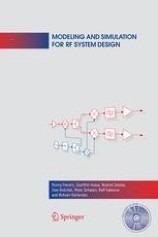
Modeling and Simulation for RF System Design
The focus of Modeling and Simulation for RF System Design lies on RF specific modeling and simulation methods and the consideration of system and circuit level descriptions. It contains application-oriented training material for RF designers which combines the presentation of a mixed-signal design flow.

Modeling and Control of Antennas and Telescopes
Modeling and Control of Antennas and Telescopes presents the author’s research and field experience in the area of antenna modeling, dynamics, and control. The required spacecraft tracking accuracy of 1 mdeg was the impetus for the new approaches to the antenna controls that use model based controllers (LQG and H¥ ). Consequently, modeling also required a new approach using system identification techniques. Most of the material presented is new in the telescope industry. The methods have been not only analyzed and tested, but actually implemented, giving confidence in the final result, which is significantly increased antenna pointing accuracy.

Modeling and computations in electromagnetics ; A volume dedicated to Jean-Claude Nédélec
Modeling and computations in electromagnetics is a quite novel and growing discipline, expanding as a result of the steadily increasing demand for designing electrical devices, modeling electromagnetic materials, and simulating electromagnetic fields in nanoscale structures. The aim of this volume is to bring together prominent worldwide experts to review state-of-the-art developments and future trends of modeling and computations in electromagnetics. This volume is devoted to merging the expertise of scientists working in this dynamic discipline, and to raising interest for challenging issues. The most significant advances in computational techniques have been made only in the last few years, and several challenging technological applications are presented in this volume.
Model-Driven Development of Reliable Automotive Services ; 2nd Automotive Software Workshop, ASWSD 2006, San Diego, CA, USA, March 15-17, 2006, Revised Selected Papers
This book constitutes the thoroughly refereed post-workshop proceedings of the Second Automotive Software Workshop, ASWSD 2006, held in San Diego, CA, USA in March 2006.The 11 revised full papers presented were carefully reviewed and selected from 18 lectures held at the workshop, that brought together experts from industry and academia, working on highly complex, distributed, reactive software systems related to the automotive domain. The papers are organized in topical sections on modeling techniques and infrastructures, model transformations, quality assurance, real-time control, as well as services and components.
Model-Driven Development and Operation of Multi-Cloud Applications : The MODAClouds Approach
In this book readers will find technological discussions on the existing and emerging technologies across the different stages of the big data value chain. They will learn about legal aspects of big data, the social impact, and about education needs and requirements. And they will discover the business perspective and how big data technology can be exploited to deliver value within different sectors of the economy. The book is structured in four parts: Part I "The Big Data Opportunity" explores the value potential of big data with a particular focus on the European context. It also describes the legal, business and social dimensions that need to be addressed, and briefly introduces the European Commission's BIG project.

Model-Based Reasoning in Science, Technology, and Medicine
The volume is based on the papers that were presented at the international conference Model-Based Reasoning in Science and Medicine (MBR’06 China), held at Sun Yat-sen University, Guangzhou, P.R. China in July 2006. The presentations given at the conference explored how scientific thinking uses models and explanatory reasoning to produce creative changes in theories and concepts. Some addressed the problem of model-based reasoning in technology, and stressed the issue of technological innovation and medical reasoning. The various contributions of the book are written by interdisciplinary researchers who are active in the area of creative reasoning in science and technology: the most recent results and achievements about the topics above are illustrated in detail in the papers.

Model-based Process Supervision : A Bond Graph Approach
Model-based fault detection and isolation requires a mathematical model of the system behaviour. Modelling is important and can be difficult because of the complexity of the monitored system and its control architecture. The authors use bond-graph modelling, a unified multi-energy domain modelling method, to build dynamic models of process engineering systems by composing hierarchically arranged sub-models of various commonly encountered process engineering devices. The structural and causal properties of bond-graph models are exploited for supervisory systems design.
