



الصفحة 20
الصفحة 20

Designing machine learning systems : An iterative process for production-ready applications
Machine learning systems are both complex and unique. Each design decision--such as how to process and create training data, which features to use, how often to retrain models, and what to monitor--in the context of how it can help your system as a whole achieve its objectives. The iterative framework in this book uses actual case studies backed by ample references. The book will help you tackle scenarios such as: Engineering data and choosing the right metrics to solve a business problem Automating the process for continually developing, evaluating, deploying, and updating models Developing a monitoring system to quickly detect and address issues your models might encounter in production Architecting an ML platform that serves across use cases Developing responsible ML systems

Designing Intelligent Construction Projects
Readers will find: Illuminating case study material that highlights how change management methodologies, game theory, and collaborative contractual design can deliver results Strategies for achieving lean, viable, and digitally oriented construction leadership fit for the modern market Rigorous discussions of the current and potential future impact of digitization on construction firms

Designing a human future with machines
What is human flourishing in an age of machine intelligence, when many claim that the world's most complex problems can be reduced to narrow technical questions? Does more computing make us more intelligent, or simply more computationally powerful? We need not always resist reduction; our ability to simplify helps us interpret complicated situations. The trick is to know when and how to do so. Against Reduction offers a collection of provocative and illuminating essays that consider different ways of recognizing and addressing the reduction in our approach to artificial intelligence, and ultimately to ourselves.

Design, user experience, and usability interaction design ; 9th International Conference, DUXU 2020, Held as Part of the 22nd HCI International Conference, HCII 2020, Copenhagen, Denmark, July 19–24, 2020, Proceedings, Part I
This book constitutes the refereed proceedings of the 9th International Conference on Design, User Experience, and Usability, DUXU 2020, held as part of the 22nd International Conference on Human-Computer Interaction, HCII 2020, in Copenhagen, Denmark, in July 2020. The conference was held virtually due to the COVID-19 pandemic. From a total of 6326 submissions, a total of 1439 papers and 238 posters has been accepted for publication in the HCII 2020 proceedings. The 40 papers included in this volume were organized in topical sections on UX design methods, tools and guidelines, interaction design and information visualization, and emotional design.

Design process Improvement : A review of current practice
Intended for business leaders who want to understand the role of design management as a driver for commercial success; design managers who want to improve their company design procedures; designers who want to know how to design more efficiently and researchers who want to explore the field of design process improvement

Design computing and cognition 08 ; Proceedings of the 3rd International conference on design computing and cognition
This is the third volume of the new conference series Design Computing and Cognition (DCC) that takes over from and subsumes the successful series Artificial Intelligence in Design (AID) published by Kluwer (now Springer) since 1992.

Design computing and cognition 06 ; 1st ed. ; Proceedings of the 2nd International conference on design computing and cognition
This is the second volume of the new conference series Design Computing and Cognition (DCC) that takes over from and subsumes the successful series Artificial Intelligence in Design (AID) published by Kluwer since 1992. The AID volumes have become standard reference texts for the field. It is expected that the DCC volumes will perform the same role.

Design by Evolution : Advances in Evolutionary Design
This book showcases the state of the art in evolutionary algorithms for design. The chapters are organized by experts in the following fields: evolutionary design and "intelligent design" in biology, art, computational embryogeny, and engineering.

Design and Analysis of Learning Classifier Systems : A Probabilistic Approach
This book provides a comprehensive introduction to the design and analysis of Learning Classifier Systems (LCS) from the perspective of machine learning. LCS are a family of methods for handling unsupervised learning, supervised learning and sequential decision tasks by decomposing larger problem spaces into easy-to-handle subproblems.

Dependability Modelling under Uncertainty : An Imprecise Probabilistic Approach
Mechatronic design processes have become shorter and more parallelized, induced by growing time-to-market pressure. Methods that enable quantitative analysis in early design stages are required, should dependability analyses aim to influence the design. Due to the limited amount of data in this phase, the level of uncertainty is high and explicit modeling of these uncertainties becomes necessary. This work introduces new uncertainty-preserving dependability methods for early design stages.

Deontic Logic in Computer Science ; 9th International Conference, DEON 2008, Luxembourg, Luxembourg, July 15-18, 2008. Proceedings
This volume presents the refereed proceedings of the 9th International Conference on Deontic Logic in Computer Science, DEON 2008, held in Luxembourg in July 2008.

Deontic Logic and Artificial Normative Systems ; 8th International Workshop on Deontic Logic in Computer Science, DEON 2006, Utrecht, The Netherlands, July 12-14, 2006, Proceedings
This volume presents the papers contributed to DEON 2006, the 8th Inter- tional Workshop on Deontic Logic in Computer Science, held in Utrecht, The Netherlands, July 12–14, 2006. These biennial DEON (more properly, ?EON) workshops are designed to promote international cooperation among scholars across disciplines who are interested in deontic logic and its use in computer science.

Defence Industry Applications of Autonomous Agents and Multi-Agent Systems
In this book defense and security related applications are increasingly being tackled by researchers and practioners using technologies developed in the field of Intelligent Agent research.

Deepfake detection = اكتشاف التزييف العميق
In the rapidly evolving era of artificial intelligence, addressing the escalating threats of deepfake technology becomes a necessity because of the increasing sophistication of AI algorithms in generating deceptive content, and since it threatens the integrity of information across diverse data. The main objective is to build a sophisticated AI-driven system to detect different types of deepfake in text, audio, and images. In English text deepfake detection, multiple pre-trained tokenizers have been used, but XLNET and BERT stand out with identifying objects outside the dataset with an accuracy of 0.9809 and both have been generalized & trained using LSTM. In Arabic text deepfake detection, Arabert has been trained using LSTM which led with an accuracy of 99.53% by generalizing the model. Both English and Arabic datasets have been generated to enhance the accuracy and effectiveness of the models. Audio deepfake detection has been generalized too, using Random Forest with an accuracy of 98.259%.

Deepfake detection
Recently, various techniques of manipulating the video content have become available to everyone – online, one can find free applications e.g., for face swapping in videos. Such universal accessibility carries a notable risk of flooding online content with false information, affecting not only the greats of this world, but also the whole societies, also the rapid progress in synthetic image generation and manipulation has now come to a point where it raises significant concerns for the implications towards society. It is therefore necessary to develop a verification tool that will help assess the authenticity of the videos posted on the internet. This project describes the approach of using artificial intelligence solutions to detect doctored videos.

Deepfake
The technology used to create such digital content has quickly become accessible to the masses, such as “DEEPFAKE.” Deep fakes refer to manipulated videos, or other digital representations produced by sophisticated artificial intelligence, that yields to synthesize a sequence of face images and voices of characters corresponding to their identities, such as voice tone, facial expression, with a good lip synchronization. Therefore, this study is about developing real-time video generation software, which generates a target video from a single input image. Several methods and algorithms have been applied to detect, analyze personalize facial expression, voice and natural head poses to present a life-like image instead of a low quality one.

Deep Statistical Comparison for Meta-heuristic Stochastic Optimization Algorithms
Presents a comprehensive comparison of the performance of stochastic optimization algorithms / Includes an introduction to benchmarking and statistical analysis / Provides a web-based tool for making statistical comparisons of optimization algorithms / Overviews of the current approaches used to analyze algorithm performance in a range of common scenarios, while also addressing issues that are often overlooked. In turn, it shows how these issues can be easily avoided by applying the principles that have produced Deep Statistical Comparison and its variants. The focus is on statistical analyses performed using single-objective and multi-objective optimization data. At the end of the book, examples from a recently developed web-service-based e-learning tool (DSCTool) are presented. The tool provides users with all the functionalities needed to make robust statistical comparison analyses in various statistical scenarios. The book is intended for newcomers to the field and experienced researchers alike. For newcomers, it covers the basics of optimization and statistical analysis, familiarizing them with the subject matter before introducing the Deep Statistical Comparison approach. Experienced researchers can quickly move on to the content on new statistical approaches.

Deep Learning, Machine Learning and IoT in Biomedical and Health Informatics : Techniques and Applications
Examines and demonstrates state-of-the-art approaches for IoT and Machine Learning based biomedical and health related applications. This book aims to provide computational methods for accumulating, updating and changing knowledge in intelligent systems and particularly learning mechanisms that help us to induce knowledge from the data. It is helpful in cases where direct algorithmic solutions are unavailable, there is lack of formal models, or the knowledge about the application domain is inadequately defined. In the future IoT has the impending capability to change the way we work and live. These computing methods also play a significant role in design and optimization in diverse engineering disciplines. With the influence and the development of the IoT concept, the need for AI (artificial intelligence) techniques has become more significant than ever.
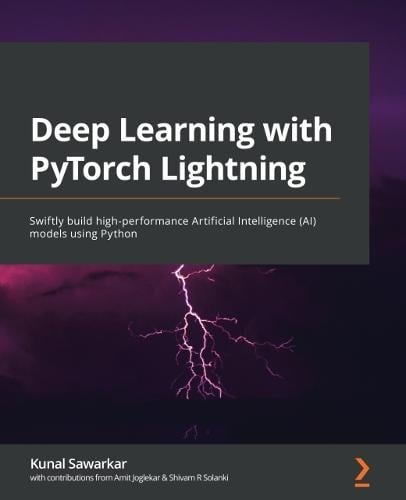
Deep Learning with PyTorch Lightning : Build and train high-performance artificial intelligence and self-supervised models using Python
You’ll learn how to configure PyTorch Lightning on a cloud platform, understand the architectural components, and explore how they are configured to build various industry solutions. You’ll build a neural network architecture, deploy an application from scratch, and see how you can expand it based on your specific needs, beyond what the framework can provide. In the later chapters, you’ll also learn how to implement capabilities to build and train various models like Convolutional Neural Nets (CNN), Natural Language Processing (NLP), Time Series, Self-Supervised Learning, Semi-Supervised Learning, Generative Adversarial Network (GAN) using PyTorch Lightning.

Deep learning pipeline : Building a deep learning model with TensorFlow
Build your own pipeline based on modern TensorFlow approaches rather than outdated engineering concepts. This book shows you how to build a deep learning pipeline for real-life TensorFlow projects. You'll learn what a pipeline is and how it works so you can build a full application easily and rapidly. Then troubleshoot and overcome basic Tensorflow obstacles to easily create functional apps and deploy well-trained models. Step-by-step and example-oriented instructions help you understand each step of the deep learning pipeline while you apply the most straightforward and effective tools to demonstrative problems and datasets.
