



الصفحة 20
الصفحة 20

Databases, information systems, and peer-to-peer computing ; 2nd international workshop, DBISP2P 2004, Toronto, Canada, August 29-30, 2004, revised selected papers
Peer-to-peer (P2P) paradigm lends itself to constructing large-scale complex, adaptive, - tonomous and heterogeneous database and information systems, endowed with clearly speci?ed and di?erential capabilities to negotiate, bargain, coordinate, and self-organize the information exchanges in large-scale networks. This vision will have a radical impact on the structure of complex organizations (business, scienti?c, or otherwise) and on the emergence and the formation of social c- munities, and on how the information is organized and processed. The P2P information paradigm naturally encompasses static and wireless connectivity, and static and mobile architectures. Wireless connectivity c- bined with the increasingly small and powerful mobile devices and sensors pose new challenges to as well as opportunities for the database community. Inf- mation becomes ubiquitous, highly distributed and accessible anywhere and at any time over highly dynamic, unstable networks with very severe constraints on the information management and processing capabilities.

Database systems for advanced applications ; Vol. 3453 ; 10th international conference, DASFAA 2005, Beijing, China, April 17-20, 2005, Proceedings
Data Stream Mining and Resource Adaptive Computation.- Purpose Based Access Control for Privacy Protection in Database Systems.- Complex Networks and Network Data Mining.- Bioinformatics.- Indexing DNA Sequences Using q-Grams.- PADS: Protein Structure Alignment Using Directional Shape Signatures.- LinkageTracker: A Discriminative Pattern Tracking Approach to Linkage Disequilibrium Mapping.- Watermarking and Encryption.- Query Optimization in Encrypted Database Systems.- Watermarking Spatial Trajectory Database.- Effective Approaches for Watermarking XML Data.- XML Query Processing.- A Unifying Framework for Merging and Evaluating XML Information.- Efficient Evaluation of Partial Match Queries for XML Documents Using Information Retrieval Techniques.- PathStack: A Holistic Path Join Algorithm for Path Query with Not-Predicates on XML Data.- XML Coding and Metadata Management.- An Improved Prefix Labeling Scheme: A Binary String Approach for Dynamic Ordered XML.- Efficiently Coding and Indexing XML Document.- XQuery-Based TV-Anytime Metadata Management.- Data Mining.- Effective Database Transformation and Efficient Support Computation for Mining Sequential Patterns.

Database Systems for Advanced Applications ; 13th International Conference, DASFAA 2008, New Delhi, India, March 19-21, 2008. Proceedings
This book constitutes the refereed proceedings of the 13th International Conference on Database Systems for Advanced Applications, DASFAA 2008, held in New Delhi, India, in March 2008.
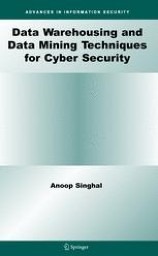
Data Warehousing and Data Mining Techniques for Cyber Security
It provide techniques for collecting information from distributed databases and for performing data analysis. The ever expanding, tremendous amount of data collected and stored in large databases has far exceeded our human ability to comprehend--without the proper tools. There is a critical need for data analysis that can automatically analyze data, summarize it and predict future trends. In the modern age of Internet connectivity, concerns about denial of service attacks, computer viruses and worms are extremely important. Data Warehousing and Data Mining Techniques for Cyber Security contributes to the discipline of security informatics. The author discusses topics that intersect cyber security and data mining, while providing techniques for improving cyber security. Since the cost of information processing and internet accessibility is dropping, an increasing number of organizations are becoming vulnerable to cyber attacks. This volume introduces techniques for applications in the area of retail, finance, and bioinformatics, to name a few.

Data parallel C++programming accelerated systems using C++ and SYCL
Full of practical advice, detailed explanations, and code examples to illustrate key topics. SYCL enables access to parallel resources in modern accelerated heterogeneous systems. Now, a single C++ application can use any combination of devices–including GPUs, CPUs, FPGAs, and ASICs–that are suitable to the problems at hand. This book teaches data-parallel programming using C++ with SYCL and walks through everything needed to program accelerated systems. The book begins by introducing data parallelism and foundational topics for effective use of SYCL. Later chapters cover advanced topics, including error handling, hardware-specific programming, communication and synchronization, and memory model considerations.

Data Management. Data, Data Everywhere ; 24th British National Conference on Databases, BNCOD 24, Glasgow, UK, July 3-5, 2007, Proceedings
One of the most pressing challenges is to ?nd ways of evolving database technology to cope with its new role in underpinning the massively distributed and heterogeneous applications built on top of the Internet. This has afiected both the ways in which data has been accessed and the ways in which it is represented, with XML data management becoming an important issue and, as such, heavily represented at this conference. It has also brought back issues of performance that might have been considered largely solved by the improvements in hardware, since data now has to be managed on devices of low power and small memory as well as on standard client and powerful server machines. We therefore invited papers on all aspects of data management, particularly related to how dataisused in the ubiquitous environment of the modern Internet by complex distributed and scientific applications.

Data Journeys in the Sciences
This groundbreaking, book analyses and compares data practices across several fields through the analysis of specific cases of data journeys. It brings together leading scholars in the philosophy, history and social studies of science to achieve two goals: tracking the travel of data across different spaces, times and domains of research practice; and documenting how such journeys affect the use of data as evidence and the knowledge being produced.

Data and applications security XXII ; 22nd Annual IFIP WG 11.3 Working Conference on data and applications security London, UK, July 13-16, 2008 Proceedings
This volume contains the papers presented at the 22nd Annual IFIP WG 11.3 Working Conference on Data and Applications Security (DBSEC) held in L- don, UK, July 13–16, 2008.
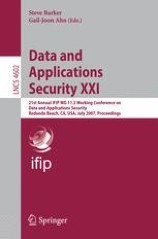
Data and applications security XXI ; 21st Annual IFIP WG 11.3 Working Conference on data and applications security, Redondo Beach, CA, USA, July 8-11, 2007, Proceedings
This book presented secure query evaluation, location-based security/mobile security, distributed security issues, cryptographic-based security, temporal access control and usage control, as well as system security issues.
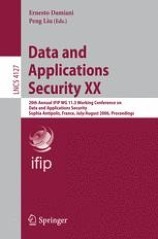
Data and applications security XX ; 20th Annual IFIP WG 11.3 Working Conference on data and applications security, Sophia Antipolis, France, July 31-August 2, 2006, Proceedings
For 20 years, the IFIP WG 11. 3 Working Conference on Data and Appli- tions Security (DBSEC) has been a major forum for presenting originalresearch results, practical experiences, and innovative ideas in data and applications - curity.Like the previous conference, the 20th DBSEC has proved to be up to this challenge. DBSEC 2006 received 56 submissions, out of which the program committee selected22 high-qualitypaperscoveringanumber of diverseresearchtopicssuch as access control, privacy, and identity management.

Data and applications security and privacy XXXIV ; 34th Annual IFIP WG 11.3 Conference, DBSec 2020, Regensburg, Germany, June 25–26, 2020, Proceedings
This book constitutes the refereed proceedings of the 34th Annual IFIP WG 11.3 Conference on Data and Applications Security and Privacy, DBSec 2020, held in Regensburg, Germany, in June 2020.* The 14 full papers and 8 short papers presented were carefully reviewed and selected from 39 submissions. The papers present high-quality original research from academia, industry, and government on theoretical and practical aspects of information security. They are organized in topical sections named network and cyber-physical systems security; information flow and access control; privacy-preserving computation; visualization and analytics for security; spatial systems and crowdsourcing security; and secure outsourcing and privacy.

Cyberspace security and defense : Research issues ; Proceedings of the NATO advanced research workshop on cyberspace security and defense : Research issues, Gdansk, Poland, from 6 to 9 September 2004.
The development of Internet, mobile communications, distributed computing, computer software and databases storing essential enterprise information has helped to conduct business and personal communication between individual people. and it has created many opportunities for abuse, fraud and expensive damage. This book is a selection of the best papers presented at the NATO Advanced Research Workshop dealing with the Subject of Cyberspace Security and Defense. The level of the individual contributions in the volume is advanced and suitable for senior and graduate students, researchers and technologists who wish to get some feeling of the state of the art in several sub-disciplines of Cyberspace security.

Customer relationship management : Concept, strategy, and tools, 3rd
Presents an extensive discussion of the strategic and tactical aspects of customer relationship management as we know it today. It helps readers obtain a comprehensive grasp of CRM strategy, concepts and tools and provides all the necessary steps in managing profitable customer relationships. Throughout, the book stresses a clear understanding of economic customer value as the guiding concept for marketing decisions. Exhaustive case studies, mini cases and real-world illustrations under the title “CRM at Work” all ensure that the material is both highly accessible and applicable, and help to address key managerial issues, stimulate thinking, and encourage problem solving.

Cryptography, information theory, and error-correction : A handbook for the 21st century ; 2nd ed.
A rich examination of the technologies supporting secure digital information transfers from respected leaders in the field. Is an indispensable resource for anyone interested in the secure exchange of financial information. Identity theft, cybercrime, and other security issues have taken center stage as information becomes easier to access. Three disciplines offer solutions to these digital challenges: cryptography, information theory, and error-correction, all of which are addressed in this book. The book also: Shares vital, new research in the field of information theory / Provides quantum cryptography updates / Includes over 350 worked examples and problems for greater understanding of ideas.

Crypto-Finance, Law and Regulation : Governing an Emerging Ecosystem
Explores the emergence of a decentralised and disintermediated crypto-market and investigates the way in which it can transform the financial markets. It examines three components of the financial market – technology, finance, and the law – and shows how their interrelationship dictates the structure of a crypto-market. It focuses on regulators’ enforcement policies and their jurisdiction over crypto-finance operators and participants. The book also discusses the latest developments in crypto-finance, and the advantages and disadvantages of crypto-currency as an alternative payment product. It also investigates how such a decentralised crypto-finance system can provide access to finance, promote a shared economy, and allow access to justice.

Critical Points for the Organisation of Test Performance Studies in Microbiology : Plant Pathogens as a Case Study
This book in the field of plant pest detection shows a constant demand in development and improvement of fast and reliable detection tools, especially for high-priority pests. This open access book describes and summarizes the whole process of the organization of test performance study (TPS) for these tools. The outcome of TPS, obtained through the evaluation of the performance of one or more diagnostic tests by several laboratories on defined samples, is the finding of the best performing test/s for particular pest and for specific uses.

Critical Information Infrastructured Security ; 1st International Workshop, CRITIS 2006, Samos Island, Greece, August 31 - September 1, 2006
This volume contains the proceedings of the 1st International Workshop on Critical Information Infrastructure Security (CRITIS 2006), that was held between August 31 and September 1, 2006 on Samos, Greece, and was hosted by the University of the Aegean, Department of Information and Communication Systems Engineering, Laboratory of Information and Communication Systems Security (Info-Sec-Lab). In response to the CRITIS 2006 call for papers, 57 papers were submitted.

Criminal law: The basics
Considers key questions such as: How should we decide what is criminal and what isn't? What is the difference between murder and manslaughter? Could you ever be guilty of stealing your own property? What defences are available to those accused of crime? Featuring a range of case studies, from the infamous to the bizarre, the new edition has been thoroughly updated to include new material on loss of control, accessorial liability, dishonesty, causation, liability, manslaughter and sexual offences.

Crime and safety in the rural : Lessons from research
This book highlights 20 reasons why crime and safety in rural areas is a topic of relevance. We attempt to untangle currently simplistic views of the rural by discussing a number of facets of the countryside as both safe and criminogenic, and more importantly, a hybrid place worth to be examined in its own right. We adopt the notion of a rural-urban continuum that captures the nuances of places of varied nature, spanning from remote and desolate spaces to accessible and connected environments of the urban fringe. Areas on the rural-urban continuum may be in constant transformation given local and global influences, which imposes challenges for policing and long-term social sustainability.

Creativity, Psychology and the History of Science
The present book includes papers from a wide range of topics. In the contributions to creativity research, Gruber proposes his key ideas for studying creative work. Gruber focuses on how the thinking, motivation and affect of extraordinarily creative individuals evolve and how they interact over long periods of time. Gruber’s approach bridges many disciplines and subdisciplines in psychology and beyond, several of which are represented in the present volume: cognitive psychology, developmental psychology, history of science, aesthetics, and politics. The volume thus presents a unique and comprehensive contribution to our understanding of the creative process. Many of Gruber's papers have not previously been easily accessible; they are presented here in thoroughly revised form. The book is for psychologists, historians and philosophers of science interested in the intersection of psychology and the history of science.
