



الصفحة 2
الصفحة 2
Computer Aided Verification ; 33rd International Conference, CAV 2021, Virtual Event, July 20–23, 2021, Proceedings, Part II
This two-volume set LNCS 12759 and 12760 constitutes the refereed proceedings of the 33rd International Conference on Computer Aided Verification, CAV 2021, held virtually in July 2021. The 63 full papers presented together with 16 tool papers and 5 invited papers were carefully reviewed and selected from 290 submissions. The papers were organized in the following topical sections: Part I: invited papers; AI verification; concurrency and blockchain; hybrid and cyber-physical systems; security; and synthesis. Part II: complexity and termination; decision procedures and solvers; hardware and model checking; logical foundations; and software verification.

Computer Aided Verification ; 33rd International Conference, CAV 2021, Virtual Event, July 20–23, 2021, Proceedings, Part I
This two-volume set LNCS 12759 and 12760 constitutes the refereed proceedings of the 33rd International Conference on Computer Aided Verification, CAV 2021, held virtually in July 2021. The 63 full papers presented together with 16 tool papers and 5 invited papers were carefully reviewed and selected from 290 submissions. The papers were organized in the following topical sections: Part I: invited papers; AI verification; concurrency and blockchain; hybrid and cyber-physical systems; security; and synthesis. Part II: complexity and termination; decision procedures and solvers; hardware and model checking; logical foundations; and software verification.

Computer Aided Verification ; 32nd International Conference, CAV 2020, Los Angeles, CA, USA, July 21–24, 2020, Proceedings, Part II
The two-volume set LNCS 12224 and 12225 constitutes the refereed proceedings of the 32st International Conference on Computer Aided Verification, CAV 2020, held in Los Angeles, CA, USA, in July 2020.*
Computer Aided Verification ; 32nd International Conference, CAV 2020, Los Angeles, CA, USA, July 21–24, 2020, Proceedings, Part I
The two-volume set LNCS 12224 and 12225 constitutes the refereed proceedings of the 32st International Conference on Computer Aided Verification, CAV 2020, held in Los Angeles, CA, USA, in July 2020.*

Computer Aided Verification ; 31st International Conference, CAV 2019, New York City, NY, USA, July 15-18, 2019, Proceedings, Part I
This volume presented automata and timed systems; security and hyperproperties; synthesis; model checking; cyber-physical systems and machine learning; probabilistic systems, runtime techniques; dynamical, hybrid, and reactive systems.

Computer aided verification ; 30th International Conference, CAV 2018, Held as Part of the Federated Logic Conference, FloC 2018, Oxford, UK, July 14-17, 2018, Proceedings, Part II
Constitutes the refereed proceedings of the 30th International Conference on Computer Aided Verification, CAV 2018, held in Oxford, UK, in July 2018.The 52 full and 13 tool papers presented together with 3 invited papers and 2 tutorials were carefully reviewed and selected from 215 submissions. The papers cover a wide range of topics and techniques, from algorithmic and logical foundations of verication to practical applications in distributed, networked, cyber-physical, and autonomous systems. They are organized in topical sections on model checking, program analysis using polyhedra, synthesis, learning, runtime verification, hybrid and timed systems, tools, probabilistic systems, static analysis, theory and security, SAT, SMT and decisions procedures, concurrency, and CPS, hardware, industrial applications.

Computer Aided Verification ; 30th International Conference, CAV 2018, Held as Part of the Federated Logic Conference, FloC 2018, Oxford, UK, July 14-17, 2018, Proceedings, Part I
This open access two-volume set LNCS 10980 and 10981 constitutes the refereed proceedings of the 30th International Conference on Computer Aided Verification, CAV 2018, held in Oxford, UK, in July 2018. The papers cover a wide range of topics and techniques, from algorithmic and logical foundations of verication to practical applications in distributed, networked, cyber-physical, and autonomous systems. They are organized in topical sections on model checking, program analysis using polyhedra, synthesis, learning, runtime verification, hybrid and timed systems, tools, probabilistic systems, static analysis, theory and security, SAT, SMT and decisions procedures, concurrency, and CPS, hardware, industrial applications.

Computational methods in systems biology ; 18th International Conference, CMSB 2020, Konstanz, Germany, September 23–25, 2020, Proceedings
This book constitutes the refereed proceedings of the 18th International Conference on Computational Methods in Systems Biology, CMSB 2020, held in Konstanz, Germany, in September 2020.* The 17 full papers and 5 tool papers were carefully reviewed and selected from 30 submissions. In addition 3 abstracts of invited talks and 2 tutorials have been included in this volume. Topics of interest include formalisms for modeling biological processes; models and their biological applications; frameworks for model verification, validation, analysis, and simulation of biological systems; high-performance computational systems biology and parallel implementations; model inference from experimental data; model integration from biological databases; multi-scale modeling and analysis methods; computational approaches for synthetic biology; and case studies in systems and synthetic biology.

Mathematical Knowledge Management ; Vol. 4108 ; 5th International Conference, MKM 2006, Wokingham, UK, August 11-12, 2006, Proceedings
This book constitutes the refereed proceedings of the 5th International Conference on Mathematical Knowledge Management, MKM 2006, held in Wokingham, UK in August 2006 as official satellite event of the International Congress of Mathematicians, ICM 2006. The 22 revised full papers presented were carefully selected during two rounds of reviewing and improvement. The papers in this volume cover the whole area of mathematical knowledge management in the intersection of mathematics, computer science, library science, and scientific publishing. The papers are organized in topical sections on proof representations, proof processing, knowledge extraction, knowledge representation, as well as systems and tools.

Mathematical Knowledge Management ; Vol. 3863 ; 4th International Conference, MKM 2005, Bremen, Germany, July 15-17, 2005, Revised Selected Papers
This volume contains the proceedings of the Fourth International Conference on Mathematical Knowledge Management MKM 2005 held July 15–17, 2005 at - ternational University Bremen, Germany.

Logics in Artificial Intelligence ; 11th European Conference, JELIA 2008, Dresden, Germany, September 28-October 1, 2008. Proceedings
Constitutes the refereed proceedings of the 11th European Conference on Logics in Artificial Intelligence, JELIA 2008, held in Dresden, Germany, Liverpool, in September/October 2008.The 32 revised full papers presented together with 2 invited talks were carefully reviewed and selected from 98 submissions. The papers cover a broad range of topics including belief revision, description logics, non-monotonic reasoning, multi-agent systems, probabilistic logic, and temporal logic.

Logic, language, information and computation ; 14th International Workshop, WoLLIC 2007, Rio de Janeiro, Brazil, July 2-5, 2007, Proceedings
The Workshop on Logic, Language, Information and Computation (WoLLIC) is an annual international forum on inter-disciplinary research involving formal logic, computing and programming theory, and natural language and reasoning. The WoLLIC meetings alternate between Brazil (and Latin America) and other countries, with the aim of fostering interest in applied logic among Latin Am- ican scientists and students, and facilitating their interaction with the international - plied logic community.
Logic in Reality
The interface of logic, philosophy and science. It is intended for readers with interest and/or current involvement in process philosophy, ontology and in the philosophy or metaphysical aspects of science, especially, quantum physics, biology and cosmology. The content requires competence in reasoning, but not detailed knowledge of the fields discussed.
Logic for Computer Scientists
This book introduces the notions and methods of formal logic from a computer science standpoint, covering propositional logic, predicate logic, and foundations of logic programming. It presents applications and themes of computer science research such as resolution, automated deduction, and logic programming in a rigorous but readable way.The style and scope of the work, rounded out by the inclusion of exercises, make this an excellent textbook for an advanced undergraduate course in logic for computer scientists.

Leveraging applications of formal methods, verification and validation : Verification Principles ; 9th International Symposium on Leveraging Applications of Formal Methods, ISoLA 2020, Rhodes, Greece, October 20–30, 2020, Proceedings, Part I
Constitutes the refereed proceedings of the 9th International Symposium on Leveraging Applications of Formal Methods, ISoLA 2020, which was planned to take place during October 20–30, 2020, on Rhodes, Greece. The papers presented were carefully reviewed and selected for inclusion in the proceedings. Each volume focusses on an individual topic with topical section headings within the volume : Part I, Verification Principles : Modularity and (De-)Composition in Verification ; X-by-Construction: Correctness meets Probability ; 30 Years of Statistical Model Checking ; Verification and Validation of Concurrent and Distributed Systems.

Leveraging applications of formal methods, verification and validation : Engineering Principles ; 9th International Symposium on Leveraging Applications of Formal Methods, ISoLA 2020, Rhodes, Greece, October 20–30, 2020, Proceedings, Part II
Constitutes the refereed proceedings of the 9th International Symposium on Leveraging Applications of Formal Methods, ISoLA 2020, which was planned to take place during October 20–30, 2020, on Rhodes, Greece. The event itself was postponed to 2021 due to the COVID-19 pandemic. The papers presented were carefully reviewed and selected for inclusion in the proceedings. Each volume focusses on an individual topic with topical section headings within the volume: Part II, Engineering Principles : Automating Software Re-Engineering ; Rigorous Engineering of Collective Adaptive Systems.

Leveraging applications of formal methods, verification and validation : Applications ; 9th International Symposium on Leveraging Applications of Formal Methods, ISoLA 2020, Rhodes, Greece, October 20–30, 2020, Proceedings, Part III
The three-volume set LNCS 12476 - 12478 constitutes the refereed proceedings of the 9th International Symposium on Leveraging Applications of Formal Methods, ISoLA 2020, which was planned to take place during October 20–30, 2020, on Rhodes, Greece. The event itself was postponed to 2021 due to the COVID-19 pandemic. The papers presented were carefully reviewed and selected for inclusion in the proceedings. Each volume focusses on an individual topic with topical section headings within the volume: Part III, Applications: Reliable Smart Contracts: State-of-the-art, Applications, Challenges and Future Directions; Automated Verification of Embedded Control Software; Formal methods for DIStributed COmputing in future RAILway systems.

Knowledge discovery, knowledge engineering and knowledge management ; 10th International Joint Conference, IC3K 2018, Seville, Spain, September 18-20, 2018, Revised Selected Papers
Constitutes the thoroughly refereed proceedings of the 10th International Joint Conference on Knowledge Discovery, Knowledge Engineering and Knowledge Management, IC3K 2018, held in Seville, Spain, in September 2018. The 12 full papers presented were carefully reviewed and selected from 167 submissions. The papers are organized in topical sections on knowledge discovery and information retrieval; knowledge engineering and ontology development; and knowledge management and information sharing.
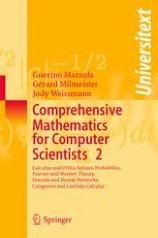
Comprehensive mathematics for computer scientists 2 : Calculus and ODEs, splines, probability, fourier and wavelet theory, fractals and neural networks, categories and lambda calculus
This second volume of a comprehensive tour through mathematical core subjects for computer scientists completes the first volume in two - gards: Part III first adds topology, di?erential, and integral calculus to the t- ics of sets, graphs, algebra, formal logic, machines, and linear geometry, of volume 1. With this spectrum of fundamentals in mathematical e- cation, young professionals should be able to successfully attack more involved subjects, which may be relevant to the computational sciences. In a second regard, the end of part III and part IV add a selection of more advanced topics. In view of the overwhelming variety of mathematical approaches in the computational sciences, any selection, even the most empirical, requires a methodological justi?cation. Our primary criterion has been the search for harmonization and optimization of thematic - versity and logical coherence. This is why we have, for instance, bundled such seemingly distant subjects as recursive constructions, ordinary d- ferential equations, and fractals under the unifying perspective of c- traction theory.

Comprehensive mathematics for computer scientists 1 : Sets and numbers, graphs and algebra, logic and machines, linear geometry
This two-volume textbook Comprehensive Mathematics for Computer Scientists is a self-contained comprehensive presentation of mathematics including sets, numbers, graphs, algebra, logic, grammars, machines, linear geometry, calculus, ODEs, and special themes such as neural networks, Fourier theory, wavelets, numerical issues, statistics, categories, and manifolds. The concept framework is streamlined but defining and proving virtually everything.
