



الصفحة 2
الصفحة 2
Apprehension and Argument : Ancient Theories of Starting Points for Knowledge
This book offers the first synoptic study of how the primary elements in knowledge structures were analysed in antiquity from Plato to late ancient commentaries, the main emphasis being on the Platonic-Aristotelian tradition. It argues that, in the Platonic-Aristotelian tradition, the question of starting points was treated from two distinct points of view: from the first perspective, as a question of how we acquire basic knowledge; and from the second perspective, as a question of the premises we may immediately accept in the line of argumentation. It was assumed that we acquire some general truths rather naturally and that these function as starting points for inquiry. In the Hellenistic period, an alternative approach was endorsed: the very possibility of knowledge became a central issue when sceptics began demanding that true claims should always be distinguishable from false ones.
Analysis and Synthesis of Logics : How to Cut and Paste Reasoning Systems
Starting with simple examples showing the relevance of cutting and pasting logics, the monograph develops a mathematical theory of combining and decomposing logics, ranging from propositional and first-order based logics to higher-order based logics as well as to non-truth functional logics. The theory covers mechanisms for combining semantic structures and deductive systems either of the same or different nature (for instance, two Hilbert calculi or a Hilbert calculus and a tableau calculus). The important issue of preservation of properties is extensively addressed. For instance, sufficient conditions are provided for a combined logic to be sound and complete when the original component logics are known to be sound and complete.
Anaesthesia, pain, intensive care and emergency medicine A.P.I.C.E. ; Proceedings of the 21st Postgraduate Course in Critical Medicine: Venice-Mestre, Italy - November 10-13, 2006
Developing sectors in the Intensive Care field – and in Critical Care Medicine in general – require specific levels of competence having a same common denominator: an in-depth knowledge of human pathophysiology. Although this volume presents plenty of topics in constant evolution, as witnessed by the collection of chapters compiled by several researchers, this edition includes, in particular, fields in which decision-making at the patient’s bedside prevails over theoretical argumentation. In other words, the first and foremost message this edition wants to provide is for the reader to focus his/her attention on evidence-based medicine.
Agent Communication II ; International Workshops on Agent Communication, AC 2005 and AC 2006, Utrecht, Netherlands, July 25, 2005, and Hakodate, Japan, May 9, 2006, Selected and Revised Papers
Although everyone recognizes communication as a central concept in mul- agents, many no longer see agent communication as a research topic. Unf- tunately there seems to be a tendency to regard communication as a kind of information exchange that can easily be covered using the standard FIPA ACL. However, the papers in this volume show that research in agent communication is far from ?nished. If we want to develop the full potential of multi-agent s- tems, agent communication should also develop to a level beyond parameter or value passing as is done in OO approaches! In this book we present the latest collection of papers around the topic of agentcommunication.Thecollectioncomprisesofthebestpapersfromtheagent communication workshops of 2005 and 2006, enriched with a few revised agent communication papers from the AAMAS conference.
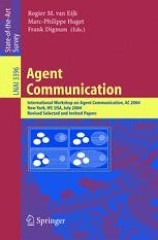
Agent communication ; International workshop on agent communication, AC 2004, New York, NY, July 19, 2004
In this book, we present a collection of papers around the topic of agent com- nication. The communication between agents has been one of the major topics of research in multiagent systems. The current work can therefore build on a number of previous Workshops of which the proceedings have been published in earlier volumes in this series. The basis of this collection is formed by the accepted submissions of the Workshop on Agent Communication held in c- junction with the AAMAS Conference in July 2004 in New York. the current collection comprises a very good and quite complete overview of the state of the art in this area of research and gives a good indication of the topics that are of major interest at the moment. The papers can roughly be divided over the following ?ve themes: – social commitments – multiparty communication – content languages – dialogues and conversations – speech acts Although these themes are of course not mutually exclusive they indicate some main directions of research. We therefore have arranged the papers in the book according to the topics indicated above.
