



الصفحة 2
الصفحة 2
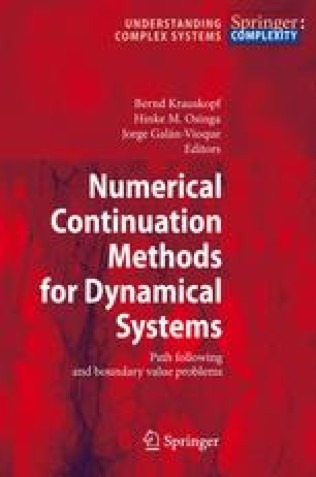
Numerical Continuation Methods for Dynamical Systems : Path following and boundary value problems
The book opens with a foreword by Herbert B. Keller and lecture notes by Sebius Doedel himself that introduce the basic concepts of numerical bifurcation analysis. The other chapters by leading experts discuss continuation for various types of systems and objects and showcase examples of how numerical bifurcation analysis can be used in concrete applications. Topics that are treated include: interactive continuation tools, higher-dimensional continuation, the computation of invariant manifolds, and continuation techniques for slow-fast systems, for symmetric Hamiltonian systems, for spatially extended systems and for systems with delay. Three chapters review physical applications: the dynamics of a SQUID, global bifurcations in laser systems, and dynamics and bifurcations in electronic circuits.

Numerical analysis
Introduces readers to the theory and application of modern numerical approximation techniques. Providing an accessible treatment that only requires a calculus prerequisite, the authors explain how, why, and when approximation techniques can be expected to work-and why, in some situations, they fail. A wealth of examples and exercises develop readers' intuition, and demonstrate the subject's practical applications to important everyday problems in math, computing, engineering, and physical science disciplines.

Numeri e Crittografia
Number Theory is one of the most classic fields of Mathematics. The numbers he deals with are those that are called natural 0, 1, 2, ... and that we use since childhood to count. Seemingly simple and harmless, they nevertheless hide some of the most difficult and exciting mysteries of the whole of mathematics. Cryptography, on the other hand, is concerned with hiding the content of confidential communications from prying eyes and corresponds to widespread needs in our society. The Theory of Numbers can help Cryptography in these needs, thanks to the mysteries that still surround it. The text gives an account of this link. It first introduces Modern Cryptography, its goals and priorities. He then goes on to expose arguments of Number Theory, with particular reference to the two problems of recognizing prime numbers, and of decomposing a natural into its prime factors; for each of the two issues it provides a vast panorama of the algorithms that deal with it and try to solve it as effectively as possible. In particular, it presents the very recent AKS procedure for recognizing prime numbers. The book then returns to Cryptography and shows how ideas and methods of Number Theory apply to the construction of reliable procedures for the secure transmission of confidential information.

Number theory in science and communication : With applications in cryptography, physics, digital information, computing, and self-similarity
"Number Theory in Science and Communication" is a well-known introduction for non-mathematicians to this fascinating and useful branch of applied mathematics . It stresses intuitive understanding rather than abstract theory and highlights important concepts such as continued fractions, the golden ratio, quadratic residues and Chinese remainders, trapdoor functions, pseudoprimes and primitive elements. Their applications to problems in the real world are one of the main themes of the book. This revised fourth edition is augmented by recent advances in primes in progressions, twin primes, prime triplets, prime quadruplets and quintruplets, factoring with elliptic curves, quantum factoring, Golomb rulers and "baroque" integers.

Number Theory and the Periodicity of Matter
The book launch was held at the University of Pretoria (UP) on 26 March 2008. … It’s a fascinating and original concept and I hope you all get the opportunity to read it. It will challenge your current views of numbers. … If there is a link between numbers and the Periodic Table this will of course have major implications as to the ‘meaning’ on the Periodic Table. It’s great to have original thinkers in our midst

Number Theory ; Vol.15 : Tradition and Modernization
This book appears varied, they are unified by two underlying principles:first, making everything readable as a book, and second, making a smooth transition from traditional approaches to modern ones by providing a rich array of examples. The chapters are presented in quite different in depth and cover a variety of descriptive details.The book emphasizes a few common features such as functional equations for various zeta-functions, modular forms, congruence conditions, exponential sums, and algorithmic aspects.

Number Theory ; Vol. II : Analytic and Modern Tools
The central theme of this graduate-level number theory textbook is the solution of Diophantine equations, i.e., equations or systems of polynomial equations which must be solved in integers, rational numbers or more generally in algebraic numbers. This theme, in particular, is the central motivation for the modern theory of arithmetic algebraic geometry. In this text, this is considered through three aspects.

Number Theory ; Vol. I : Tools and Diophantine Equations
The central theme of this graduate-level number theory textbook is the solution of Diophantine equations, i.e., equations or systems of polynomial equations which must be solved in integers, rational numbers or more generally in algebraic numbers. This theme, in particular, is the central motivation for the modern theory of arithmetic algebraic geometry. In this text, this is considered through three aspects.

Number Theory : An Introduction via the Distribution of Primes
This book provides an introduction and overview of number theory based on the distribution and properties of primes. This unique approach provides both a firm background in the standard material as well as an overview of the whole discipline. All the essential topics are covered: fundamental theorem of arithmetic, theory of congruences, quadratic reciprocity, arithmetic functions, and the distribution of primes.

Number Theory : An Introduction to Mathematics ; Part B
This book attempts to provide such an understanding of the nature and extent of mathematics. It is a modern introduction to the theory of numbers, emphasizing its connections with other branches of mathematics. This part B is more advanced than the first and should give the reader some idea of the scope of mathematics today. The connecting theme is the theory of numbers. By exploring its many connections with other branches, we may obtain a broad picture.

Number Theory : An Introduction to Mathematics ; Part A
This book attempts to provide such an understanding of the nature and extent of mathematics. It is a modern introduction to the theory of numbers, emphasizing its connections with other branches of mathematics. This part A, which should be accessible to a first-year undergraduate, deals with elementary number theory.

Number Story : From Counting to Cryptography
Numbers have fascinated people for centuries. They are familiar to everyone, forming a central pillar of our understanding of the world, yet the number system was not presented to us "gift-wrapped" but, rather, was developed over millennia. Today, despite all this development, it remains true that a child may ask a question about numbers that no one can answer. Many unsolved problems surrounding number matters appear as quirky oddities of little account while others are holding up fundamental progress in mainstream mathematics.

Number Fields and Function Fields – Two Parallel Worlds
These invited articles by leading researchers in the field explore various aspects of the parallel worlds of function fields and number fields. Topics range from Arakelov geometry, the search for a theory of varieties over the field with one element, via Eisenstein series to Drinfeld modules, and t-motives.

Nuel Belnap on Indeterminism and Free Action
Seeks to further the use of formal methods in clarifying one of the central problems of philosophy: that of our free human agency and its place in our indeterministic world. It celebrates the important contributions made in this area by Nuel Belnap, American logician and philosopher. Philosophically, indeterminism and free action can seem far apart, but in Belnap’s work, they are intimately linked. This book explores their philosophical interconnectedness through a selection of original research papers that build forth on Belnap’s logical and philosophical work. Some contributions take the form of critical discussions of Belnap's published work, some develop points made in his publications in new directions, and others provide additional insights on the topics of indeterminism and free action.

Nuclear Fission and Cluster Radioactivity : An Energy-Density Functional Approach
It is the first application to nuclear physics from energy-density functional method, for which Professor Walter Kohn received the Nobel Prize in Chemistry. The book presents a comprehensive extension of the Bohr-Wheeler theory with the present knowledge of nuclear density distribution function.

Novel Optical Resolution Technologies
After theend ofthe 20th century, the science ofcrystallizationreached a truly exciting stage where new opportunities emerged in both theory and expe- ment. Variousphysical methodsare capable of resolving the surface as wellas the insid estructure of crystalsat the atomiclevel while newhigh-performance computing resourcesafford thecapability of modeling the complexlarge-scale alignments necessary to simulatecrystallizationinrealsystems. Asaresult, the science of crystallization has shifted gradually fromstatic to dynamic science and considerable progress now underlies the complex but beautiful cryst- lization process.The vastpotential ofcrystallizationasan- portant feld ofscience isfar beyondthesimple technologyofpharmaceutical industries during the 20th century.

Notions of Convexity
The first two chapters of this book are devoted to convexity in the classical sense, for functions of one and several real variables respectively. This gives a background for the study in the following chapters of related notions which occur in the theory of linear partial differential equations and complex analysis such as (pluri-)subharmonic functions, pseudoconvex sets, and sets which are convex for supports or singular supports with respect to a differential operator. In addition, the convexity conditions which are relevant for local or global existence of holomorphic differential equations are discussed, leading up to Trépreau’s theorem on sufficiency of condition (capital Greek letter Psi) for microlocal solvability in the analytic category.

Notes on Set Theory
This is introduction to axiomatic set theory, viewed both as a foundation of mathematics and as a branch of mathematics with its own subject matter, basic results, open problems.

Notes on Coxeter Transformations and the McKay Correspondence
One of the beautiful results in the representation theory of the finite groups is McKay's theorem on a correspondence between representations of the binary polyhedral group of SU(2) and vertices of an extended simply-laced Dynkin diagram. The Coxeter transformation is the main tool in the proof of the McKay correspondence, and is closely interrelated with the Cartan matrix and Poincaré series. The Coxeter functors constructed by Bernstein, Gelfand and Ponomarev plays a distinguished role in the representation theory of quivers.

Nonstandard Analysis
The book is an introduction with emphasis on those more advanced applications in analysis which are hardly accessible by other methods. Examples of such topics are a deeper analysis of certain functionals like Hahn-Banach limits or of finitely additive measures: From the viewpoint of classical analysis these are strange objects whose mere existence is even hard to prove. From the viewpoint of nonstandard analysis, these are rather 'explicit' objects.
