



الصفحة 2
الصفحة 2
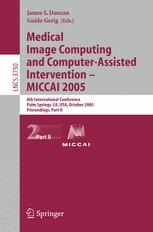
Medical Image Computing and Computer-Assisted Intervention -- MICCAI 2005 ; 8th International Conference, Palm Springs, CA, USA, October 26-29, 2005, Proceedings, Part II
Robotics, Image-Guided Surgery and Interventions -- Image Registration II -- Medical Image Computing -- Atlases -- Shape I -- Structural and Functional Brain Analysis -- Model-Based Image Analysis -- Image-Guided Intervention: Simulation, Modeling and Display -- Simulation and Modeling II -- Medical Image Computing -- Shape II -- Image Segmentation and Analysis II -- Image Registration III --

Medical Image Computing and Computer-Assisted Intervention – MICCAI 2005 ; 8th International Conference, Palm Springs, CA, USA, October 26-29, 2005, Proceedings, Part I
This paper presents a method for classification of medical images, using machine learning and deformation-based morphometry. A morphological representation of the anatomy of interest is first obtained using highdimensional template warping, from which regions that display strong correlations between morphological measurements and the classification (clinical) variable are extracted using a watershed segmentation, taking into account the regional smoothness of the correlation map which is estimated by a crossvalidation strategy in order to achieve robustness to outliers. A Support Vector Machine-Recursive Feature Elimination (SVM-RFE) technique is then used to rank computed features from the extracted regions, according to their effect on the leave-one-out error bound. Finally, SVM classification is applied using the best set of features, and it is tested using leave-one-out. The results from a group of 61 brain images of female normal controls and schizophrenia patients demonstrate not only high classification accuracy (91.8%) and steep ROC curves, but also exceptional stability with respect to the number of selected features and the SVM kernel size

Medical data processing and analysis
Medical data can be defined as obtaining information from patients (such as signals, images, sounds, chemical components and their concentration, body temperature, respiratory rate, blood pressure, and different treatment measurements) to quantify the patient’s status and disease stage. Computer-aided diagnostic (CAD) systems use classical image processing, computer vision, machine learning, and deep learning methods for image analysis. Using image classification or segmentation algorithms, they find a region of interest (ROI) pointing to a specific location within the given image or an outcome of interest in the form of a label pointing to a diagnosis or prognosis. Computer science, with the evolution of artificial intelligence and machine learning techniques, facilitates the modeling and interpretation of results—from carrying out measurements to experiments and observations.

IP Networking over Next-Generation Satellite Systems ; International Workshop, Budapest, July 2007
Highlights the very latest research output of several EU satellite-related projects and addresses many unresolved issues in next-generation satellite systems, such as efficient deployment of IPv6 over satellites, working with WLAN and WiMax, QoS provisioning over multi-segment networks (including satellite networks), multicast networks and security.

Intrinsic Molecular Mobility and Toughness of Polymers II
The series Advances in Polymer Science presents critical reviews of the present and future trends in polymer and biopolymer science including chemistry, physical chemistry, physics and material science . the authors highlight the dual role of segmental jumps and displacements to improve toughness by energy dissipation and relaxation of critical stresses and to influence without exception all damage mechanisms. The dynamic response of a chain segment to thermo-mechanical excitation strongly depends on in-chain cooperative motions. By combining the powerful techniques of multi-dimensional Nuclear Magnetic Resonance and of dielectric and dynamic mechanical analysis Monnerie,

Intrinsic Molecular Mobility and Toughness of Polymers I
The series Advances in Polymer Science presents critical reviews of the present and future trends in polymer and biopolymer science including chemistry, physical chemistry, physics and material science . the authors highlight the dual role of segmental jumps and displacements to improve toughness by energy dissipation and relaxation of critical stresses and to influence without exception all damage mechanisms. The dynamic response of a chain segment to thermo-mechanical excitation strongly depends on in-chain cooperative motions. By combining the powerful techniques of multi-dimensional Nuclear Magnetic Resonance and of dielectric and dynamic mechanical analysis Monnerie,
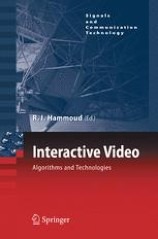
Interactive Video : Algorithms and Technologies
This is a groundbreaking resource that covers both algorithms and technologies of interactive videos, so that businesses in IT and data managements, scientists, teachers, and software engineers in video processing and computer vision, coaches and instructors that use video technology in teaching, and finally end-users of hyper videos will greatly benefit from it. This comprehensive four part book contains excellent scientific and up-to-date contributions made by a number of pioneering scientists, futurists and experts in the field.

Intelligent Computing Theories and Application ; 17th International Conference, ICIC 2021, Shenzhen, China, August 12–15, 2021, Proceedings, Part I
The ICIC theme unifies the picture of contemporary intelligent computing techniques as an integral concept that highlights the trends in advanced computational intelligence and bridges theoretical research with applications. The theme for this conference is “Advanced Intelligent Computing Methodologies and Applications.”

Information Security Practice and Experience ; Vol. 3439 : 1st International Conference, ISPEC 2005, Singapore, April 11-14, 2005, Proceedings
As applications of information security technologies become pervasive, issues pertaining to their deployment and operation are becoming increasingly important. ISPEC is intended to be an annual conference that brings together researchers and practitioners to provide a con?uence of new information se- rity technologies, their applications and their integration with IT systems in various vertical sectors. The Program Committee consisted of leading experts in the areas of information security, information systems, and domain experts in applications of IT in vertical business segments. The topics of the conference covered security applications and case studies, access control, network security, data security, secure architectures, and cryp- graphic techniques. Emphasis was placed on the application of security research to meet practical user requirements, both in the paper selection process and in the invited speeches. Acceptance into the conference proceedings was very competitive. The Call for Papers attracted more than 120 submissions, out of which the Program Committee selected only 35 papers for inclusion in the proceedings.

Individual Financial Planning for Retirement : Empirical Insights from the Affluent Segment in Germany
Over time, the responsibility for providing for a financially secure retirement has shifted more towards the individual. A number of implicit assumptions about perspectives, behavior, and individual choices underlie this shift. These assumptions presume that individuals are well-informed and reason unemotionally; that they process information correctly; and that they take rational decisions and act to maximize their own welfare. Empirical evidence, however, shows that such maxims do not often guide individuals’ actual behavior. Building on a new structure applied to insights drawn from behavioral finance, this book analyzes the perspectives of individuals with regard to their financial situation in retirement and compares the actions they take with ideal behavior. The work provides new insights into the broadly defined topic of individual retirement-specific financial planning behavior.

Independent component analysis and signal separation ; 7th International Conference, ICA 2007, London, UK, September 9-12, 2007, Proceedings
Independent Component Analysis and Signal Separation has applications at the intersection of many science and engineering disciplinesconcernedwithunderstandingandextractingusefulinformationfrom data as diverse as neuronal activity and brain images, bioinformatics, com- nications, the World Wide Web, audio, video, sensor signals, or time series.

Independent Component Analysis and Blind Signal Separation ; 6th International Conference, ICA 2006, Charleston, SC, USA, March 5-8, 2006, Proceedings
This book constitutes the refereed proceedings of the 6th International Conference on Independent Component Analysis and Blind Source Separation, ICA 2006, held in Charleston, SC, USA, in March 2006. The 120 revised papers presented were carefully reviewed and selected from 183 submissions. The papers are organized in topical sections on algorithms and architectures, applications, medical applications, speech and signal processing, theory, and visual and sensory processing.

Image-Guided Interventions : Technology and Applications
Responding to the growing demand for minimally invasive procedures, Image-Guided Interventions: Technology and Applications provides a cohesive overview of the current technological advances in image-guided surgery, and their applications in the clinical environment.

Image Processing Using Pulse-Coupled Neural Networks
This is the first book to explain and demonstrate the tremendous ability of Pulse-Coupled Neural Networks (PCNNs) when applied to the field of image processing. PCNNs and their derivatives are biologically inspired models that are powerful tools for extracting texture, segments, and edges from images.

Image and Signal Processing ; 3rd International Conference, ICISP 2008. Cherbourg-Octeville, France, July 1 - 3, 2008. Proceedings
This book constitutes the refereed proceedings of the Third International Conference on Image and Signal Processing, ICISP 2008, held in Cherbourg-Octeville, France, in July 2008.The 48 revised full papers and 22 revised poster papers presented were carefully reviewed and selected from 193 submissions. The papers are organized in topical sections on image filtering, image segmentation, computer vision, feature extraction, pattern recognition, graph-based representations, motion detection and estimation, new interfaces, document processing, and signal processing.

Image Analysis and Recognition ; 5th International Conference, ICIAR 2008, Póvoa de Varzim, Portugal, June 25-27, 2008. Proceedings
The 110 revised full papers presented together with 2 invited papers were carefully reviewed and selected from 226 submissions. The papers are organized in topical sections on image restoration and enhancement, image and video segmentation, non-linear image processing, image and video coding and encryption, indexing and retrieval, computer vision, feature extraction and classification, shape representation and matching, object recognition, character recognition, texture and motion analysis, tracking, biomedical image analysis, biometrics, face recognition, and a special session on recent advances in multimodal biometric systems and applications.

Image Analysis and Recognition ; 4th International Conference, ICIAR 2007, Montreal, Canada, August 22-24, 2007, Proceedings
These papers cover image restoration and enhancement, image and video processing and analysis, image segmentation, computer vision, pattern recognition for image analysis, shape and matching, motion analysis, tracking, and more.

Image Analysis and Recognition ; 17th International Conference, ICIAR 2020, Póvoa de Varzim, Portugal, June 24–26, 2020, Proceedings, Part I
This two-volume set LNCS 12131 and LNCS 12132 constitutes the refereed proceedings of the 17th International Conference on Image Analysis and Recognition, ICIAR 2020, held in Póvoa de Varzim, Portugal, in June 2020. The 54 full papers presented together with 15 short papers were carefully reviewed and selected from 123 submissions. The papers are organized in the following topical sections: image processing and analysis; video analysis; computer vision; 3D computer vision; machine learning; medical image and analysis; analysis of histopathology images; diagnosis and screening of ophthalmic diseases; and grand challenge on automatic lung cancer patient management.

Image Analysis and Processing – ICIAP 2005 ; 13th International Conference, Cagliari, Italy, September 6-8, 2005, Proceedings
This volume contains the Proceedings of the 13th International Conference on Image Analysis and Processing (ICIAP 2005), held in Cagliari, Italy, at the conference centre “Centro della Cultura e dei Congressi”, on September 6–8, 2005. ICIAP 2005 was the thirteenth edition of a series of conferences organized every two years by the Italian group of researchersa?liated to the International Association for Pattern Recognition (GIRPR) with the aim to bring together researchers in image processing and pattern recognition from around the world. As for the previous editions, conference topics concerned the theory of image analysis and processing and its classical and Internet-driven applications. The central theme of ICIAP 2005 was “Pattern Recognition in the Internet and Mobile Communications Era”. The interest for such a theme was con?rmed by the large number of papers dealing with it, the special session devoted to pattern recognition for computer network security, and the emphasis of two invited talks on Internet and mobile communication issues. ICIAP 2005 received 217 paper submissions. Fifteen papers were collected into the two special sessions dealing with Pattern Recognition for Computer Network Security and Computer Vision for Augmented Reality and Augmented Environments.

Hyperspectral Data Compression
HYPERSPECTRAL DATA COMPRESSION presents the most recent results in the field of compression of remote sensing 3D data, with a focus on multispectral and hyperspectral imagery. This book is essential for researchers working across related fields including: multi-dimensional data compression, multispectral and hyperspectral data archives, remote sensing, scientific image processing, military and aerospace image processing, image segmentation, image classification, and target detection.
